| INSPECTION |
POWER RELAY TEST (TYPE A)
| 1. |
There should be continuity between the No.1
and No.2 terminals when power and ground are connected to the No.3
and No.5 terminals. |
| 2. |
There should be continuity between the No.1
and No.4 terminals when power is disconnected.
|
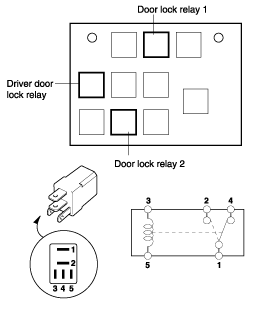
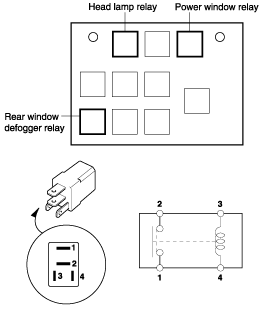
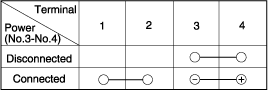
POWER RELAY TEST (TYPE B)
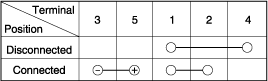
| 1. |
There should be continuity between the No.1
and No.2 terminals when power and ground are connected to the No.3
and No.4 terminals. |
| 2. |
There should be no continuity between the No.1
and No.2 terminals when power is disconnected.
|
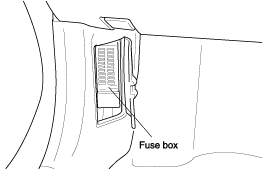
FUSE INSPECTION
| 1. |
Be sure there is no play in the fuse holders,
and that the fuses are held
securely. |
| 2. |
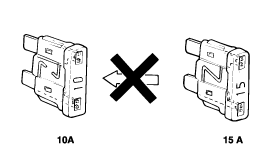
Are the fuse capacities for each circuit
correct? |
| 3. |
Are there any blown fuses?
If a fuse is to be replaced, be sure to use a
new fuse of the same capacity. Always determine why the fuse blew
and completely eliminate the problem before installing a new
fuse.
|

FUSES
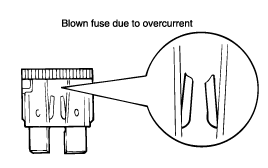
| 1. |
Fuse blown due to
over-current.
Prior to replacing the fuse with a new one,
check the circuit for a short and the related parts for abnormal
conditions. Only after the correction of a short or replacement of
abnormal parts, should a fuse with the same ampere rating be
installed.
|
| 2. |
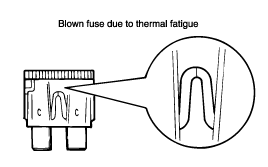
Fuse blown due to
repeated on-off current.
Normally, this type of problem occurs after a
fairly long period of use, and is less frequent than #1 above. In
this case, you may simply replace with a new fuse of the same
capacity.
|