|
Do not spill brake fluid on the vehicle; it
may damage the paint.
If brake fluid does contact the paint, wash if
off immediately with water. |
|
Before reassembling, check that all parts are
free of dust and other foreign
particles. |
| 1. |
Replace the brake hose if the hose is twisted,
cracked, or if it leaks. |
| 2. |
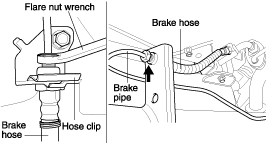
Disconnect the brake hose from the brake pipe
using a flare nut wrench.
|
| 3. |
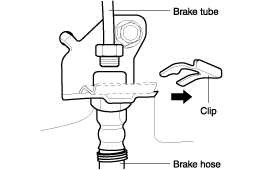
Remove the brake hose clip from the brake hose
using pliers or a hammer.
|
| 4. |
Remove the brake
hose. |
| 1. |
Install the brake hoses so they do not
twist. |
| 2. |
The brake tubes should be installed away from
edges, weld beads or moving parts.
| (1) |
Align the brake hose connector to the
bracket groove. |
| (2) |
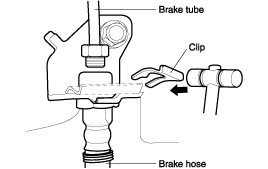
Install the brake hose
clip.
|
| (3) |
Tighten the brake hose connecting flare
nut.
| |
| 3. |
Tighten the connections to the specified
torque.
13-17
Nm (130-170 kgf·cm, 10-12 lb·ft)
Brake hose to front
caliper:
25-30 Nm (250-300 kgf·cm,
18-22
lb·ft)
|
|
| 4. |
After replacing the brake hose, bleed the
system. (Refer to "Air bleeding" of adjustment
procedure) |
| 1. |
Check the brake tubes for cracks, crimps and
corrosion. |
| 2. |
Check the brake hoses for cracks, damage and
leakage. |
| 3. |
Check the brake tube flare nuts for damage and
leakage. | |

