| 1. |
Remove the timing belt, cylinder head, front
case, flywheel, pistons and
crankshaft. |
| 2. |
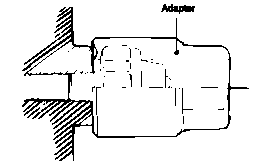
Remove the oil pressure switch.
|
| 1. |
Check the engine block for scores, rust and
corrosion. Also check for cracks or any other defects. Replace the
block if defective. |
| 2. |
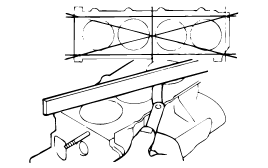
Using a straight edge and feeler gauge,
check the top surface of the block for warpage. Make sure that the
surface is free from gasket chips or other foreign
material.
Standard : 0.03 mm (0.0012 in.) or
less
Limit : 0.15 mm (0.0059 in.) or
less
|
|
| 3. |
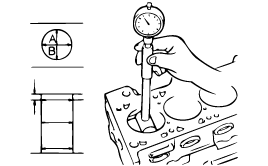
Measure the cylinder bore with a cylinder
gauge at three levels in the direction of A and B. If the cylinder
bores show more than the specified out-of-round or taper or if the
cylinder walls are badly scuffed or scored, the cylinder block
should be rebored and honed. Oversize pistons and rings must be
fitted.
Cylinder I.D : 76.5 ~ 76.53 mm (3.0118
~ 3.0130 in.)
Cylinder I.D taper : 0.01 mm (0.0004
in.) or less
|
|
| 4. |
If a cylinder ridge exists, cut away with a
ridge reamer. |
| 5. |
Oversize pistons are available in four
sizes.
Pistom service size and mark mm
(in.)
0.25 (0.010) O.S. : 0.25
0.50 (0.020) O.S. : 0.50
0.75 (0.030) O.S. : 0.75
1.00 (0.039) O.S. :
1.00
| |
| 6. |
When boring the cylinder to the oversize,
maintain the specified clearance between the oversize piston and the
bore, and make sure that all pistons used are the same
oversize.
The standard measurment of the piston's
outside diameter is taken 47 mm (1.85 in.) from the top land of the
piston.
Piston - to - cylinder clearance
:
0.025 ~ 0.045 mm (0.0010 ~ 0.0018
in.)
| | |