| INSPECTION |
POWER
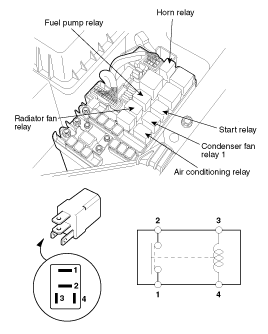
RELAY (TYPE A)
Check for continuity
between the terminals.
| 1. |
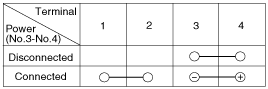
There should be continuity between the No.1
and No.2 terminals when power and ground are connected to the No.3
and No.4 terminals. |
| 2. |
There should be no continuity between the
No.1 and No.2 terminals when power is disconnected.
|
POWER
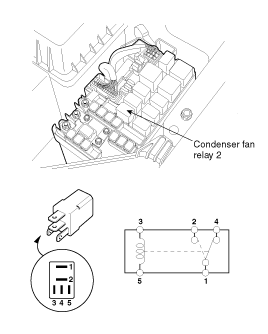
RELAY (TYPE B)
Check for continuity
between the terminals.
| 1. |
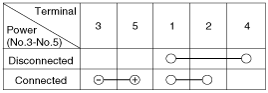
There should be continuity between the No.1
and No.2 terminals when power and ground are connected to the No.3
and No.5 terminals. |
| 2. |
There should be continuity between the No.1
and No.4 terminals when power is disconnected.
|
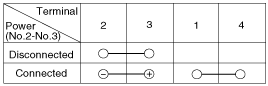
POWER
RELAY (TYPE C)
Check for continuity
between the terminals.
| 1. |
There should be continuity between the No.1
and No.4 terminals when power and ground are connected to the No.2
and No.3 terminals. |
| 2. |
There should be no continuity between the
No.1 and No.4 terminals when power is disconnected.
|
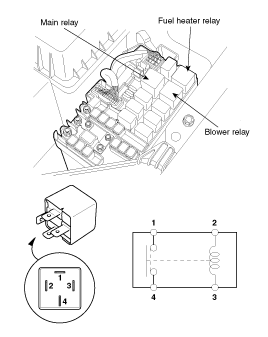
FUSE
| 1. |
Be sure there is no play in the fuse
holders, and that the fuses are held
securely. |
| 2. |
Are the fuse capacities for each circuit
correct? |
| 3. |
Are there any blown fuses?
If a fuse is to be replaced, be sure to use
a new fuse of the same capacity. Always determine why the fuse blew
first and completely eliminate the problem before installing a new
fuse. |