| STARTER CIRCUIT TROUBLESHOOTING |
The battery must be in good condition and
fully charged. |

| 1. |
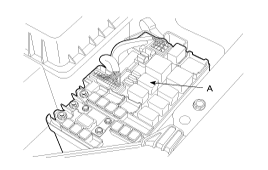
Remove the fuel pump relay from the fuse
box.
|
| 2. |
With the shift lever in N or P (A/T) or
clutch pedal pressed (M/T), turn the ignition switch to
"START"
If the starter normally cranks the engine,
starting system is OK. If the starter will not crank the engine at
all, go to next step.
If it won't disengage from the ring gear
when you release key, check for the following until you find the
cause.
|
| 3. |
Check the battery condition. Check
electrical connections at the battery, battery negative cable
connected to the body, engine ground cables, and the starter for
looseness and corrosion. Then try starting the engine
again.
If the starter cranks normally the engine,
repairing the loose connection repaired the problem. The starting
system is now OK.
If the starter still does not crank the
engine, go to next step. |
| 4. |
Disconnect the connector from the S-terminal
of solenoid. Connect a jumper wire from the B-terminal of solenoid
to the S-terminal of solenoid.
If the starter cranks the engine, go to next
step.
If the starter still does not crank the
engine, remove the starter, and repair or replace as
necessary. |
| 5. |
Check the following items in the order
listed until you find the open circuit.
|
STATER
SOLENOID TEST
| 1. |
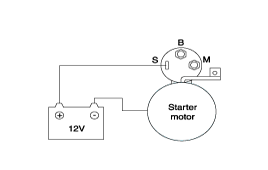
Disconnect the field coil wire from the
M-terminal of solenoid switch. |
| 2. |
Connect a 12V battery between S-terminal and
the starter body.
|
| 3. |
Connect the field coil wire to the
M-terminal.
|

| 4. |
If the pinion moves out, the pull-in coil of
solenoid is working properly.
If the pinion does not move, replace the
solenoid. |
| 5. |
Diconnect the field coil wire from the
M-terminal. |
| 6. |
If the pinion has moved out, the hold-in
coil of the solenoid is working properly.
If the pinion moves in, replace the
solenoid. |
FREE
RUNNING TEST
| 1. |
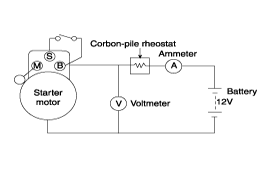
Place the starter motor in a vise equipped
with soft jaws and connect a fully-charged 12-volt battery to
starter motor as follows. |
| 2. |
Connect a test ammeter (100-ampere scale)
and carbon pile rheostats shown is the
illustration. |
| 3. |
Connect a voltmeter (15-volt scale) across
starter motor.
|
| 4. |
Rotate carbon pile to the off
position. |
| 5. |
Connect the battery cable from battery’s
negative post to the starter motor
body. |
| 6. |
Adjust until battery voltage shown on the
voltmeter reads 11volts. |
| 7. |
Confirm that the maximum amperage is within
the specifications and that the starter motor turns smoothly and
freely. |
|
Current : 35A max
Speed : 4350 rpm
|