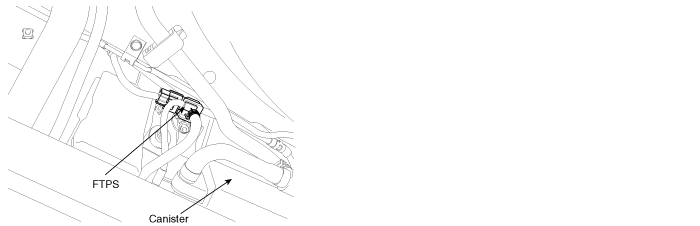
The evaporative
emissions system prevents hydrocarbon (HC) vapors from the fuel tank from
escaping into the atmosphere where they could form photochemical smog. The
fuel tank pressure sensor is a component of the evaporative emission
system.The Tank Pressure Sensor converts fuel tank pressure to a
proportional analog voltage signal which is read by the engine controller
for evaluation during execution of the Evaporative System Diagnostic. The
Tank Pressure may be below atmospheric pressure (ie. a vacuum) or above
atmospheric pressure.The fuel tank pressure is used to measure the
difference between the air pressure (or vacuum) in the fuel tank and the
ambient air pressure. ECM/PCM supplies a 5-volt reference and a ground to
the sensor, which allows the sensor’s output voltage to range from 0.1 to
4.9 volts.
If ECM/PCM detects the
abnormal signal input of FTPS, ECM/PCM sets DTC P0451.
Item
|
Detecting
Condition
|
Possible
Cause
|
DTC Strategy
|
|
|
Case 1
|
Enable Conditions
|
| •
|
Idle controller
activated | |
Threshold Value
|
| •
|
Filtered fuel tank pressure
>20.0hPa (41.8
lbf/ft²) | |
Diagnostic Time
|
|
Case 2
|
Enable Conditions
|
| •
|
Time after engine start >
3.0s | |
Threshold Value
|
| •
|
Filtered fuel tank pressure <
-30hPa (-62.7 lbf/ft²) | |
Diagnostic Time
|
|
Case 3
|
Enable Conditions
|
| •
|
Canister purge phase
activated |
| •
|
Intake manifold press. / amb. press.
< 0.62 |
| •
|
Ambient pressure > 680hPa (1420.21
lbf/ft²) | |
Threshold Value
|
| •
|
Counter of Δpressure < 0.8hPa(1.67
lbf/ft²) when the duty cycle of PCSV is increased more than
30% ] ≥ 2 times | |
Diagnostic Time
|
|
MIL ONCondition
|
|
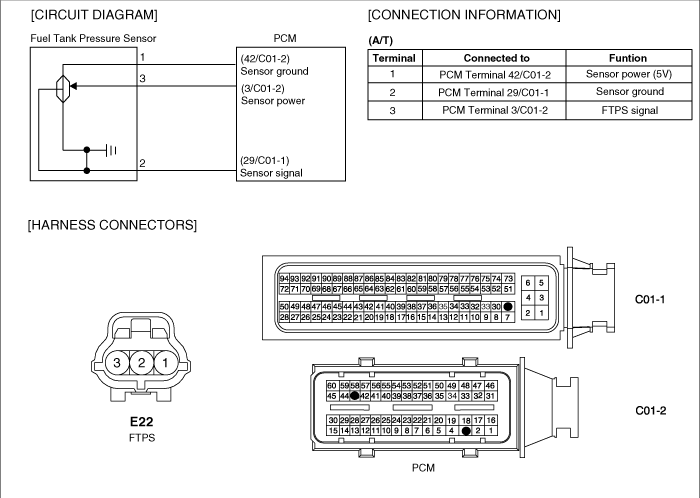
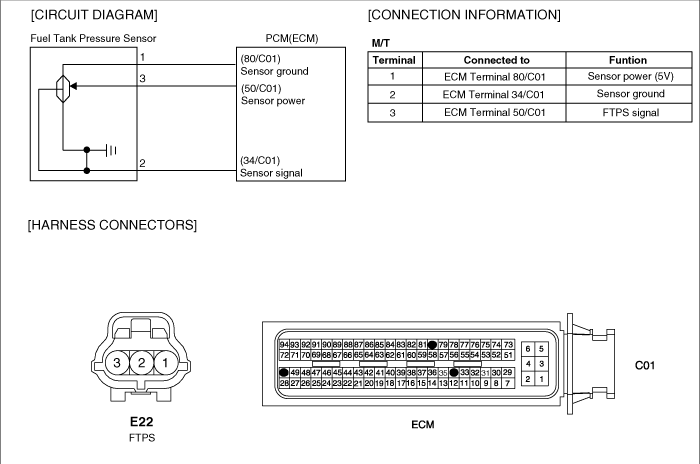
| TERMINAL AND CONNECTOR
INSPECTION |
| 1. |
Many malfunctions in the electrical system
are caused by poor harness and terminals. Faults can also be caused
by interference from other electrical systems, and mechanical or
chemical damage. |
| 2. |
Thoroughly check connectors for looseness,
poor connection, bending, corrosion, contamination, deterioration,
or damage. |
| 3. |
Has a problem been found?

▶ Repair as necessary and go to
"Verification of vehicle Repair" procedure.

▶ Go to " Circuit Voltage Check "
procedure. |
Circuit
Voltage Check
| 1. |
IG "OFF" and disconnect FTPS
connector. |
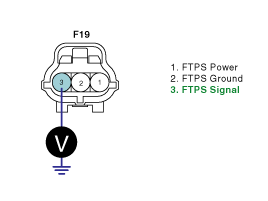
| 3. |
Measure voltage between terminal 1 of FTPS
harness connector and chassis ground.
Measure voltage between terminal 2 of FTPS
harness connector and chassis ground.
Measure voltage between terminal 3 of FTPS
harness connector and chassis ground.
Specification Terminal 1 Approx.
5V
Terminal 2 Approx. 0V
Terminal 3 Approx.
5V
|
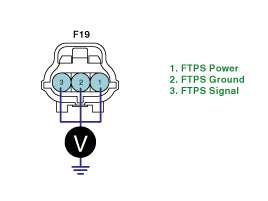
|
| 4. |
Is the measured voltage within specification
?
▶ Go to "Component inspection"
procedure.
▶ Repair or replace as necessary and go to
"Verification of Vehicle Repair"
procedure. |
| 1. |
Check FTPS
| (2) |
Disassemble FTPS. (Don't disconnect
FTPS connector.) |
| (3) |
Connect the vacuum
guage. |
| (4) |
Measure the output voltage with using
the vacuum guage.
* Caution : Be careful while you do
this procedure. FTPS would be damaged if you apply vacuum
excessively.
Specification :
FTPS
|
Normal
Parameter
|
Gauge pressure
|
-66.66 hpa(-139.2 lbf/ft²)
|
0 hpa
|
66.66 hpa (139.2 lbf/ft²)
|
Voltage
|
0.5 V
|
2.5 V
|
4.5 V
|
|
| (5) |
Is the measured voltage within
specification ?
▶ Substitute with a known-good ECM/PCM
and check for proper operation. If the problem is corrected,
replace ECM/PCM and then go to "Verification of Vehicle
Repair" procedure.
▶ Substitute with a known-good FTPS
and check for proper operation. If the problem is corrected,
replace FTPS and then go to "Verification of Vehicle Repair"
procedure. | |
| VERIFICATION OF VEHICLE
REPAIR |
After a repair, it is
essential to verify that the fault has been corrected.
| 1. |
Connect scan tool and select "Diagnostic
Trouble Codes(DTCs)" mode. |
| 2. |
Clear the DTCs and Operate the vehicle
within DTC Enable conditions in General
information. |
| 3. |
Are any DTCs present ?
▶ Go to the applicable troubleshooting
procedure.
▶ System is performing to specification at
this time. |
FTPS
|
Normal
Parameter
|
Gauge pressure
|
-66.66 hpa(-139.2 lbf/ft²)
|
0 hpa
|
66.66 hpa (139.2 lbf/ft²)
|
Voltage
|
0.5 V
|
2.5 V
|
4.5 V
|