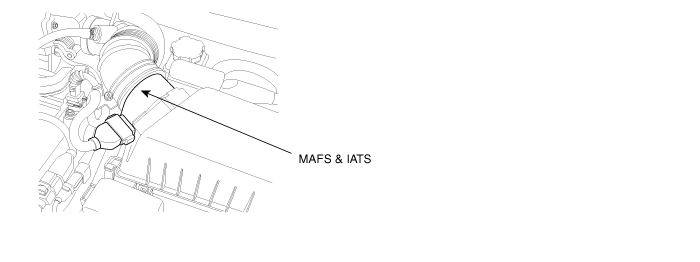
The Intake Air
Temperature (IAT) sensor measures the temperature of engine intake air.
The Intake Air Temperature (IAT) sensor is a thermistor (a variable
resistor that changes along with outside air temperature) in series with a
fixed resistor in the ECM/PCM. The ECM/PCM applies 5V to the IAT sensor.
The ECM/PCM monitors the voltage across the IAT sensor and converts it
into a temperature reading. When the outside air temperature is cold the
IAT sensor resistance is high, and when the outside air temperature is
warm the IAT sensor resistance is low. Therefore, when the air temperature
is cold the ECM/PCM will receive a high voltage input, and when the air
temperature is warm the ECM/PCM will receive a low voltage input. The
signal from IAT sensor is used for injection duration correction, ignition
timing correction and idle speed correction(Air-density
correction).
If measured
temperature is higher than the maximum threshold value during 2sec,
ECM/PCM sets DTC P0112.
(In this case, the
input signal voltage is the minimum threshold vaue.)
Item
|
Detecting
Condition
|
Possible
Cause
|
DTC Strategy
|
|
| •
|
Short to ground in signal
circuit |
|
Enable
Conditions
|
|
Threshold
Value
|
| •
|
Measured temperature > 128.3 °C
(262.9 °F)c | |
Diagnostic
Time
|
|
MIL ON
Condition
|
|
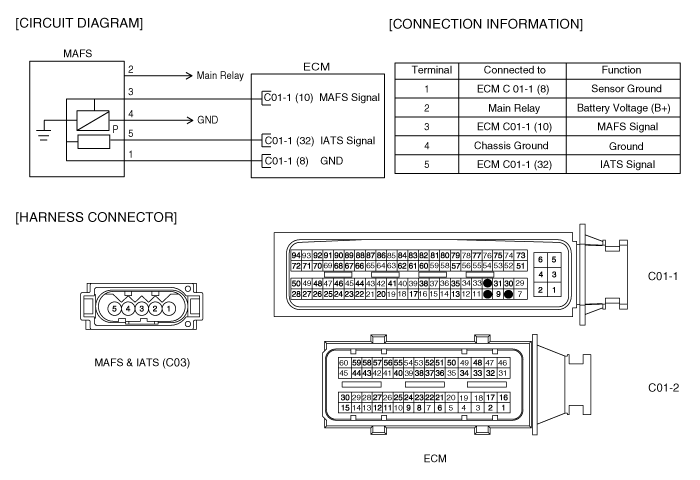
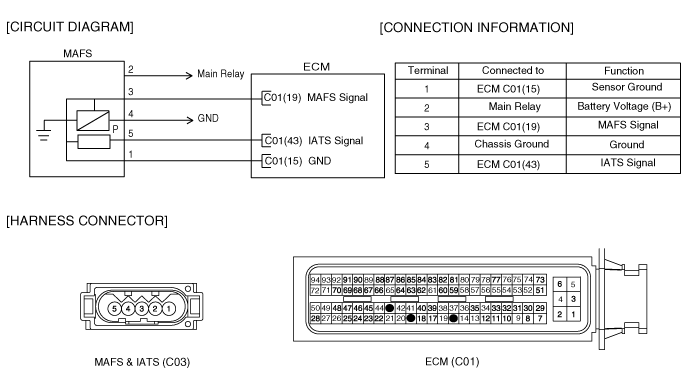
| TERMINAL AND CONNECTOR
INSPECTION |
| 1. |
Many malfunctions in the electrical system
are caused by poor harness and terminals. Faults can also be caused
by interference from other electrical systems, and mechanical or
chemical damage. |
| 2. |
Thoroughly check connectors for looseness,
poor connection, bending, corrosion, contamination, deterioration,
or damage. |
| 3. |
Has a problem been found?

▶ Repair as necessary and go to
"Verification of vehicle Repair" procedure.

▶ Go to " Signal Circuit Inspection "
procedure. |
| SIGNAL CIRCUIT
INSPECTION |
| 2. |
Disconnect IATS
connector. |
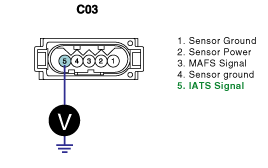
| 4. |
Measure voltage between terminal 5 of IATS
harness connector and chassis ground.
Specification : Approx.
5V
|
|
| 5. |
Is the measured voltage within
specification?
▶ Go to "Component Inspection"
procedure.
▶ Repair or replace as necessary and then,
go to "Verification of Vehicle Repair"
procedure. |
| 1. |
Check IATS resistance.
| (2) |
Disconnect IATS
connector. |
| (3) |
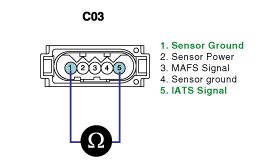
Measure resistance between terminal 1
and 5 of IATS connector.(Component Side)
Specification :
Temperature
|
Resistance
[kΩ]
|
°C
|
°F
|
-40
|
-40
|
41.26 ~ 47.49kΩ
|
-20
|
-4
|
14.26 ~ 16.02kΩ
|
0
|
32
|
5.5 ~ 6.05kΩ
|
20
|
68
|
2.35 ~ 2.54kΩ
|
40
|
104
|
1.11 ~ 1.19kΩ
|
60
|
140
|
0.57 ~ 0.6kΩ
|
80
|
176
|
0.31 ~
0.32kΩ
|
|
| (4) |
Is the measured resistance within
specification ?
▶ Go to "Check ECM/PCM" as
follows.
▶ Substitute with a known - good IATS
and check for proper operation.
▶ If the problem is corrected, replace
IATS and go to "Verification of Vehicle Repair"
procedure. | |
| 2. |
Check ECM/PCM.
| (1) |
IG "OFF" and disconnect MAFS/MAPS
connector. |
| (2) |
Connect scantool and Key
"ON". |
| (3) |
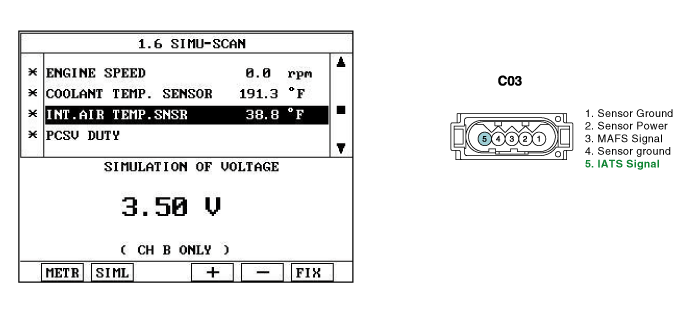
Select simulation function on
scantool. |
| (4) |
Simulate voltage at terminal 5 of IATS
signal connector.
|
| (5) |
Does the signal value of IATS change
according to simulation voltage?
▶ Thoroughly check connectors for
looseness, poor connection, bending, corrosion,contamination,
deterioration, or damage. Repair or replace as necessary and
go to "Verificationof Vehicle Repair" procedure.
▶ Substitute with a known - good
ECM/PCM and check for proper operation.
▶ If the problem is corrected, replace
ECM/PCM and go to "Verification of Vehicle Repair"
procedure. | |
| VERIFICATION OF VEHICLE
REPAIR |
After a repair, it is
essential to verify that the fault has been corrected.
| 1. |
Connect scan tool and select "Diagnostic
Trouble Codes(DTCs)" mode. |
| 2. |
Clear the DTCs and Operate the vehicle
within DTC Enable conditions in General
information. |
| 3. |
Are any DTCs present ?
▶ Go to the applicable troubleshooting
procedure.
▶ System is performing to specification at
this time. |
Temperature
|
Resistance [kΩ]
|
°C
|
°F
|
-40
|
-40
|
41.26 ~ 47.49kΩ
|
-20
|
-4
|
14.26 ~ 16.02kΩ
|
0
|
32
|
5.5 ~ 6.05kΩ
|
20
|
68
|
2.35 ~ 2.54kΩ
|
40
|
104
|
1.11 ~ 1.19kΩ
|
60
|
140
|
0.57 ~ 0.6kΩ
|
80
|
176
|
0.31 ~ 0.32kΩ
|