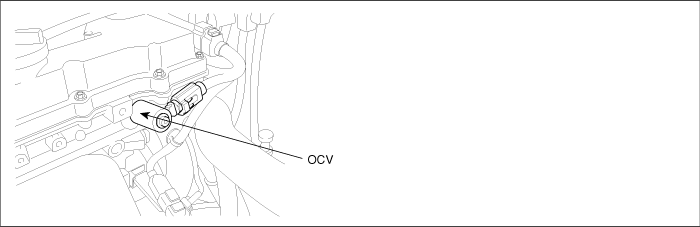
Different from the
existing fixed cam phase angle type, CVVT(Continuously Variable Valve
Timing) is the device which varies cam phase angle continuously to be
optimum. And with engine oil pressure, it operates. CVVT consists of
OCV(Oil Control Valve) and cam phaser. OCV, mounted on cylinder head,
controlls the amount and direction of oil delivered to cam phaser by oil
valve which is connected to a solenoid. Cam phaser, rotating cam phaser
rotor with pressure and amount of oil produced by OCV, rotates cam shaft
forcefully for or against the rotating direction and finally, cam shaft
phase changes. With the appliance of CVVT, engine power,fuel efficiency
and the quality of exhaust gas are improved.
If "Counter of Δ
(original target - actual angle) > 3 Deg" is over 10 times under enable
conditions, ECM/PCM sets DTC P0012.
Item
|
Detecting
Condition
|
Possible
Cause
|
DTC Strategy
|
|
| •
|
Contamination of Oil / Clog of Oil
path |
|
Enable
Conditions
|
| •
|
Difference of target and actual angle
> 10 Deg (2 sec and above) |
| •
|
Adaptation of alignment between
camshaft and crankshaft
finished |
| •
|
Time after engine start >
10~60s |
| •
|
Coolant temperature
60~110°C |
| •
|
Engine oil temperature (model)
60~110°C |
| •
|
Engine speed
1000~5000rpm | |
Threshold
Value
|
| •
|
l Counter of Δ (original target -
actual angle) > 3 Deg l > 10
times | |
Diagnostic
Time
|
|
MIL ON
Condition
|
|
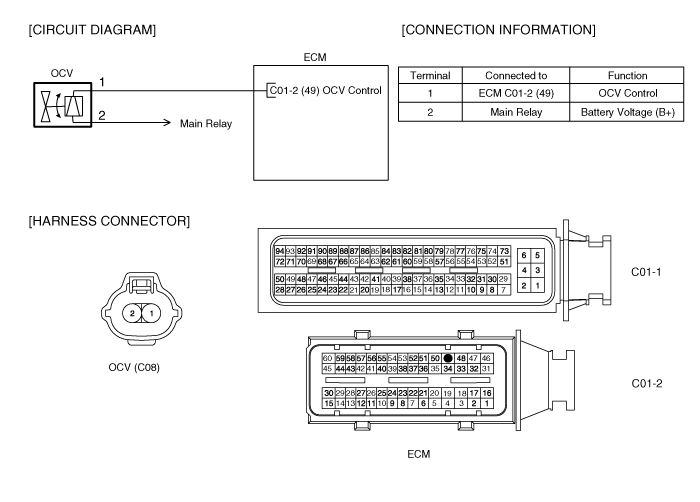
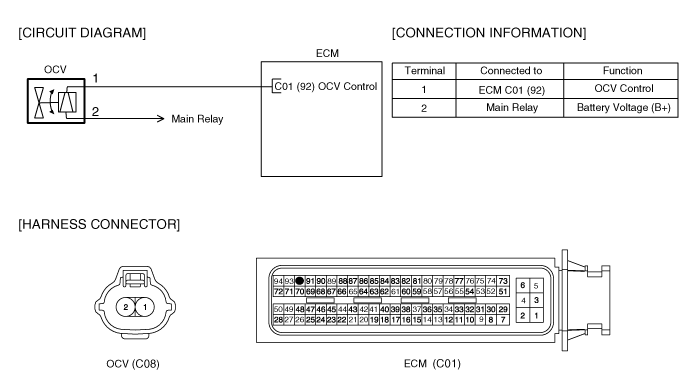
| 1. |
Connect scantool to Data Link
Connector(DLC). |
| 2. |
Warm up the engine to normal operating
temperature. |
| 3. |
Monitor the "OCV" parameters on the
scantool.
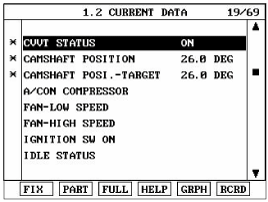
|
| 4. |
Are the parameters displayed correctly
?

▶ Fault is intermittent caused by poor
contact in the sensor’s and/or ECM’s connector or was repaired and
ECM/PCM memory was not cleared. Thoroughly check connectors for
looseness, poor connection, bending, corrosion, contamination,
eterioration, or damage. Repair or replace as necessary and go to
"Verification of vehicle Repair" procedure.

▶ Go to ""Terminal and Connector
Inspection"" procedure. |
| TERMINAL AND CONNECTOR
INSPECTION |
| 1. |
Many malfunctions in the electrical system
are caused by poor harness and terminals. Faults can also be caused
by interference from other electrical systems, and mechanical or
chemical damage. |
| 2. |
Thoroughly check connectors for looseness,
poor connection, bending, corrosion, contamination, deterioration,
or damage. |
| 3. |
Has a problem been found?
▶ Repair as necessary and go to
"Verification of vehicle Repair" procedure.
▶ Go to "System inspection"
procedure. |
| 1. |
Visual check.
| (1) |
Check engine oil
gauge. |
| (2) |
Check contamination of engine
oil. |
| (3) |
Check contamination of OCV
filter. |
| (4) |
Check clog of oil
path. |
| (5) |
Is there any problem?
▶ Repair as necessary and go to
"Verification of vehicle Repair" procedure.
▶ Go to "Component inspection"
procedure. | |
| 1. |
Check OCV
| (1) |
Connect scantool to Data Link
Connector(DLC). |
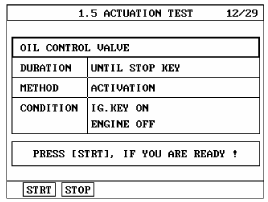
| (3) |
Perform "Actuation Test" for
OCV.
|
| (4) |
Does the OCV work normally (Check
Clicking Sound)?
▶ Substitute with a known-good CVVT
and check for proper operation. If the problem is corrected,
replace CVVT and then go to "Verification of Vehicle Repair"
procedure.
▶ Substitute with a known-good OCV and
check for proper operation. If the problem is corrected,
replace OCV and then go to "Verification of Vehicle Repair"
procedure. | |
| VERIFICATION OF VEHICLE
REPAIR |
After a repair, it is
essential to verify that the fault has been corrected.
| 1. |
Connect scan tool and select "Diagnostic
Trouble Codes(DTCs)" mode. |
| 2. |
Clear the DTCs and Operate the vehicle
within DTC Enable conditions in General
information. |
| 3. |
Are any DTCs present ?
▶ Go to the applicable troubleshooting
procedure.
▶ System is performing to specification at
this time. |
ITEM
|
SPECIFICATION
|
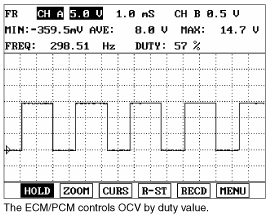
Coil Resistance (Ω)
|
6.9 ~ 7.9Ω at 20°C
(68°F)
|