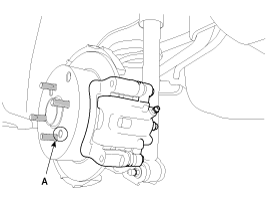
| REMOVAL |
| 1. |
Raise the rear of the vehicle and make sure it
is securely supported. Remove the rear
wheel. |
| 2. |
Disconnect the brake hose after removing the
brake hose clip. |
| 3. |
Remove the guide rod bolt (A). After, raise
the caliper assembly (B), and support it with a wire.
|
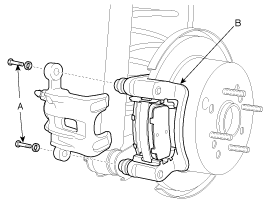
| 4. |
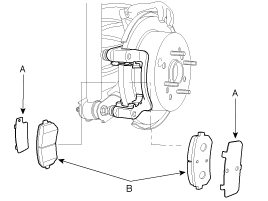
Remove the pad shim(A) and pad assembly(B)
.
|
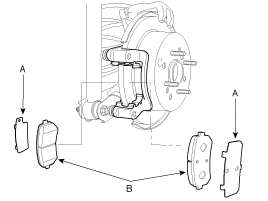
| INSTALLATION |
| 1. |
Install the pad retainers(A) to the caliper
braket(B).
|
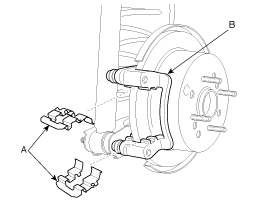
| 2. |
Check the foreign material at the pad shim (A)
and the back of the pads (B).
|
| 3. |
Contaminated brake discs or pads reduce
stopping ability. Keep grease off the discs and
pads. |
| 4. |
Install the brake pads (B) and pad shim (A) on
the caliper bracket. |
| 5. |
If you are reusing the pads, always reinstall
the brake pads in their original positions to prevent a momentary
loss of braking efficiency. Push in the piston using
SST(09581-11000) so that the caliper will fit over the pads. Make
sure that the piston boot is in position to prevent damaging it when
pivoting the caliper down. |
| 6. |
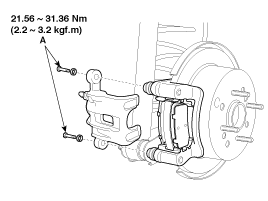
Pivot caliper down into position. Being
careful not to damage the pin boot, install the guide rod bolt (A)
and tighten it to the specified torque.
|
| 7. |
Install the brake caliper
. |
| 8. |
After installation, check for leaks at hose
and line joints and connections, and retighten if
necessary. |
| 9. |
Depress the brake pedal several times to make
sure the brakes work, then test-drive.
|

| INSPECTION |
| REAR BRAKE DISC THICKNESS CHECK |
| 1. |
Remove all rust and contamination from the
disc surface and then measure the disc thickness at 8 positions,
minimum.
|
| 2. |
Thickness variation should not exceed
0.005mm(0.0002 in) (circumference) and 0.01mm(0.0004 in) (radius) at
any directions. |
| 3. |
If wear exceeds the limit, replace the discs
and pad assembly for left and right of the vehicle.
|
REAR BRAKE PAD CHECK
| 1. |
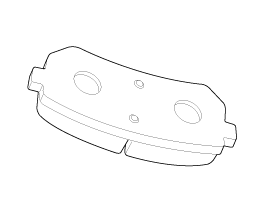
Check the pad wear. Measure the pad thickness
and replace it, if it is less than the specified value.
|
| 2. |
Check that grease is applied, and the pad and
backing metal for damage. |
REAR BRAKE DISC RUN OUT CHECK
| 1. |
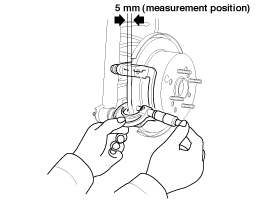
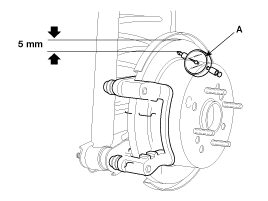
Place a dial gauge(A) about 5mm (0.2 in) from
the outer circumference of the brake disc, and measure the run out
of the disc.
|
| 2. |
If the run out of the brake disc exceeds the
limit specification, replace the disc, and then measure the run out
again. |
| 3. |
If the run out does not exceed the limit
specification, install the brake disc after turning it 180° and then
check the run out of the brake disc
again. |
| 4. |
If the run out cannot be corrected by changing
the position of the brake disc, replace the brake
disc. |
SEIZE OF REAR BRAKE DISC
| 1. |
Remove the brake disc from hub using M8
screw(A) if the brake disc has been seized with the hub due to
corrosion or overheat.
|