The catalyst’s
efficiency is demonstrated by its ability to oxidize CO and hydrocarbon
emissions. The ECM/PCM compares the output signals of the front and rear
oxygen sensors to determine whether the output of the rear sensor is
beginning to match the output of the front oxygen sensor. Air/fuel mixture
compensation keeps the frequency of the front oxygen sensor high due to
the changes from rich-to-lean combusition. The catalyst causes the rear
oxygen sensor to have a lower frequency. As the catalyst wears, the rear
oxygen sensor’s signal trace begins to match the front oxygen sensor’s
signal trace. That is because the catalyst becomes saturated with oxygen
and cannot use the oxygen to convert hydrocarbon and CO into H₂O and CO₂
with the same efficiency as when it was new. A completely worn catalyst
shows a 100% match between the frequency of the front and rear
sensors.
If the correction value
of air-fuel ratio is higher than the threshold value, ECM/PCM sets DTC
P0171.
Item
|
Detecting
Condition
|
Possible
Cause
|
DTC Strategy
|
| •
|
Long-term fuel trim
limit | |
|
General
Enable
Conditions
|
| •
|
Coolant temperature > 70°C
(158°F) |
| •
|
Intake air temperature < 80°C
(176°F) |
| •
|
Closed loop control
enabled |
| •
|
No transient control
phase |
| •
|
No canister purge
phase | |
Case1
|
Enable
Conditions
|
| •
|
Air mass : 40~200 kg/h (88.2~441
lb/h) | |
Threshold
Value
|
|
Diagnostic
Time
|
|
Case2
|
Enable
Conditions
|
| •
|
Air mass ≤ 24 kg/h (53
lb/h) | |
Threshold
Value
|
|
Diagnostic
Time
|
|
MIL ONCondition
|
|
| 1. |
Connect scantool to Data Link
Connector(DLC). |
| 2. |
Warm up the engine to normal operating
temperature. |
| 3. |
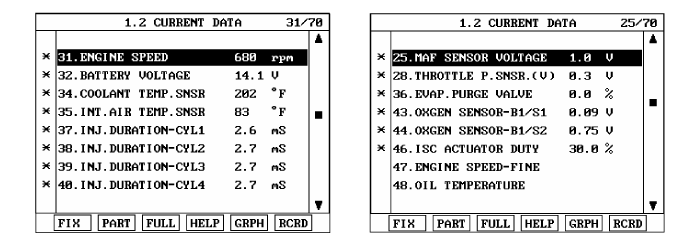
Monitor the "Parameters related to air/fuel
ratio(HO2S, MAF, MAP, TPS, ECTS, PCSV, Injector, etc)" on the
scantool.
|
| 4. |
Are the parameters displayed
correctly?

▶ Fault is intermittent caused by poor contact
in the sensor’s and/or ECM’s connector or wasrepaired and ECM/PCM
memory was not cleared. Thoroughly check connectors for looseness,
poorconnection, bending, corrosion, contamination, deterioration, or
damage. Repair or replace as necessary and go to "Verification of
vehicle Repair" procedure.

▶ Go to "Terminal and Connector Inspection"
procedure |
| TERMINAL AND CONNECTOR
INSPECTION |
| 1. |
Many malfunctions in the electrical system are
caused by poor harness and terminals. Faults can also be caused by
interference from other electrical systems, and mechanical or
chemical damage. |
| 2. |
Thoroughly check connectors for looseness,
poor connection, bending, corrosion, contamination, deterioration,
or damage. |
| 3. |
Has a problem been found?
▶ Repair as necessary and go to "Verification
of vehicle Repair" procedure.
▶ Go to "System inspection"
procedure. |
| 1. |
Air leakage check.
| (1) |
Check "Air intake system"
▶ Check looseness, deterioration or
contamination on throttle body and gasket.
▶ Check contamination, damage or crack
on intake manifold, ISCA and
injectors. |
| (2) |
Is there any leakage?
▶ Repair as necessary and go to
"Verification of vehicle Repair" procedure
▶ Go to "Fuel line check"
procedure. | |
| 2. |
Fuel line check.
| (1) |
Check "Fuel line system"
▶ Check looseness of connectors on fuel
line.
▶ Check looseness, damage, or
interference of vacuum hose on fuel line.
▶ Check damage, leakage or bending on
fuel line pipe. |
| (2) |
Is fuel line normal?
▶ Go to "Fuel line pressure check"
procedure.
▶ Repair as necessary and go to
"Verification of vehicle Repair"
procedure. | |
| 3. |
Fuel line pressure check.
| (2) |
Remove fuel pump
relay. |
| (3) |
Engine start and wait until engine stop.
and then key "OFF". |
| (4) |
Install a fuel pump
relay. |
| (5) |
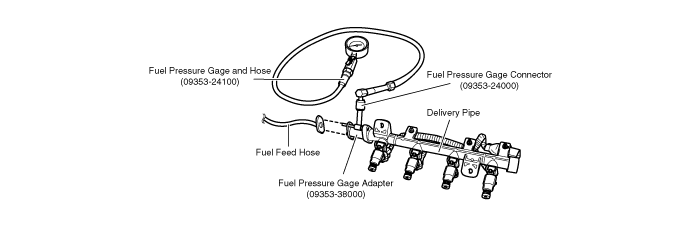
Connect fuel pressure gauge using the
correct adapter. |
| (6) |
Start the engine, and record fuel
pressure.
Specification : Approx. 3.5
kgf/cm² (343.2 kPa, 50psi)
|
|
| (7) |
Is the fuel pressure
normal?
▶ Go to "Component inspection"
procedure.
▶ Check clogging on the fuel
filter.
▶ Check the supply pressure of fuel
pump.
▶ Repair as necessary and go to
"Verification of vehicle Repair"
procedure. | |
| 1. |
PCV(Positive Crankcase Ventilation) valve
check.
| (2) |
Disconnect PCV
valve. |
| (3) |
Check PCV plunger
movement. |
| (4) |
Is the movement of plunger
normal?
▶ Go to "PCSV check"
procedure.
▶ Substitute with a known - good PCV
valve and check for proper operation.
▶ If the problem is corrected, replace
PCV valve and go to "Verification of Vehicle Repair"
procedure. | |
| 2. |
PCSV check.
| (2) |
Disconnect PCSV and vacuum
hose. |
| (3) |
Apply a vacuum by a hand vacuum gauge on
PCSV. |
| (4) |
Does PCSV keep the vacuum condition
normally?
▶ Go to "Injector check"
procedure.
▶ Substitute with a known - good PCSV
and check for proper operation.
▶ If the problem is corrected, replace
PCSV and go to "Verification of Vehicle Repair"
procedure. | |
| 3. |
Injector check.
| (2) |
Disconnect
injectors. |
| (3) |
Check clog on
injectors. |
| (4) |
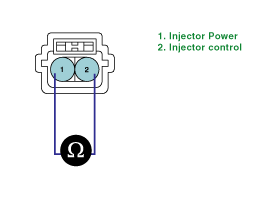
Measure the resistance between terminal
1 and 2 of injectors(Component side).
Specification :
Temperature
(°F)
|
Resistance
(Ω)
|
20°C (68°F)
|
13.8 ~
15.2Ω
|
|
| (5) |
Is the measured resistance within
specifications?
▶ Go to "Sensors related to air/fuel
ratio check" procedure.
▶ Repair or replace as necessary. And
then, go to "Verification of Vehicle Repair"
procedure. | |
| 4. |
Sensors related to air/fuel ratio
check.
| (1) |
Check the output data of sensors related
to air/fuel ratio (HO2S, MAPS, TPS, ECTS, PCSV, Injectors,
etc) on scantool. (Refer to each DTC guide
procedure.) |
| (2) |
Are those sensors normal?
▶ Substitute with a known - good ECM/PCM
and check for proper operation.
▶ If the problem is corrected, replace
ECM/PCM and go to "Verification of Vehicle Repair"
procedure.
▶ Repair or replace as necessary. And
then, go to "Verification of Vehicle Repair"
procedure. | |
| VERIFICATION OF VEHICLE
REPAIR |
After a repair, it is
essential to verify that the fault has been corrected.
| 1. |
Connect scan tool and select "Diagnostic
Trouble Codes(DTCs)" mode. |
| 2. |
Clear the DTCs and Operate the vehicle within
DTC Enable conditions in General
information. |
| 3. |
Are any DTCs present ?
▶ Go to the applicable troubleshooting
procedure.
▶ System is performing to specification at
this
time. | |