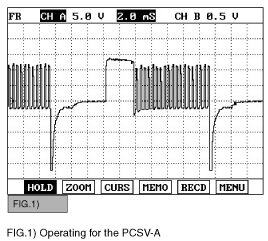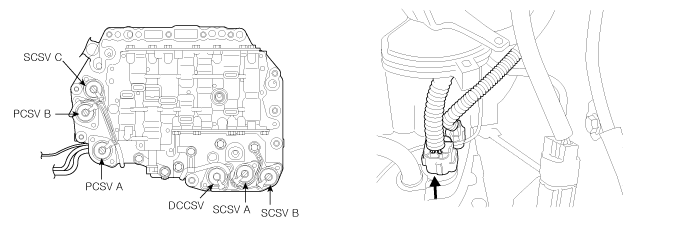
The Pressure Control
Solenoid Valve A ( PCSV A ) converts the electric signals, which are
controlled by the PCM, into hyraulic pressure. The PCSV A controls the
hydraulic pressure, which is applied to the Clutches and Brakes, to reduce
the shift shock during shifting.
The PCM checks the
Pressure Control Solenoid Valve signals by monitoring the feedback signals
from the solenoid valve drive circuit. If an unexpected signal is
monitored, (For example, high voltage is detected when low voltage is
expected, or low voltage is detected when high voltage is expected) the
PCM judges that the PCSV A drive circuit is malfunctioning and sets this
code.
Item
|
Detecting Condition & Fail
Safe
|
Possible cause
|
DTC Strategy
|
|
※ PWM :
Pulse Width Modulation
| •
|
Open or short in
circuit |
|
Enable Conditions
|
| •
|
Timer of PWM monitoring >
0.5sec |
|
Threshold value
|
| •
|
The circuit is open in condition of the
Max. of feedback
voltage>3.999V |
| •
|
The circuit is short in condition of the
Max. of feedback
voltage<0.097V | |
Diagnostic Time
|
|
Fail Safe
|
|
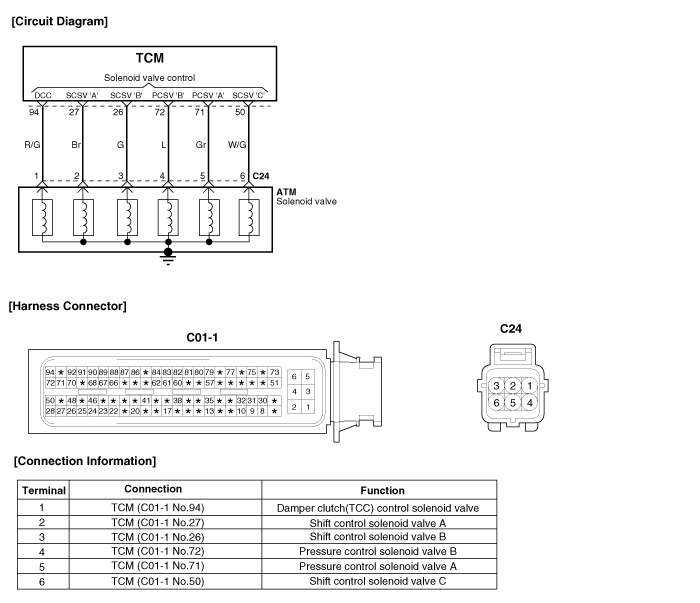
| 1. |
Connect scantool to data link
connector(DLC). |
| 3. |
Monitor the "PCSV-A" parameter on the
scantool. |
| 5. |
Check "PCSV-A " parameter value changes while
driving.
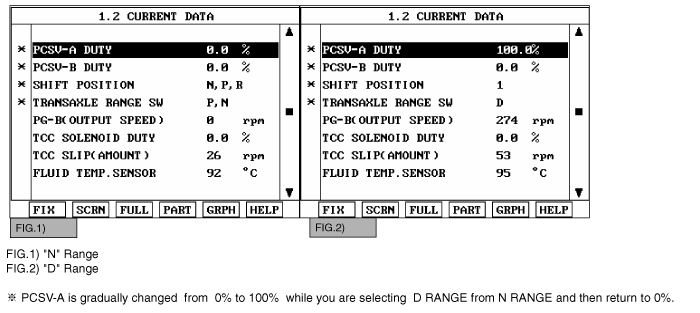
|
| 6. |
Does "PCSV-A DUTY " follow the referance
data?

▶ Fault is intermittent caused by poor contact
in the sensor's and/or PCM's connector or was repaired and PCM
memory was not cleared. Thoroughly check connectors for looseness,
poor connection, bending, corrosion, contamination, deterioration or
damage. Repair or replace as necessary and go to "Verification of
vehicle repair" procedure.

▶ Go to "Terminal&connector inspection"
procedure. |
| TERMINAL & CONNECTOR
INSPECTION |
| 1. |
Many malfunctions in the electrical system are
caused by poor harness and terminals. Faults can also be caused by
interference from other electrical systems, and mechanical or
chemical damage. |
| 2. |
Thoroughly check connectors for looseness,
poor connection, bending, corrosion, contamination, deterioration,
or damage. |
| 3. |
Has a problem been found?
▶ Repair as necessary and then go to
"Verification of vehicle repair" procedure.
▶ Go to "Signal circuit inspection"
procedure. |
| SIGNAL CIRCUIT
INSPECTION |
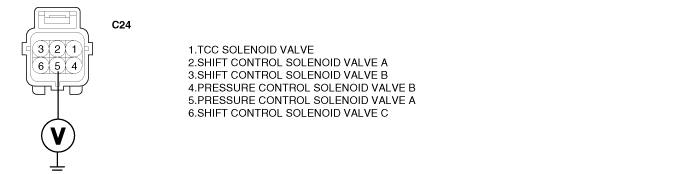
| 1. |
Disconnect "A/T SOLENOID VALVE"
connector. |
| 2. |
IGNITION "ON", ENGINE
"OFF". |
| 3. |
Measure voltage between terminal "5" of the
sensor harness connector and chassis ground.
Specification: approx.
6V
|
|
| 4. |
Is voltage within specifications?
▶ Go to "Component inspection"
procedure.
▶ Check for open or short in harness. Repair
as necessary and Go to "Verification of vehicle repair"
procedure.
▶ If signal circuit in harness is OK, Go to
"Check PCM" of the "Component inspection"
procedure |
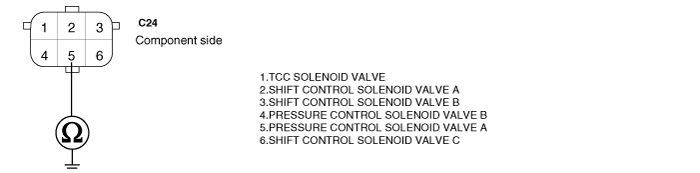
| 1. |
CHECK SOLENOID VALVE
| (2) |
Disconnect "A/T SOLENOID VALVE"
connector. |
| (3) |
Measure resistance between terminal "5"
and chassis ground.
Specification: Approximately
2.7~3.4 Ω [20°C(68°F)]
|
|
| (4) |
Is resistance within
specification?
▶ Go to "CHECK PCM" as
below.
▶ Replace TCC SOLENOID VALVE as
necessary and go to "Verification of vehicle repair"
procedure. | |
| 2. |
CHECK PCM
| (1) |
Connect scantool to data link
connector(DLC). |
| (2) |
Ignition "ON" & Engine
"OFF". |
| (3) |
Select A/T solenoid valve actuator test
and operate actuator test. |
| (4) |
Can you hear operating sound for "TCC
SOLENOID VALVE" actuator testing function?
▶ Go to "Verification of vehicle repair"
procedure.
▶ Replace PCM as necessary and Go to
"Verification of vehicle repair" procedure
ACTUATOR TEST
CONDITION
| B. |
TRANSAXLE RANGE SWITCH is
normal |
| D. |
Vehicle speed 0 mph(0
km/h) |
| E. |
Throttle position sensor<
1V |
| |
| VERIFICATION OF VEHICLE
REPAIR |
After a repair, it is
essential to verify that the fault has been corrected.
| 1. |
Connect scan tool and select "Diagnostic
Trouble Codes(DTCs)" mode. |
| 2. |
Using a scantool, clear
DTC. |
| 3. |
Operate the vehicle within DTC Enable
conditions in general information. |
| 4. |
Are any DTCs present?
▶ Go to the applicable troubleshooting
procedure.
▶ System performing to specification at this
time. |