
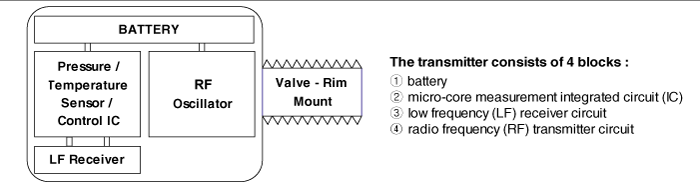
This transmitter is a
transmitter device with tire valve, which is mounted in the valve hole of
the wheel rim and transmits the pressure and temperature inside the tire,
the battery voltage of the transmitter, and the tire identification code
(ID) at normal and abnormal condition with the radio wave (RF) that
conforms to the used area. Also this device has a countermeasure function
such as the random delay of transmission time so that the RF signal from
each tire will not interfere due to transmission. Wheel sensors shall
support usage on steel or aluminum rims.
Sensor transmissions
continue when sensor status is 'Normal Fixed State'. Sensor transmissions
stop when sensor status is 'Storage State' or the sensor battery runs out.
The transmitter should transmit data at vehicle speeds between 0 mph (0
kph) and 186 mph (300 kph). Operating Temperature Range is -40 to 248
°F(-40 to 120 °C). Transmitter shall enter thermal shutdown once the
measured temperature is greater than or equal to 257 °F(125 °C). The
accuracy of the sensor is -9/12.6 degree Fahrenheit (-5/7 degree Celsius)
at this temperature, therefore the actual temperature may be 244.4 degree
Fahrenheit (118 degree Celsius). The sensor shall exit thermal shutdown
once the temperature is less than or equal to 212 °F(100 °C). The
transmitter shall have the capability to measure the internal battery
voltage as an indicator of the end of life of the sensor. Since the unit
is sealed, this parameter cannot be verified with a production
unit..
【Tire Pressure Monitoring】
When 4 sensors have been
learned as road wheels, it shall not be possible to learn new road wheel
sensors on the same Ignition cycle. In normal mode low line, tire pressure
and temperature shall be transmitted every 3 minutes 20 s nominally
independent of vehicle operation. Monitoring shall be every 20 s. If
sensor detects rapid deflation, then RF messages will be transmitted every
4 s for 1 minute duration. Communication from wheel sensors shall be via
RF at a frequency of 315 MHz, 5 kBaud. Tire pressure measurement tolerance
shall be ±7 kPa from 32 to 122 °F(0 to 50 °C) and ±17.5 kPa from -40 to
248 °F(-40 to 120°C) with a range of 100 to 450 kPa. Tire temperature
measurement tolerance shall be ±37.4 °F(±3 °C) from -4 to 158 °F(-20 to 70
°C) and ±9 °F(±5 °C) from -40 to 194 °F(40 to 90 °C) and -9/12.6 degree
Fahrenheit (-5/7 degree Celsius) from -40 to 248 degree Fahrenheit (-40 to
120 degree Fahrenheit).
This DTC indicates that
the sensor has detected that it has an internal fault. The most likely
cause is sensor failure.
Item
|
Detecting
Condition
|
Possible cause
|
DTC
strategy
|
|
|
Enable
conditions
|
| •
|
An internal fault in the TPMS
sensor | |
Threshold
value
|
|
Diagnosis
time
|
|
| 1. |
Park the vehicle on a level
surface. |
| 2. |
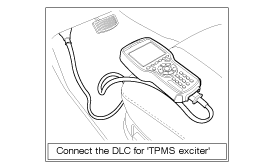
Connect 'TPMS exciter' or scantool to Data
Link Connector(DLC).
|
| 3. |
Select "TPMS DIAGNOSIS"
mode. |
| 4. |
Select the "FULL" mode of "CURRENT DATA"
function. |
| 5. |
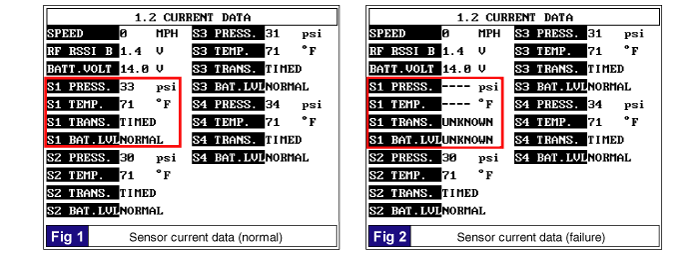
Monitor each sensor's temperature parameter on
the 'TPMS exciter' or scantool after 9 minutes.
|
| 6. |
Is parameter normal?
|

|
▶ Fault is
intermittent. It has been repaired and TPM receiver module
memory is not cleared yet.
▶ Go to
"Verification of vehicle Repair" procedure.
|
|

|
▶ Go to
"Component Inspection"
procedure.
|
|
| 1. |
Turn ON 'TPMS
exciter'. |
| 2. |
Select "TIRE SNSR CONFIG(EXCITER)"
mode. |
| 3. |
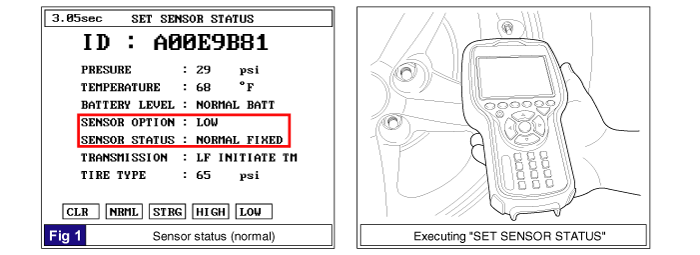
Execute "SET SENSOR STATUS" of each
wheel.
|
| 4. |
Is data unable to be retrieved for any
sensor?
|
|
▶ Check for
damaged of TPMS sensor on affected wheel.
▶ Replace TPMS sensor if necessary and register
sensor ID with 'TPMS exciter'.
▶ Go
to "Verification of Vehicle Repair"
procedure.
|
|
|
▶
Substitute with a known-good TPM receiver module and check for
proper operation.
▶ If the problem
is corrected, replace TPM receiver module and then go to
"Verification of Vehicle Repair"
procedure.
|
|
| Verification of Vehicle
Repair |
After a repair, it is
essential to verify that the fault has been corrected.
| 1. |
Connect TPMS exciter or scantool and select
"Diagnostic Trouble Codes(DTCs)"
mode |
| 2. |
Using a TPMS exciter or scantool, Clear
DTC. |
| 3. |
Operate the vehicle within DTC Enable
conditions in General information. |
| 4. |
Are any DTCs present ?
|
|
▶ Go to the
applicable troubleshooting procedure.
|
|
|
▶ System
performing to specification at this
time.
|
|