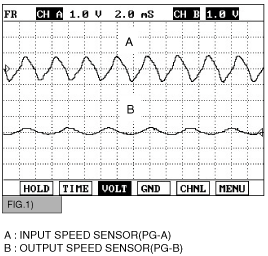
The value of the input
shaft speed should be equal to the value of the output shaft speed, when
multiplied by the 1st gear ratio, while the transaxle is engaged in the
1st gear. For example, if the input speed is 1000 rpm and the 1st gear
ratio is 2.846, then the output speed is about 2846 rpm.
This code is set if the
value of input shaft speed is not equal to the value of the output shaft,
when multiplied by the 1st gear ratio, while the transaxle is engaged in
1st gear. This malfunction is mainly caused by mechanical troubles such as
control valve sticking or solenoid valve malfunctioning rather than an
electrical issue.
Item
|
Detecting Condition & Fail
Safe
|
Possible cause
|
DTC Strategy
|
| •
|
1st gear incorrect
ratio | |
| •
|
Faulty input speed
sensor |
| •
|
Faulty output speed
sensor |
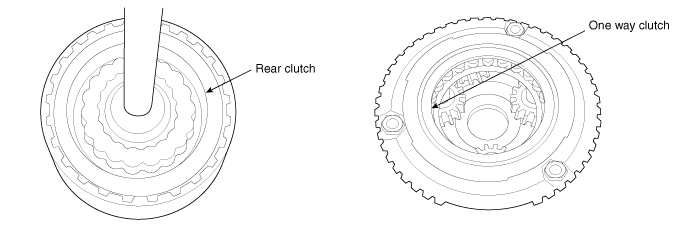
F/C-Front Clutch
R/C - Rear
Clutch
E/C - End Clutch
OWC - One Way Clutch
K/B -
Kicdown brake
L/R - Low&Reverse
brake
|
Enable Conditions
|
| •
|
Output speed(PG-B)
>300rpm |
| •
|
Input speed(PG-A)
>300rpm |
| •
|
A/T fluid temp.
>-10°C(14°F) |
| •
|
Inhibitor switch :
"D,2,L" |
|
Threshold value
|
| •
|
ㅣInput speed/1st gear ratio - output
speedㅣ≥200rpm | |
Diagnostic Time
|
|
Fail Safe
|
| •
|
Locked into 3rd gear.
(If diagnosis code P0731 is output four
times, the transaxle is locked into 3rd
gear) | |
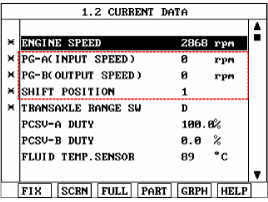
| 1. |
Connect scantool to data link
connector(DLC). |
| 3. |
Monitor the "ENGINE SPEED, INPUT SPEED
SENSOR(PG-A), OUTPUT SPEED SENSOR(PG-B), GEAR POSITION" parameter on
the scantool. |
| 4. |
Perform the "STALL TEST" at gear position
"1"
Specification
: 2400~2800 engine
rpm
|
Operating Element Of Each Shifting Range
Selector
lever
position
|
Overdrive
control
switch
|
Shifting
gear
|
Engine
start
|
Parking
Mechanism
|
Clutch
|
Brake
|
C1
|
C2
|
C3
|
OWC
|
B1
|
B2
|
P
|
-
|
Neutral
|
Possible
|
O
|
|
|
|
|
|
|
R
|
-
|
Reverse
|
|
|
O
|
|
|
|
|
|
N
|
-
|
Neutral
|
Possible
|
|
|
|
|
|
|
O
|
D
|
ON
|
1st
|
|
|
|
O
|
|
O
|
|
|
2nd
|
|
|
|
O
|
|
|
O
|
|
3rd
|
|
|
O
|
O
|
O
|
|
|
|
4th
|
|
|
|
|
O
|
|
O
|
|
D
|
OFF
|
1st
|
|
|
|
O
|
|
O
|
|
|
2nd
|
|
|
|
O
|
|
|
O
|
|
3rd
|
|
|
O
|
O
|
O
|
|
|
|
2
|
-
|
1st
|
|
|
|
O
|
|
O
|
|
|
2nd
|
|
|
|
O
|
|
|
O
|
|
L
|
-
|
1st
|
|
|
|
O
|
|
|
|
O
|
C1 : Front clutch
C2 : Rear clutch
C3 : End clutch
OWC : One way clutch
B1 : Kickdown brake
B2 : Low&reverse brake
Stall test procedure
in D1 and reason
Procedure
| B. |
Fully depress the brake pedal, than
place the transaxle gear lever in to "D" range.
Press and hold the accelerator pedal to
the floor for no more than eight seconds while observing the
engine, input speed, and output speed, and output speed RPM
value.
* The slippage of 1st gear operating
parts can be detected by stall test in
D1. |
Reason for stall test
| A. |
If there is no mechanical defaults in
A/T, all slippage occurs in torque
converter. |
| B. |
Therefore, engine revolution is output,
but input and output speed revolution must be "zero" due to
wheel's lock. |
| C. |
If 1st gear operating part has faults,
input speed revolution will be out of
specification. |
| D. |
If output speed revolution is output. It
means that the foot brake force is not applied fully.
Remeasuring is
required. | |
| 5. |
Is "STALL TEST " within
specification?
|

|
▶ Go to
"W/Harness inspection" procedure.
|
|

|
▶ Go to
"Component inspection"
procedure.
|
|
● Do not let anybody stand in front of
or behind the vehicle while this test is being carried
out.
● Check the A/T fluid level and
temperature and the engine coolant temperature.
| -
|
Fluid level : At the hot mark on
the oil level gauge. |
| -
|
Fluid temperature : 176 °F~ 212 °F
(80~100 °C). |
| -
|
Engine coolant temperature : 176
°F~ 212 °F (80~100 °C). |
● Chock both rear wheel(left and
right).
● Pull the parking brake lever on with
the brake pedal fully depressed.
● The throttle should not be left fully
open for more than eight seconds.
● If carrying out the stall test two or
more times, move the select lever to the "N" position and run
the engine at 1,000 rpm to let the A/T fluid cool down before
carrying out subsequent
tests. |
※ Perform stall test on "L" range If the
result of stall test on "D" range is out of
specifications.
"One Way Clutch" is fauly If the result of
stall test on "L" range is within
specifications. |
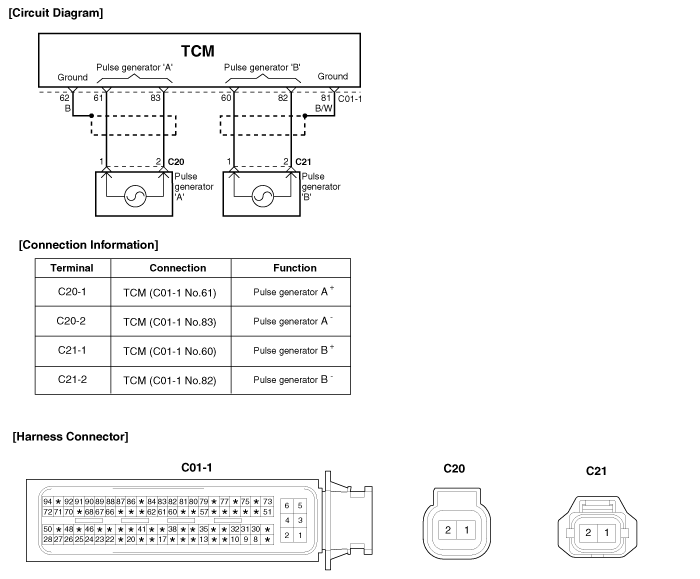
| Signal Circuit
Inspection |
| 1. |
Connect scantool to data link
connector(DLC). |
| 3. |
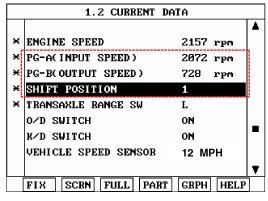
Monitor the "ENGINE SPEED, INPUT SPEED SENSOR,
OUTPUT SPEED SENSOR, GEAR POSITION" parameter on the
scantool. |
| 4. |
Perform the "STALL TEST" at gear position
"1".
Specification
: INPUT SPEED - (OUTPUT SPEED × GEAR
RATIO) ≤ 200 RPM
|
|
| 5. |
Are "INPUT & OUTPUT SPEED SENSOR" within
specifications?
|
|
▶ Go to
"Component inspection" procedure.
|
|
|
▶ Check for
electrical noise of circuit in INPUT&OUTPUT SPEED SENSOR
or Replace INPUT&OUTPUT SPEED SENSOR. Repair as necessary
and go to "Verification of vehicle repair"
procedure.
|
|
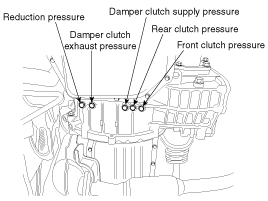
| 1. |
Connect oil pressure gauge to "R/C(rear
clutch)" port. |
| 3. |
Drive a car at gear position 1 in "D
RANGE". |
| 4. |
Compare actual value to
specifications.
Specification
: Shown below
|
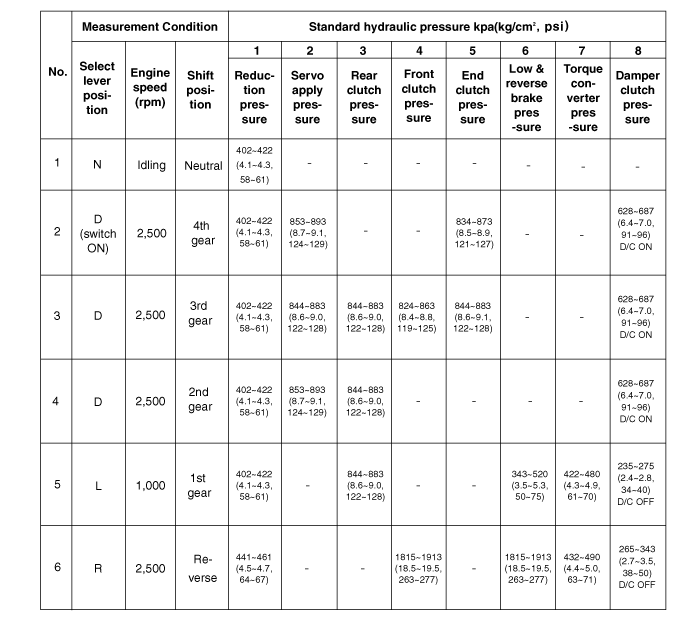
| •
|
"-" is 0.2(0.3)kg/cm² or less and
"( )" is the reverse. |
| •
|
SW-ON : Turn the overdrive control
switch ON. |
| •
|
SW-OFF : Turn the overdrive
control switch OFF. |
| •
|
The hydraulic pressure may be more
than standard value at the ambient
temperature. | |
※ The values are subject to change according
to vehicle model or condition |
| 5. |
Is oil pressure value within
specification?
|
|
▶ Repair
AUTO TRANSAXLE(Clutch or brake) as necessary and go to
"Verification of vehicle repair" procedure.
|
|
|
▶ Replace
AUTO TRANSAXLE (BODY CONTROL VALVE faulty) as necessary and go
to "Verification of vehicle repair "
procedure.
|
|
| Verification of Vehicle
Repair |
After a repair, it is
essential to verify that the fault has been corrected.
| 1. |
Connect scan tool and select "Diagnostic
Trouble Codes(DTCs)" mode |
| 2. |
Using a scantool, Clear
DTC. |
| 3. |
Operate the vehicle within DTC Enable
conditions in General information. |
| 4. |
Are you DTCs present?
|
|
▶ Go to the
applicable troubleshooting procedure.
|
|
|
▶ System
performing to specification at this
time.
|
|

