Due to the increasing
ambient temperature of the fuel, fuel vapors are generated in the tank. In
order to control the release of these vapors to the atmosphere, the
evaporative emissions control system is used. The evaporative emission
control system reduces hydrocarbon (HC) emissions by trapping fuel tank
vapors until they can be burned in the combustion process. Evaporating
fuel is stored in a charcoal canister until it can be flushed into the
intake manifold. The evaporative emission control system is made up of a
fuel tank that can be completely sealed from outside air, a Fuel Tank
Pressure Sensor (FTPS), a Canister Close Valve (CCV) that seals the
canister from the outside air, a canister filled with activated charcoal
granules, a Purge Control Solenoid Valve (PCSV). The evaporative emission
system can be checked for leaks by sealing the system off from the outside
air, creating a vacuum, and monitoring if the system can hold that vacuum
sufficiently for a set amount of time. If it cannot, a leak exists
somewhere in the system.
If there is a large leak
caused by as a fuel cap loosened, ECM/PCM sets DTC P0457.
Item
|
Detecting
Condition
|
Possible Cause
|
DTC
Strategy
|
| •
|
Fuel tank pressure behavior (large
leak) | |
|
Enable
Conditions
|
| •
|
Refueling > 10.0L (2.642
GAL) |
| •
|
Vehicle speed > 30kph
(18.64mph) |
| •
|
Drive mileage > 300m (328
yd) |
| •
|
Suspicion of large
leak | |
Threshold
Value
|
| •
|
Pressure when the intrusive diagnosis
activated > threshold f (fuel
level) | |
Diagnostic
Time
|
|
MIL
ON
Condition
|
| •
|
DTC only ; "CHECK FUEL CAP" lamp
illuminated | |
| 1. |
Connect scantool to DLC(Data Link
Cable) |
| 2. |
Warm -up the engine to normal operatig
temperature. |
| 3. |
Erase DTC currently
displayed. |
| 4. |
Perform the "EVAP. LEAKAGE TEST" with
scantool.
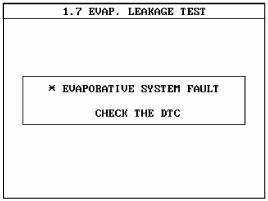
|
| 5. |
Is the same DTC displayed after "EVAP. LEAKAGE
TEST" has done ?
|

|
▶ Go to
"System Insepction" procedure.
|
|

|
▶ Fault is
intermittent caused by poor contact in the sensor’s and/or
PCM’s connector or was repaired and ECM/PCM memory was not
cleared. Thoroughly check connectors for looseness, poor
connection, ending, corrosion, contamination, deterioration,
or damage. Repair or replace asnecessary and go to
"Verification of Vehicle Repair"
procedure
|
|
| 1. |
Check Fuel Cap
| (1) |
Check fuel cap is firmly
tightened. |
| (2) |
Check damage or leakage of fuel
cap. |
| (3) |
Has a problem been found ?
|
|
▶
Repair or replace as necessary and then, Go to
"Verification of Vehicle Repair"
procedure.
|
|
|
▶
Substitute with a known - good ECM/PCM and check for
proper operation. If the problem is corrected, replace
ECM/PCM and go to "Verification of Vehicle Repair"
procedure.
|
| |
| Verification Of Vehicle
Repair |
After a repair, it is
essential to verify that the fault has been corrected.
| 1. |
Connect scan tool and select "Diagnostic
Trouble Codes(DTCs)" mode. |
| 2. |
Clear the DTCs and Operate the vehicle within
DTC Enable conditions in General
information. |
| 3. |
Are any DTCs present ?
|
|
▶ Go to the
applicable troubleshooting procedure.
|
|
|
▶ System is
performing to specification at this
time.
|
|