The purge control
solenoid valve (PCSV) is a device used to meter vapor flow to the engine.
The ECM/PCM controls the PCSV using a duty cydle signal.
If the Reference value
of differential tank pressure is over 5hPa (10.443 lbf/ft²), ECM/PCM
determines that PCSV is stuck closed and sets DTC P0497.
Item
|
Detecting
Condition
|
Possible Cause
|
DTC
Strategy
|
| •
|
Fuel tank pressure behavior
(Canister purge valve stuck
check) | |
| •
|
Clog on the fuel Evaporative system
hose |
|
Enable
Conditions
|
| •
|
Time after engine start >
600sec. |
| •
|
Idle speed controller
activated |
| •
|
Mixture adaptation
activated |
| •
|
Coolant temperature at start - ambient
temperature< 6.6°C
(11.88°F) |
| •
|
Ambient temperature : 4~35°C (39.2 ~
95°F) |
| •
|
Ambient pressure >680hPa (10
lbf/in²) |
| •
|
Fuel level : 6.45 ~ 38.7 L (1.7 ~ 10.2
gal) |
| •
|
Tank ventilation must be active
>10sec. |
|
Threshold
Value
|
| •
|
Reference value of differential tank
pressure > 5hPa (10.443
lbf/ft²) | |
Diagnostic
Time
|
|
MIL
ON
Condition
|
|
Item
|
Specification
|
PCSV Coil
Resistance
|
16Ω at 20°C
(68°F)
|
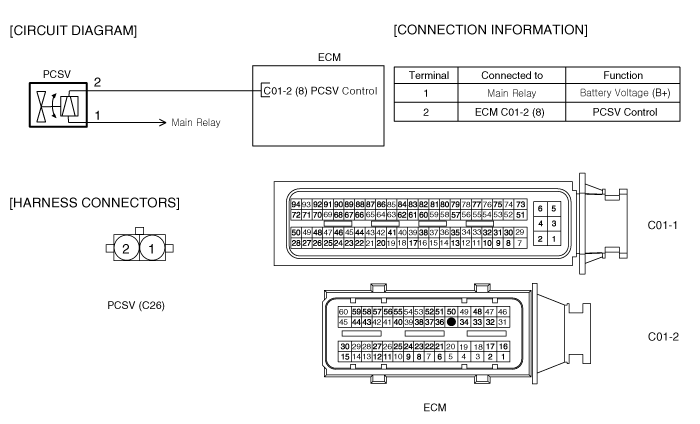
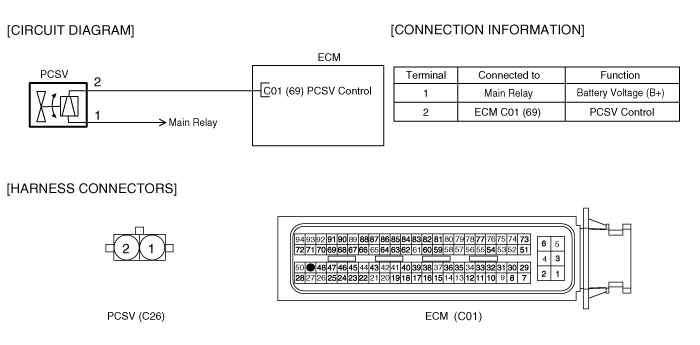
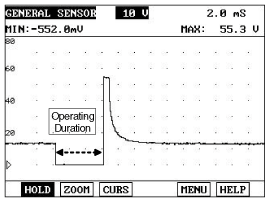
| 1. |
Connect scantool to Data Link
Connector(DLC). |
| 2. |
Warm up the engine to normal operating
temperature. |
| 3. |
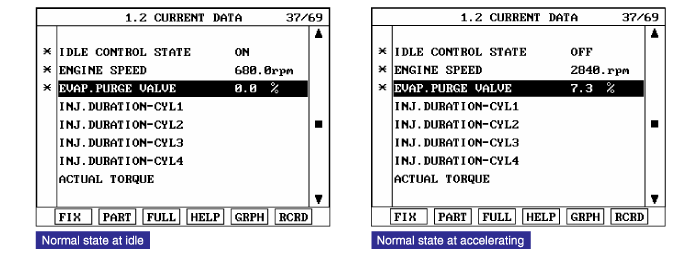
Monitor the "PCSV" parameters on the
scantool.
|
| 4. |
Are the parameters displayed
correctly?
|

|
▶ Fault is
intermittent caused by poor contact in the sensor’s and/or
ECM’s connector or wasrepaired and ECM/PCM memory was not
cleared. Thoroughly check connectors for looseness,
poorconnection, bending, corrosion, contamination,
deterioration, or damage. Repair or replace as necessary and
go to "Verification of vehicle Repair"
procedure.
|
|

|
▶ Go to
"Terminal and connector inspection"
procedure.
|
|
| Terminal And Connector
Inspection |
| 1. |
Many malfunctions in the electrical system are
caused by poor harness and terminals. Faults can also be caused by
interference from other electrical systems, and mechanical or
chemical damage. |
| 2. |
Thoroughly check connectors for looseness,
poor connection, bending, corrosion, contamination, deterioration,
or damage. |
| 3. |
Has a problem been found?
|
|
▶ Repair as
necessary and go to "Verification of vehicle Repair"
procedure.
|
|
|
▶ Go to
"PCSV Voltage Check"
procedure.
|
|
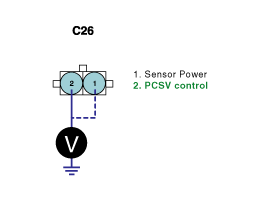
Voltage Check
| 2. |
Disconnect PCSV
connector. |
| 4. |
Measure the voltage between terminal 1 of PCSV
harness connector and chassis ground.
Measure the voltage between terminal 2 of PCSV
harness connector and chassis ground.
Specification
: Terminal 1 B+
Terminal 2 Approx.
3.5V
|
|
| 5. |
Is the measured voltage within specification
?
|
|
▶ Go to
"Component inspection" procedure.
|
|
|
▶ Repair
Open or Short in circuit and then, go to "Verification of
Vehicle Repair"
procedure.
|
|
| 1. |
Visual Inspection
| (1) |
Check damage, looseness or poor
connection on hoses for the fuel evaporative
system. |
| (2) |
Has a problem been found?
|
|
▶
Repair as necessary and go to "Verification of vehicle
Repair" procedure
|
|
|
▶ Go
to "Check PCSV"
procedure.
|
| |
| 2. |
Check PCSV
| (1) |
Disconnect a hose between a surge tank
and PCSV. (Surge tank side
only) |
| (2) |
Connect a vacuum guage to a hose, and
apply vacuum. |
| (3) |
Is it possibe to make
vacuum?
|
|
▶ Go
to "Check PCM" procedure.
|
|
|
▶
Substitute with a known-good PCSV and check for proper
operation. If the problem is corrected, replace PCSV and
then go to "Verification of Vehicle Repair"
procedure.
|
| |
| 3. |
Check PCM
| (1) |
Connect scantool on the DLC( Data Link
Connector) |
| (2) |
Perform Action Test for Canister Vent
Solenoid Valve with scantool |
| (3) |
Check clicking sound of
PCSV.
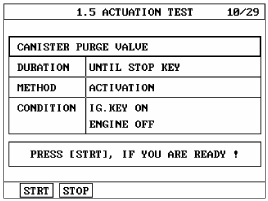
|
| (4) |
Is the PCSV normal ?
|
|
▶
Thoroughly check connectors for looseness, poor
connection, ending, corrosion,contamination,
deterioration, or damage. Repair or replace as
necessaryand go to "Verification of Vehicle Repair"
procedure.
|
|
|
▶
Substitute with a known-good ECM/PCM and check for
proper operation. If the problem is corrected, replace
ECM/PCM and then go to "Verification of Vehicle Repair"
procedure.
|
| |
| Verification Of Vehicle
Repair |
After a repair, it is
essential to verify that the fault has been corrected.
| 1. |
Connect scan tool and select "Diagnostic
Trouble Codes(DTCs)" mode. |
| 2. |
Clear the DTCs and Operate the vehicle within
DTC Enable conditions in General
information. |
| 3. |
Are any DTCs present ?
|
|
▶ Go to the
applicable troubleshooting procedure.
|
|
|
▶ System is
performing to specification at this
time.
|
|