| •
|
Frequent inhalation of brake pad dust,
regardless of material composition, could be hazardous to your
health. |
| •
|
Avoid breathing dust particles.
|
| •
|
Never use an air hose or brush to
clean brake assemblies.
| |
| 1. |
Release the parking brake.
|
| 2. |
Remove the rear wheel &
tire.
Tightening
torque:
88.3 ~ 107.9 N.m (9.0 ~ 11.0 kgf.m,
65.1 ~ 79.6 lb-ft)
| |
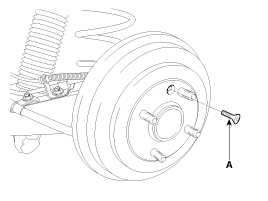
| 3. |
Remove the rear brake drum (A).
|
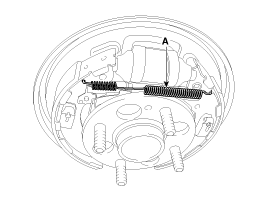
| 4. |
Remove the upper return spring
(A).
|
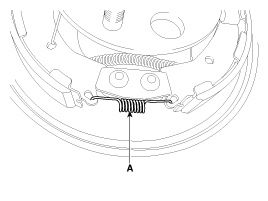
| 5. |
Remove the lower return spring (B).
|
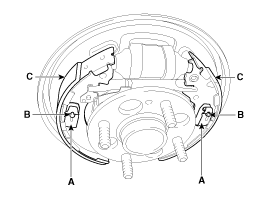
| 6. |
Remove the shoe hold springs (A) and shoe
hold pins (B) and then remove brake shoe (C). Make sure not to
damage the dust cover on the wheel cylinder.
|
| 7. |
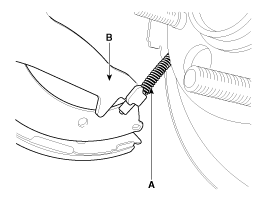
Remove the parking brake cable (A) and then
remove brake shoe (B).
|
| 8. |
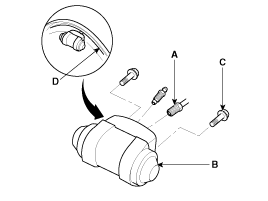
Disconnect brake tubes (A) from the wheel
cylinder (B).
|
| 9. |
Remove the bolt (C) and the wheel cylinder
(B) from the backing plate (D). |
| •
|
Do not spill brake fluid on the
vehicle: it may damage the paint; if brake fluid does contact
the paint. Wash it off immediately with water.
|
| •
|
To prevent spills, cover the hose
joints with rags or shop towels.
|
| •
|
Use only a genuine wheel cylinder
special bolt.
| |
| 1. |
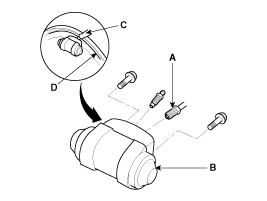
Apply sealant (C) between the wheel cylinder
(B) and backing plate (D), and install the wheel
cylinder.
|
| 2. |
Connect the brake tubes (A) to the wheel
cylinder.
Tightening
torque:
6.9 ~ 9.8 N.m (0.7 ~ 1.0 kgf.m, 5.1 ~
7.2 lb-ft)
| |
| 3. |
Connect the parking brake cable (A) to the
brake shoe.
|
| 4. |
Install the brake shoes (C) onto the backing
plate. Be careful not to damage the wheel cylinder dust covers.
|
| 5. |
Install the shoe hole down pins (B) and the
shoe hole down springs (A). |
| 6. |
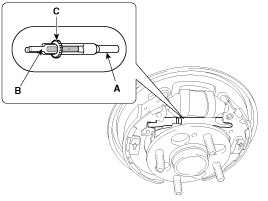
Clean the threaded portions of adjuster
sleeve (A) and push rod female (B). Coat the threads of the adjuster
assembly with grease. To shorten the clevises, turn the adjuster
bolt (C).
|
| 7. |
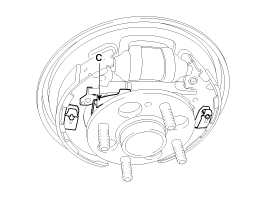
Hook the shoe adjuster lever (C), then
install it to the brake shoe.
|
| 8. |
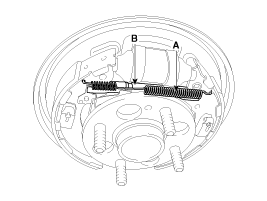
Install the adjuster assembly (B) and upper
return spring (A) as right direction. Be careful not to damage the
wheel cylinder dust covers.
|
| 9. |
Install the lower return spring (B).
|
| 10. |
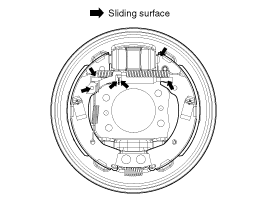
Apply brake cylinder grease or equivalent
rubber grease to the sliding surfaces shown. Don't get grease on the
brake linings.
|
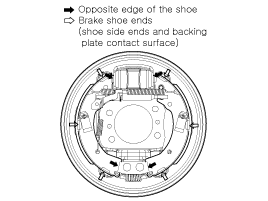
| 11. |
Apply brake cylinder grease or equivalent
rubber grease to the brake shoe ends and opposite edges of the shoes
shown. Don't get grease on the brake linings.
|
| 12. |
Install the rear brake drum
(A).
|
| 13. |
If the wheel cylinder has been removed,
bleed the brake system. |
| 14. |
Depress the brake pedal several times to set
the self-adjusting brake. |
| 15. |
Adjust the parking brake.
|
| •
|
Frequent inhalation of brake pad dust,
regardless of material composition, could be hazardous to your
health. |
| •
|
Avoid breathing dust particles.
|
| •
|
Never use an air hose or brush to
clean brake assemblies.
| |
| •
|
Contaminated brake linings or drums
reduce stopping ability. |
| •
|
Block the front wheels before jacking
up the rear of the vehicle.
| |
| 1. |
Raise the rear of the vehicle, and make sure
it is securely supported. |
| 2. |
Release the parking brake, and remove the
rear brake drum. |
| 3. |
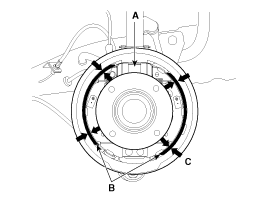
Check the wheel cylinder (A) for
leakage.
|
| 4. |
Check the brake linings (B) for cracking,
glazing, wear, and contamination. |
| 5. |
Measure the brake lining thickness
(C).Measurement does not include brake shoe thickness.
Brake
lining thickness
Standard: 4.5 mm (0.177
in)
Service limit: 1.0 mm (0.039
in)
| |
| 6. |
If the brake lining thickness is less than
the service limit, replace the brake shoes as a set.
|
| 7. |
Check the bearings in the hub unit for
smooth operation. If it requires servicing, replace it.
|
| 8. |
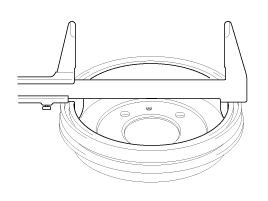
Measure the inside diameter of the brake
drum with inside vernier calipers.
Drum inside
diameter
Standard: 203.2 mm (8.0
in)
Service limit: 205.2 mm (8.079
in)
Drum
roundness
Service limit: 0.06 mm (0.00236
in)
|
|
| 9. |
If the inside diameter of the brake drum is
more than the service limit, replace the brake
drum. |
| 10. |
Check the brake drum for scoring, grooves,
and cracks. |
| 11. |
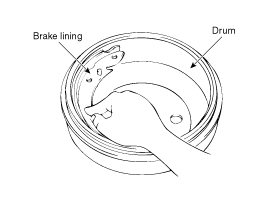
Inspect the brake lining and drum for proper
contact.
|
| 12. |
Inspect the wheel cylinder outside for
excessive wear and damage. |
| 13. |
Inspect the backing plate for wear or
damage. | |

