| DESCRIPTION |
Continuously Variable
Valve Timing (CVVT) system controls valve overlap with forcibly activating
the camshaft and adjusts EGR (Exhaust Gas Recirculation) amount. It
decreases exhaust gas (NOx, HC) and improves fuel economy, idle state,
torque in low speed and power in high speed. This system uses engine oil
pressure and consists of the two CVVT Oil Control Valves (OCV) in each
bank which supplies oil to cam phaser according to PWM (Pulse Width
Modulator) signal of the PCM, a CVVT Oil Temperature Sensor (OTS) which
detects the oil temperature and a cam phaser which is installed on the end
of the camshaft and converts camshaft phase. The oil getting out of the
CVVT oil control valve flows into the cam phaser and rotates the rotor
inside cam phaser. At this time, the camshaft rotates with the rotor and
the cam phase is changed.
| 1. |
When camshaft rotates engine rotation-wise:
Intake-Advance / Exhaust-Retard |
| 2. |
When camshaft rotates counter engine
rotation-wise: Intake- Retard / Exhaust-
Advance |
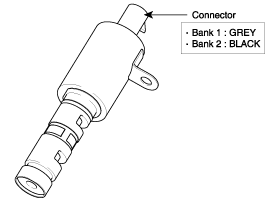
SPECIFICATION
| Item |
Specification |
| Coil
Resistance (Ω) |
6.7 ~ 7.7Ω
at 20°C (68°F) |
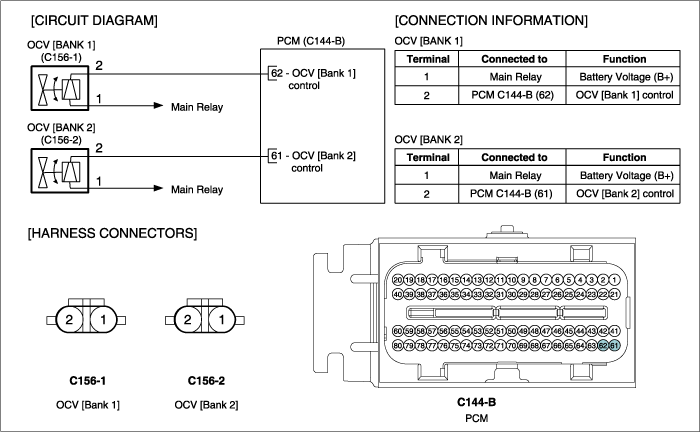
| SCHEMATIC DIAGRAM |
| INSTALLATION |
If the OCVs are installed incorrectly, the
vehicle may be damaged.
So when installing them, be careful its
connector color (Components and harness
side). |

[Bank and its color]
| Bank |
Component side |
Harness side |
| Bank 1
(RH) |
Grey |
Grey |
| Bank 2
(LH) |
Black |
Black |