Similar in operation to
the Small Leak test, the Very Small Leak test will detect the presence of
a leak that is 0.020” (0.5 mm) or larger in the evaporative system. To
prevent a possible misdiagnosis, the Very Small Leak test may use tighter
operational limits than required by the Small Leak test. If any of the
Very Small Leak test enabling conditions are not met, such as coolant and
intake air temperature, the Very Small Leak test willbe disabled for the
current trip.
Checking tank vaccum
from tank pressure sensor under detecting condition, if tank vaccum
signals is higher than threshold, PCM sets P0455. And MIL(Malfunction
Indication Lamp) turns on.
Item
|
Detecting
Condition
|
Possible cause
|
DTC
Strategy
|
| •
|
Monitor the vaccum decay
slope | |
| •
|
Leakage in each hose/fuel filler
pipe |
| •
|
Leakage in CCV/Canister/ Fuel
tank |
|
Enable
Conditions
|
| •
|
10V < Ignition Volt <
16 |
| •
|
Barometric pressure > 72
kPa |
| •
|
Engine off time >
720min |
| •
|
Startup ECT -Startup IAT < 12°C( 53.6
°F) |
| •
|
0°C( 32 °F) < Startup ECT <
40°C(104 °F) |
| •
|
0°C( 32 °F) < Startup IAT <
40°C(104 °F) |
| •
|
Start-up IAT-IAT < 1°C(33.8
°F) |
| •
|
1sec. < Engine Run Time < 100
sec. |
| •
|
Purge enabling Rum time < Threshold
(mapped in PCM) |
| •
|
Cold Test Timer <
300sec. |
| •
|
0.03 % < Fuel level change< 0.97
% |
| •
|
Under idle conditions or creep
conditions |
|
Threshold
value
|
| •
|
Decay slope is greater than threshold
(the function of fuel level and temperature mapped in
PCM) | |
Diagnosis
Time
|
|
MIL On
Condition
|
|
| 1. |
Warm-up engine to normal operating
temperature.
|
Evaporative Emissions Systems (EVAP)
Leak Tests can be run by the Scan Tool.
The tests are automated and provide
either a pass-fail result or directions to check for
DTCs. | |
| 2. |
Install scan tool and clear
DTC |
| 3. |
Perform "EVAP. LEAKAGE TEST" mode referring to
enable conditions as below
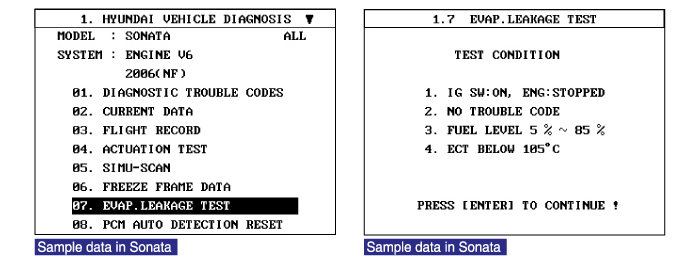
|
| 4. |
Monitoring for (pending) DTC by performing "
DIAGNOSTIC TROUBLE CODES" or "MONITORING TEST RESULTS". Is the same
DTC set ?

▶Go to "System Inspection"
procedure.

▶ Fault is intermittent caused by poor contact
in sensor’s and/or PCM’s connector or was repairedand PCM memory was
not cleared. Thoroughly check connectors for looseness, poor
connection,bending, corrosion, contamination, deterioration, or
damage. Repair or replace as necessary and goto "Verification of
vehicle Repair" procedure. |
| 1. |
Check vapor hoses for leakage in fuel
system.
| (1) |
Check vapor hoses between the following
components for leakage:
| A. |
Intake manifoled ~ Purge control
solenoid valve (PCSV) |
| B. |
Purge control solenoid valve
(PCSV) ~ Canister |
| C. |
Canister ~ Canister close valve
(CCV) |
|
| (2) |
Does a leak exist?
▶ Repair or replace as necessary and
then, go to "Verification of Vehicle Repair"
procedure.
▶ Go to "Check fuel filler pipe for
leakage" as
below. | |
| 2. |
Check fuel filler pipe for crack or
leakage.
| (1) |
Check that there is crack or leakage in
fuel filler pipe |
| (2) |
Is there any crack or leakage
?
▶ Repair or replace as necessary and
then, go to "Verification of Vehicle Repair"
procedure.
▶ Go to "Component inspection"
procedure. | |
| 1. |
Check CCV for leakage.
| (1) |
Disconnect the hose leading from the CCV
to Canister at CCV. |
| (2) |
Visually Check any tear of the hose
leading from the CCV to
Canister |
| (3) |
When the CCV operates, apply a vacuum at
the nipple and verify that the CCV holds
vacuum. |
| (4) |
Does a leak exist?
▶ Repair or replace as necessary and
then go to "Verification of Vehicle Repair"
procedure.
▶ Go to "Check Canister for leakage" as
necessary. | |
| 2. |
Check Canister for leakage.
| (1) |
Disconnect the hose leading from the CCV
to Canister at Canister. |
| (2) |
When the other nipples are plugged,
apply a vacuum at the vent nipple and verify that the Canister
holds vacuum |
| (3) |
Does a leak exist?
▶ Repair or replace as necessary and
then go to "Verification of Vehicle Repair"
procedure.
▶ Go to "Check fuel tank for leakage" as
below. | |
| 3. |
Check fuel tank for leakage.
| (1) |
Check fuel tank for crack or
leakage. |
| (2) |
Does a leak exist?
▶ Repair or replace as necessary and
then go to "Verification of Vehicle Repair"
procedure.
▶ Substitute with a known - good PCM and
check for proper operation.
▶ If the problem is corrected, replace
PCM and go to "Verification of Vehicle Repair"
procedure.
|
There is a memory reset function
on scantool that can erase optional parts automatically
detected and memorized by PCM. After testing PCM on the
vehicle, use this function to reuse the PCM on the
others | | |
| VERIFICATION OF VEHICLE
REPAIR |
After a repair, it is
essential to verify that the fault has been corrected.
| 1. |
Monitor and record the Freeze Frame Data for
the Diagnostic Trouble Code(DTC) which has been
diagnosed. |
| 2. |
Using a Scantool, Clear the
DTCs |
| 3. |
Operate the vehicle within conditions noted in
the freeze frame data or enable
conditions |
| 4. |
Monitor that all rediness test have been
verified as " Complete " |
| 5. |
Are any DTCs present ?
▶ Go to the applicable troubleshoooting
procedure.
▶ System is performing to specification at
this
time. |
