The Thermostat is a
mechanical device located in an engine coolant passage the coolant has
reached a specified temperature it expands and contracts according to
temperature, thereby controlling the passage of coolant into the
radiator.
If the engine coolant
temperature does not reach the specified value within the allocated period
of time, the PCM determines that a malfunction exists and a DTC is stored.
MIL(Malfunction Indication Lamp) turns on when the malfunction lasts till
consecutive 2 driving cycle.
Item
|
Detecting
Condition
|
Possible cause
|
DTC Strategy
|
| •
|
Monitors the time it takes for the
coolant temperature to reach the Thermostat Regulating
Temperature. | |
|
Enable Conditions
|
| •
|
No disabling faults
present |
| •
|
Coolant sensor within
range |
| •
|
Thermostat target temp - Startup coolant
temp ≥ 20°C(68°F) |
| •
|
Intake air temperature >-10°C(
14°F) |
|
Threshold value
|
| •
|
Time which the coolant temperautre is
under (the regulating temperature -11°C) exceeds the allowed
threshold. | |
Diagnosis Time
|
|
MIL On Condition
|
|
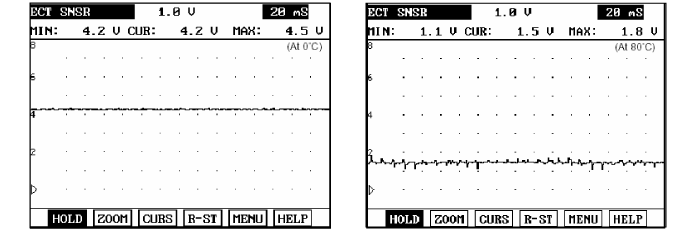
The output signals of
IATS & ECTS change smoothly without any rapid changes. Those have
almost same characteristic signal during the early period after start. It
means that the temperatures of intake air and engine coolant are depended
on the temperature of atmosphere. Meanwhile, during the warming up, the
output signal of ECTS is going up increasingly. but, the output signal of
IATS changes a little bit. even it may not change almost. It means that
the heat of engine does not affect on the temperature of intake
air.
| 2. |
Monitor Engine Coolant Temperature Sensor
parameter on Current data
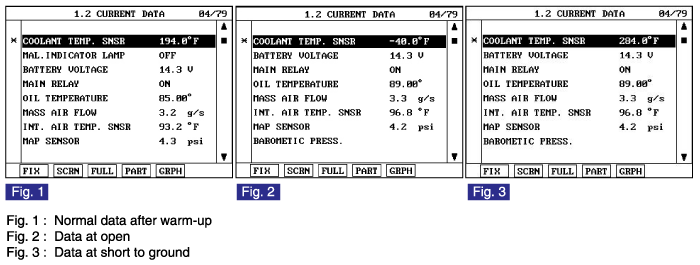
|
| 3. |
Is the measured ECTS parameter displayed
within specifications ?

▶ Fault is intermittent caused by poor contact
in the sensor’s and/or PCM’s connector or was repaired and PCM
memory was not cleared. Thoroughly check connectors for looseness,
poor connection, bending, corrosion, contamination, deterioration,
or damage. Repair or replace as necessary and go to "Verification of
Vehicle Repair" procedure

▶ Go to "Component Inspection"
procedure |
| 1. |
Check Thermostat
| (1) |
Check cooling system coolant level and
fill if low. |
| (2) |
Check for a proper cooling system
operation. Especially check that cooling and condenser fan
working normally. |
| (3) |
Remove the thermostat and check the
following items:
(1) Stuck or damaged
(2) Verify the temperature at which the
valve is open : 80
~84°C(176~183.2°F) |
| (4) |
Has a problem been found ?
▶ Substitute with a known - good
Thermostat and check for proper operation. If the problem is
corrected, replace Thermostat and go to "Verification of
Vehicle Repair" proprocedure.
▶ Substitute with a known - good PCM and
check for proper operation. If the problem is corrected,
replace PCM and go to "Verification of Vehicle Repair"
procedure.
|
There is a memory reset function
on scantool that can erase optional parts automatically
detected and memorized by PCM. Before or after testing
PCM on the vehicle, use this function to reuse the PCM
on the
others. | | |
| VERIFICATION OF VEHICLE
REPAIR |
After a repair, it is
essential to verify that the fault has been corrected.
| 1. |
Monitor and record the Freeze Frame Data for
the Diagnostic Trouble Code(DTC) which has been
diagnosed. |
| 2. |
Using a Scantool, Clear the
DTCs |
| 3. |
Operate the vehicle within conditions noted in
the freeze frame data or enable
conditions |
| 4. |
Monitor that all rediness test have been
verified as " Complete " |
| 5. |
Are any DTCs present ?
▶ Go to the applicable troubleshoooting
procedure.
▶ System is performing to specification at
this
time. |
