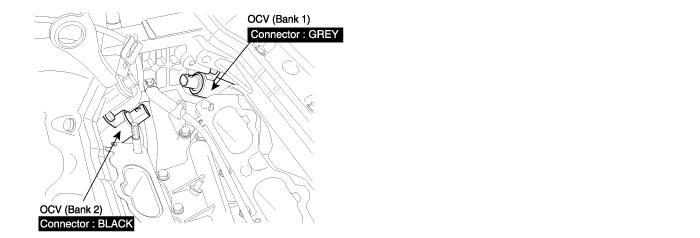
Different from the
existing fixed cam phase angle type, CVVT(Continuously Variable Valve
Timing) is the device which varies cam phase angle continuously to be
optimum. And with engine oil pressure, it operates. CVVT consists of
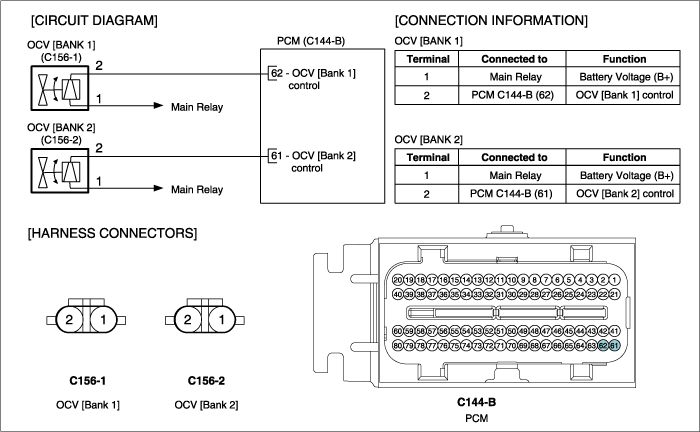
OCV(Oil Control Valve) and cam phaser. OCV, mounted on cylinder head,
controlls the amount and direction of oil delivered to cam phaser by oil
valve which is connected to a solenoid. Cam phaser, rotating cam phaser
rotor with pressure and amount of oil produced by OCV, rotates cam shaft
forcefully for or against the rotating direction and finally, cam shaft
phase changes. With the appliance of CVVT, engine power,fuel efficiency
and the quality of exhause gas are improved.
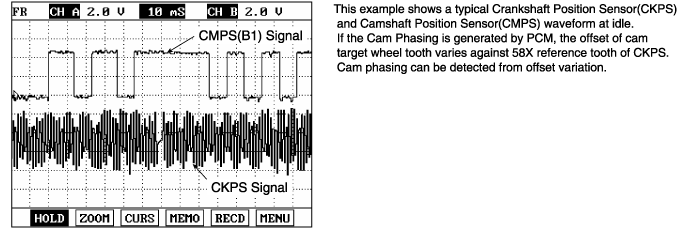
PCM detects CAM phasing
average rate while cam offset is available. If the CAM phasing rate is
failure in 12 times out of 15 CAM phasing test PCM determines that a fault
exists and a DTC is stored.
Item
|
Detecting
Condition
|
Possible cause
|
DTC Strategy
|
| •
|
Determines if the phaser is moving at an
expected rate | |
| •
|
Excessive phasing system
leakage |
| •
|
Insufficient Oil Pressure
(ex. Blockage in OCV
filter) |
|
Enable Conditions
|
| •
|
Cam Offset is
available | |
Threshold value
|
| •
|
Cam phasing average rate is out of
threshold programmed in
PCM | |
Diagnosis Time
|
| •
|
Continuous (12 tests failure for 15 cam
edge tests) | |
MIL On Condition
|
|
| 1. |
connect scantool and ENG
"ON" |
| 2. |
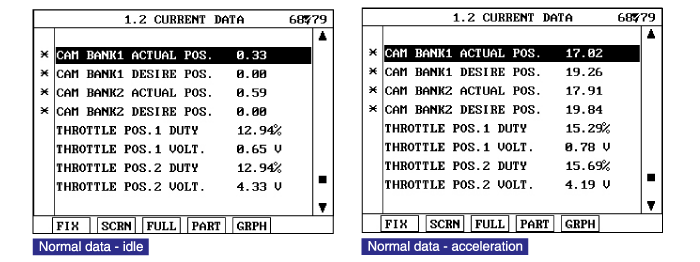
Monitor "CMPS(B2)" on the service
data.
|
| 3. |
Are the "CMPS(B2)" data displayed correctly
?

▶ Fault is intermittent caused by poor contact
in the sensor’s and/or PCM’s connector or was repairedand PCM memory
was not cleared. Thoroughly check connectors for looseness, poor
connection,bending, corrosion, contamination, deterioration, or
damage. Repair or replace as necessary and goto "Verification of
Vehicle Repair" procedure.

▶ Go to "System Inspection"
procedure. |
| 1. |
Visual Inspection
| (1) |
Check oil level is
O.K. |
| (2) |
Check oil is
contaminated. |
| (3) |
Check that any oil leakage or blockage
is occurred on the parts related to
CVVT. |
| (4) |
Has a problem been found ?
▶ Repair or replace as necessary and
then, go to " Verification of Vehicle Repair"
procedure.
▶ Go to "Component Inspection"
procedure. | |
| 1. |
Check OCV
| (1) |
Connect scantool and IG
"ON" |
| (2) |
Select "OCV" on the Actuation
Test |
| (3) |
Activate "OCV" by pressing "STRT(F1)"
key
(should hear a faint click from Oil
Control solenoid Valve) |
| (4) |
Repeat this procedure 4 or 5 times to
ensure reliability
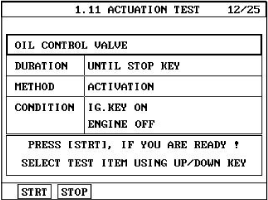
|
| (5) |
Has a problem been found ?
▶ Substitute with a known - good OCV and
check for proper operation. If the problem is corrected,
replace OCV and go to "Verification of Vehicle Repair"
procedure.
▶ Substitute with a known - good CVVT
and check for proper operation. If the problem is corrected,
replace CVVT and go to "Verification of Vehicle Repair"
procedure. | |
| VERIFICATION OF VEHICLE
REPAIR |
After a repair, it is
essential to verify that the fault has been corrected.
| 1. |
Monitor and record the Freeze Frame Data for
the Diagnostic Trouble Code(DTC) which has been
diagnosed. |
| 2. |
Using a Scantool, Clear the
DTCs |
| 3. |
Operate the vehicle within conditions noted in
the freeze frame data or enable
conditions |
| 4. |
Monitor that all rediness test have been
verified as " Complete " |
| 5. |
Are any DTCs present ?
▶ Go to the applicable troubleshoooting
procedure.
▶ System is performing to specification at
this
time. |