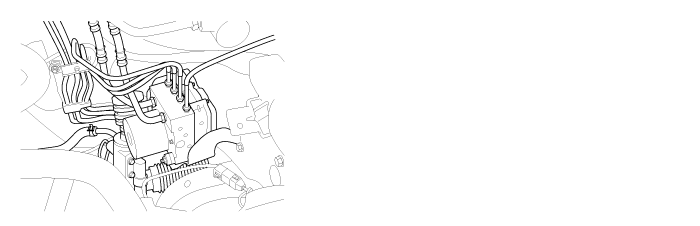
| COMPONENT LOCATION |
| General Description |
The HECU sends
requirement data, such as Torque reduction, the number of fuel cut
cylinders, and TCS control requests, to the Engine ECU & TCU through
CAN bus line. The Engine ECU performs fuel cut functions according to
requests from the HECU and retards ignition timing by torque reduction
requests. The TCU maintains current gear positions during TCS control
time, in order not to increase power which causes a Kickdown
shift.
| DTC Description |
The HECU checks the CAN
communcation lines for normal ESC control, and sets this code if an CAN
message is not transmitted within predefined time.
| DTC Detecting Condition |
| Item |
Detecting
Condition |
Possible cause | ||||
| DTC
Strategy |
|
| ||||
| Monitoring
Period |
| |||||
| Enable
Conditions |
| |||||
| Fail
Safe |
|
| Component Inspection |
| 1. |
Ignition
"OFF". |
| 2. |
Engine "ON". |
| 3. |
Does warning lamp remain On?
▶ Substitute with a known-good HECU and check
for proper operation. If problem is corrected, replace HECU and then
go to "Verification of Vehicle Repair" procedure.
▶ Fault is intermittent caused by faulty HECU
or was repaired and HECU memory was not cleared. Go to the
applicable troubleshooting
procedure. |


| Verification of Vehicle Repair |
After a repair, it is
essential to verify that the fault has been corrected.
| 1. |
Connect scantool and select "Diagnostic
Trouble Codes(DTCs)" mode |
| 2. |
Using a scantool, clear
DTC. |
| 3. |
Operate the vehicle within DTC Detecting
Condition in General Information. |
| 4. |
Are any DTCs present ?
▶ Go to the applicable troubleshooting
procedure.
▶ System performing to specification at this
time. |