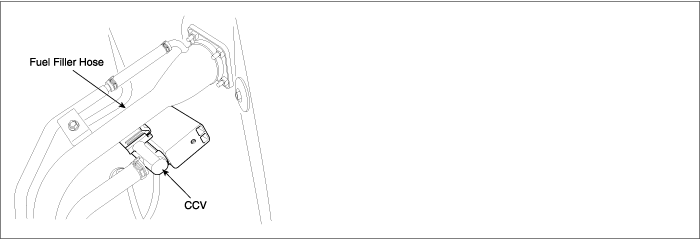
The evaporative emission
control system prevents hydrocarbon (HC) vapors from the fuel tank from
escaping into the atmosphere where they could form photochemical smog.
Gasoline vapors are collected in the charcoal canister. The PCM controls
the Purge Control Solenoid Valve (PCSV) to purge any collected vapors from
the canister back to the engine for combustion. This valve is actuated by
the purge control signal from the PCM and controls fuel vapor flow from
the canister to the intake manifold.
Checking output signals
from fuel tank pressure sensor at purging, if fuel tank's vacuum is higher
than prescribed threshold, PCM sets P2422.
Item
|
Detecting
Condition
|
Possible cause
|
DTC
Strategy
|
| •
|
Monitor the fuel tank's
vacuum | |
| •
|
Faulty Canister Close
Valve |
| •
|
Clogging of canister air
filter | |
EnableConditions
|
| •
|
10 V < Battery voltage < 16
V |
| •
|
Barometric pressure > 72 kPa (0.72
bar) |
| •
|
Engine coolant temperature at startup -
Intake air temperature at startup < 6.7°C(12
°F) |
| •
|
Engine coolant temperature at startup:
4.5 ~ 35°C(40 ~ 95 °F) |
| •
|
Intake air temperature at startup: 4.5 ~
35°C(40 ~ 95 °F) |
|
Threshold
value
|
| •
|
Fuel tank's vacuum at purging > a
prescribed threshold | |
DiagnosisTime
|
|
MIL On
Condition
|
|
| 1. |
Check DTC Status
| (1) |
Connect scantool to Data Link
Connector(DLC). |
| (3) |
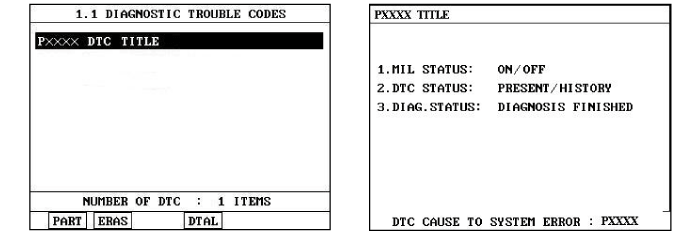
Select "Diagnostic Trouble Codes(DTCs)"
mode, and then Press F4(DTAL) to check DTC's information from
the DTCs menu |
| (4) |
Read "DTC Status"
parameter.
|
| (5) |
Is parameter displayed "Present
fault"?

▶ Go to "Component Inspection"
procedure

▶ Go to "Evap.Leakage Test" as below
with scan
tool. | |
| 2. |
Evap. Leakage Test
| (1) |
Cool the vehicle down for about two
hours to prevent
misdiagnosis. |
| (2) |
Install scan tool and IG "ON" and then
clear DTC. |
| (3) |
Select and press "EVAP.LEAKAGE TEST"
mode in the scan tool. |
| (4) |
Check if the vehicle is under test
conditions as below [Fig 1]. |
| (5) |
If OK, Start engine and restart
Evap.Leakage Test again[Fig 2].
|
| (6) |
Is the same DTC set after the
Evap.leakage test with scan tool ?
▶ Go to "Component Inspection"
procedure.
▶ Repeat "Evap.leakage test" with scan
tool after cool the vehicle down sufficiently. If the same DTC
isn't displayed after the test, it was intermittent fault. Go
to "Verification of vehicle Repair"
procedure. | |
| 1. |
Check Canister air filter and CCV
| (1) |
Visually inspect air filter is
clogged. |
| (2) |
Visually inspect duck between air filter
and CCV is clogged. |
| (3) |
Check that Canister is deformed or
clogged by foreign materials. |
| (4) |
Has a problem been found ?
▶ Repair or replace as necessary and
then, go to "Verification of Vehicle Repair"
procedure.
▶ Carefully perform this troubleshooting
procedures all over again from the
beginning. | |
| VERIFICATION OF VEHICLE
REPAIR |
After a repair, it is
essential to verify that the fault has been corrected.
| 1. |
Connect scan tool and select "Diagnostic
Trouble Codes(DTCs)" mode |
| 2. |
Press F4(DTAL) and confirm that "DTC Readiness
Flag" indicates "Complete". If not, drive the vehicle within
conditions noted in the freeze frame data or enable
conditions |
| 3. |
Read "DTC Status"
parameter |
| 4. |
Is parameter displayed "History(Not Present)
fault"?
▶ System performing to specification at this
time. Clear the DTC
▶ Go to the applicable troubleshooting
procedure. |