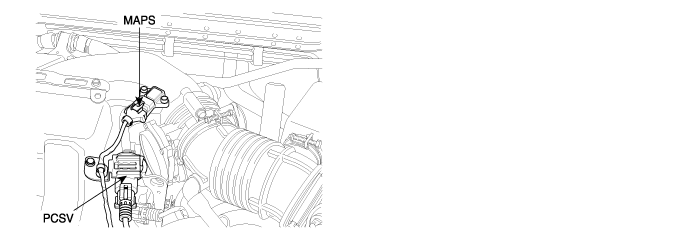
The amount of intake air
flow must be inputted to PCM in order to determine the fuel injection
quantity. To measure the pressure inside of intake manifold, MAFS is used
at idle and MAPS is required at accelerating. MAPS(Manifold Absolute
Pressure) calculates the amount of air indirectly as measuring the
pressure inside of intake manifold. This mechanism is also called
Speed-Density Type.MAPS transfers analog output signal which is
proportional to the change of intake manifold pressure, then, with this
signal and RPM, PCM calculates the amount of intake air flow. MAPS is
mounted on surge tank to measure the pressure inside of intake manifold,
and it consists of a piezo electric element and hybrid IC which amplifies
output signal from the element. A piezo electric element is a sort of a
diaphragm using piezo electric effect. One side of the diaphragm is
surrounded with vacuum chamber while intake pressure is applied to the
other side. Thus, signals are output by the transformation of diagphragm
according to the change of pressure inside of intake
manifold.
If the signal output of
MAP sensor is stuck under enable conditions, PCM determines that a fault
exists and a DTC is stored. MIL(Malfunction Indication Lamp) turns on when
the malfunction lasts till consecutive 2 driving cycle.
Item
|
Detecting
Condition
|
Possible cause
|
DTC
Strategy
|
| •
|
Monitor the MAP sensor's
signal | |
|
Enable
Conditions
|
| •
|
No Disabling Fault
Present |
| •
|
Shutdown time > 20
minutes |
|
Threshold
value
|
| •
|
The difference between the signal at
key-on and the signal at engine start < 0.5
kPa | |
Diagnosis
Time
|
| •
|
For 3 seconds out of 5
seconds | |
MIL On
Condition
|
|
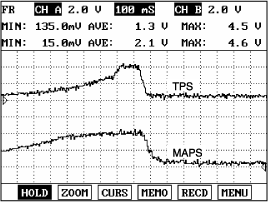
It is necessary that
MAPS should be checked along with TPS. Because The MAP/TPS Rationality
Diagnostic is comprised of two tests. A deceleration test is performed to
provide a robust method for detection of an altitude compensated MAP value
that is too high for the deceleration condition. The second test compares
the altitude compensated MAP value to both high and low limits, dependent
upon throttle position and engine speed. When the MAP value is out of the
threshold range, the MAP/TPS system is determined to be
failed.
Pressure (kPa)
|
20
|
35
|
60
|
95
|
101.32
|
Voltage (V)
|
0.789
|
1.382
|
2.369
|
3.75
|
4
|
Tolerance (V)
|
±
0.045
|
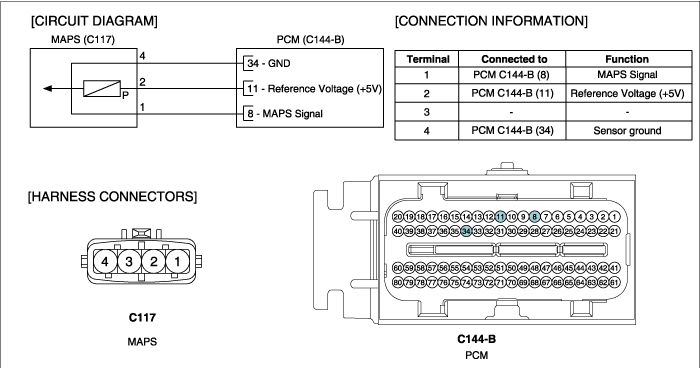
| 1. |
Connect scantool to Data Link
Connector(DLC). |
| 3. |
Select "Diagnostic Trouble Codes(DTCs)" mode,
and then Press F4(DTAL) to check DTC's information from the DTCs
menu |
| 4. |
Read "DTC Status" parameter.
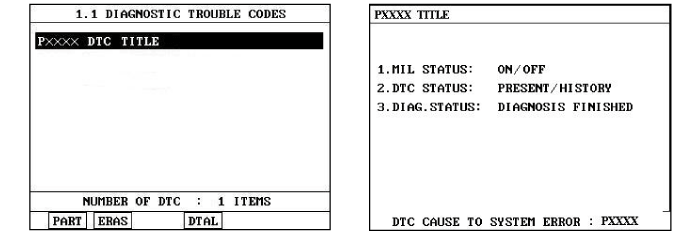
|
| 5. |
Is parameter displayed "Present
fault"?

▶ Go to "Component Inspection"
procedure.

▶ Fault is intermittent caused by PCM memory
was not cleared after repair. Erase DTC and drive the vehicle to
satisfy the enable codition then,go to " Component Inspection"
procedure. |
| 1. |
Check MAPS Performance
| (1) |
IG "OFF" and install
scatool. |
| (2) |
Connect probe to MAPS and TPS to check
signal waveform by using oscilloscope
function. |
| (3) |
ENG "ON" and monitor signal waveform
during accelleration and decelleration.
Specificaton :
Pressure
(kPa)
|
20
|
35
|
60
|
95
|
101.32
|
Voltage
(V)
|
0.789
|
1.382
|
2.369
|
3.75
|
4
|
Tolerance
(V)
|
± 0.045
|
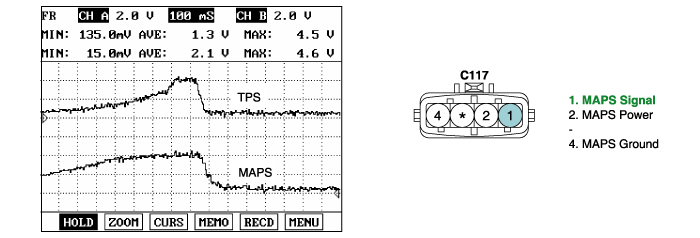
|
| (4) |
Is the measured signal waveform(MAP/TPS
Rationality) O.K ?
▶ Go to "Verification of Vehicle Repair"
procedure.
▶ Substitute with a known - good MAPS
and check for proper operation. If the problem is corrected,
replace MAPS and go to "Verification of Vehicle Repair"
procedure. | |
| VERIFICATION OF VEHICLE
REPAIR |
After a repair, it is
essential to verify that the fault has been corrected.
| 1. |
Connect scan tool and select "Diagnostic
Trouble Codes(DTCs)" mode |
| 2. |
Press F4(DTAL) and confirm that "DTC Readiness
Flag" indicates "Complete". If not, drive the vehicle within
conditions noted in the freeze frame data or enable
conditions |
| 3. |
Read "DTC Status"
parameter |
| 4. |
Is parameter displayed "History(Not Present)
fault"?
▶ System performing to specification at this
time. Clear the DTC
▶ Go to the applicable troubleshooting
procedure. |