| COMPONENT LOCATION |
| GENERAL DESCRIPTION |
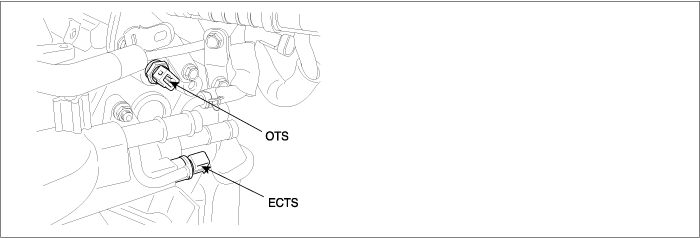
The Engine Coolant
Temperature(ECT) Sensor measures the temperature of engine coolant. The
Engine Coolant Temperature (ECT) Sensor is located near the thermostat
housing of the cylinder head. ECT Sensor is a thermistor (A Variable
Resistor that Changes Along with ECT) in series with a fixed resistor in
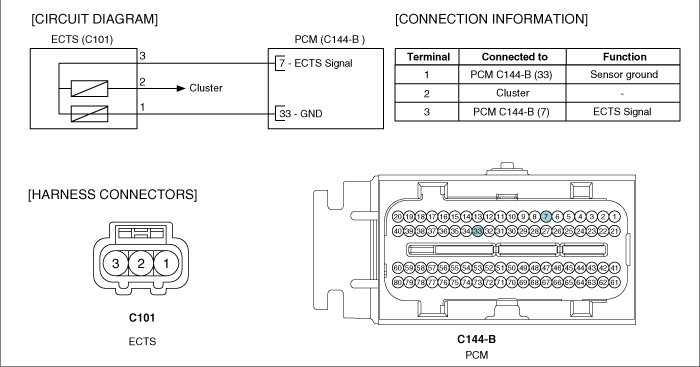
the Engine Control Module (PCM). The PCM applies 5 volts to the ECT
sensor. The PCM monitors the voltage across the ECT sensor and converts it
into a temperature reading. When the engine is cold the ECT sensor
resistance is high, and when the engine is warm the ECT sensor resistance
is low. Therefore, when the engine is cold the PCM will receive a high
voltage input, and when the engine is warm the PCM will receive a low
voltage input. The signal from ECT sensor is used for Injection, ignition
timing, idle speed and cooling fan control.
| DTC DESCRIPTION |
Checking the engine
coolant temperature under detecting condition, if if the difference
between its current temperature and startup temperature is less than
threshold value over predeterminated period, PCM sets P0115.
MIL(Malfunction Indication Lamp) turns on when the malfunction lasts till
consecutive 2 driving cycle.
| DTC DETECTING CONDITION |
| Item |
Detecting
Condition |
Possible cause | ||||||||||
| DTC Strategy |
|
| ||||||||||
| Enable Conditions |
| |||||||||||
| Threshold value |
| |||||||||||
| Diagnosis Time |
| |||||||||||
| MIL On Condition |
| |||||||||||
| SIGNAL WAVEFORM AND DATA |
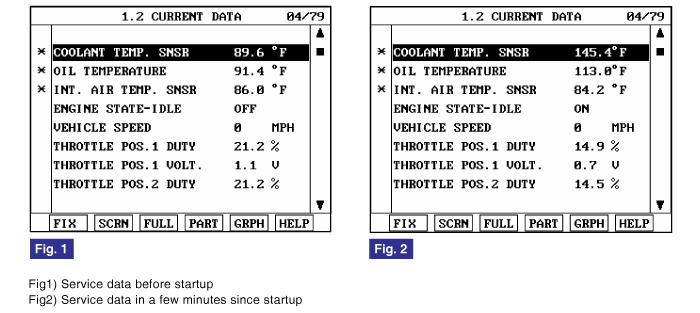
The output signals of
IATS & ECTS change smoothly without any rapid changes. Those have
almost same characteristic signal during the early period after start. It
means that the temperatures of intake air and engine coolant are depended
on the temperature of atmosphere. Meanwhile, during the warming up, the
output signal of ECTS is going up increasingly. but, the output signal of
IATS changes a little bit. even it may not change almost. It means that
the heat of engine does not affect on the temperature of intake
air.
| SPECIFICATION |
| Temp. (°C/°F) |
Resistance (kΩ) |
Temp. (°C/°F) |
Resistance
(kΩ) | ||||
| -40(-40) |
48.14 |
40(104) |
1.15 | ||||
| -20(-4) |
14.13 ~ 16.83 |
60(140) |
0.59 | ||||
| 0(32) |
5.79 |
80(176) |
0.32 | ||||
| 20(68) |
2.31 ~ 2.59 |
|
|
| SCHEMATIC DIAGRAM |
| MONITOR SCANTOOL DATA |
| 1. |
Connect scantool to Data Link
Connector(DLC). |
| 2. |
IG "ON". |
| 3. |
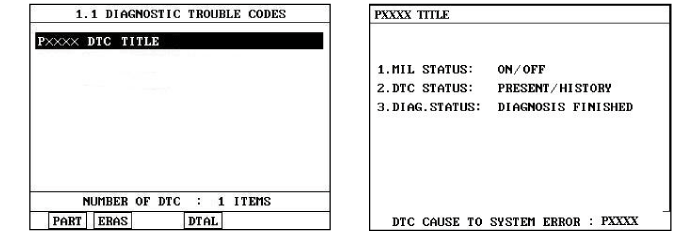
Select "Diagnostic Trouble Codes(DTCs)" mode,
and then Press F4(DTAL) to check DTC's information from the DTCs
menu |
| 4. |
Read "DTC Status" parameter.
|
| 5. |
Is parameter displayed "Present
fault"?
▶ Go to "Component Inspection"
procedure.
▶ Fault is intermittent, go to "Verification
of vehicle Repair" procedure. |


| COMPONENT INSPECTION |
| 1. |
IG "OFF" and disconnect ECTS
connector. |
| 2. |
Remove it. |
| 3. |
Measure resistance between terminals 1 and 3
of ECTS connector as the temperature rises.
Specificaton :
| ||||||||||||||||||||||||||||||||||||||||
| 4. |
Are the measured resistance within
specification?
▶ Clear DTC and Test-drive under enable
conditions above-mentioned. After the test, If this DTC is set,
recheck it thoroughly. If not, it is intermittent fault, go to
"Verification of vehicle Repair" procedure.
▶ Substitute with a known - good ECTS and
check for proper operation. If the problem is corrected, Go to
"Verification of Vehicle
Repair"procedure. |
| VERIFICATION OF VEHICLE REPAIR |
After a repair, it is
essential to verify that the fault has been corrected.
| 1. |
Connect scan tool and select "Diagnostic
Trouble Codes(DTCs)" mode |
| 2. |
Press F4(DTAL) and confirm that "DTC Readiness
Flag" indicates "Complete". If not, drive the vehicle within
conditions noted in the freeze frame data or enable
conditions |
| 3. |
Read "DTC Status"
parameter |
| 4. |
Is parameter displayed "History(Not Present)
fault"?
▶ System performing to specification at this
time. Clear the DTC
▶ Go to the applicable troubleshooting
procedure. |