| GENERAL DESCRIPTION |
When the engine is first
started, the fuel control system operates in an open loop operation,
ignoring the HO2S(Heated Oxygen Sensor) signal and calculating the
air/fuel ratio based on inputs from the engine coolant temperature, the
throttle position and the mass air flow sensors. The PCM will begin by
using the oxygen sensor signal for controlling the fuel delivery(closed
loop) when the following conditions are met:
| - |
The engine has run a minimum amount of time at
engine start up. |
| - |
The HO2S has a varying voltage output showing
that it is hot enough to operate
properly. |
| - |
The ECT has increased a minimum amount based
on the ECT at start up. |
The PCM monitors the
amount of time for the cooling system to achieve closed loop operating
temperature. The engine coolant temperature sufficient to allow closed
loop operation is not achieved within a predetermined time frame, PCM sets
DTC.
| DTC DESCRIPTION |
Checking time and
coolant temperature under detecting condition, if the coolant temperature
dose not reach the target temperature as the test timer reaches the
threshold time, PCM sets P0128. MIL(Malfunction Indication Lamp) turns on
when the malfunction lasts till consecutive 2 driving cycle.
| DTC DETECTING CONDITION |
| Item |
Detecting
Condition |
Possible cause | ||||||||||||
| DTC Strategy |
|
| ||||||||||||
| Enable Conditions |
| |||||||||||||
| Threshold value |
| |||||||||||||
| Diagnosis Time |
| |||||||||||||
| MIL On Condition |
| |||||||||||||
| SIGNAL WAVEFORM AND DATA |
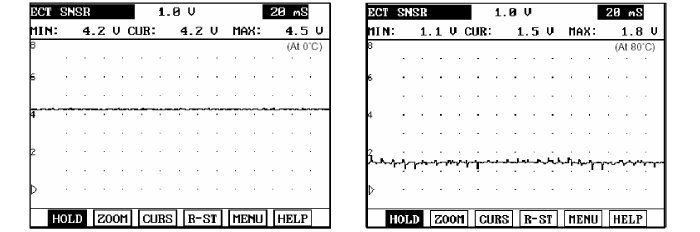
The output signals of
IATS & ECTS change smoothly without any rapid changes. Those have
almost same characteristic signal during the early period after start. It
means that the temperatures of intake air and engine coolant are depended
on the temperature of atmosphere. Meanwhile, during the warming up, the
output signal of ECTS is going up increasingly. but, the output signal of
IATS changes a little bit. even it may not change almost. It means that
the heat of engine does not affect on the temperature of intake
air.
| MONITOR SCANTOOL DATA |
| 1. |
Connect scantool to Data Link
Connector(DLC). |
| 2. |
IG "ON". |
| 3. |
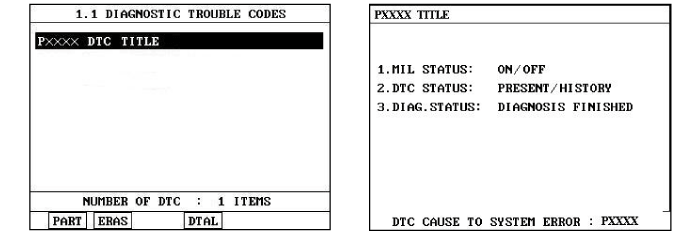
Select "Diagnostic Trouble Codes(DTCs)" mode,
and then Press F4(DTAL) to check DTC's information from the DTCs
menu |
| 4. |
Read "DTC Status" parameter.
|
| 5. |
Is parameter displayed "Present
fault"?
▶ Substitute with a known - good Thermostat
and check for proper operation. If the problem is corrected, Go to
"Verification of Vehicle Repair" procedure.
▶ Fault is intermittent, go to "Verification
of vehicle Repair" procedure. |


| COMPONENT INSPECTION |
| 1. |
Remove the thermostat and check the following
items:
|
| 2. |
Is the thermostat normal?
▶ Clear DTC and Test-drive under enable
conditions above-mentioned. After the test, If this DTC is set,
recheck it thoroughly. If not, it is intermittent fault, go to
"Verification of vehicle Repair" procedure.
▶ Substitute with a known - good Thermostat
and check for proper operation. If the problem is corrected, Go to
"Verification of Vehicle
Repair"procedure. |
| VERIFICATION OF VEHICLE REPAIR |
After a repair, it is
essential to verify that the fault has been corrected.
| 1. |
Connect scan tool and select "Diagnostic
Trouble Codes(DTCs)" mode |
| 2. |
Press F4(DTAL) and confirm that "DTC Readiness
Flag" indicates "Complete". If not, drive the vehicle within
conditions noted in the freeze frame data or enable
conditions |
| 3. |
Read "DTC Status"
parameter |
| 4. |
Is parameter displayed "History(Not Present)
fault"?
▶ System performing to specification at this
time. Clear the DTC
▶ Go to the applicable troubleshooting
procedure. |