| General Description |
The TPMS system is
intended to alert the driver of a motor vehicle if one or more tires on
the vehicle has become under-inflated. The Tire Pressure Monitoring system
comprises three different types of components which are TPMS Receiver
unit, Wheel Electronic (WE) sensor units and Low Frequency Initiator (LFI)
units.
A HIGH-LINE TPMS
Receiver performs the same functions as the LOW-LINE RX, but in addition
is equipped to control four Low Frequency Initiator (LFI) devices, fitted
to the vehicle near each of the four tire locations.
Each vehicle wheel is
fitted with a Wheel Electronic (WE) sensor unit attached to the valve on
the inside of the wheel. The WE measures tire pressure, temperature, and
acceleration periodically. The pressure, temperature, and acceleration
information is converted to digital form within the MCU inside the WE
sensor.
The LFI is located at
each vehicle wheel house(F/L, F/R, R/L, R/R). Only HIGH-LINE systems are
fitted with LFI units. An LFI unit is mounted in each wheel well of a
vehicle to enable the Receiver unit to determine the vehicle position of
each WE for which it has a stored ID code.
| DTC Description |
This DTC indicates that
an unmonitored tire is detected.
| DTC Detecting Condition |
| Item |
Detecting
Condition |
Possible cause | ||||
| DTC
strategy |
|
| ||||
| Enable conditions |
| |||||
| Threshold value |
| |||||
| Diagnosis
time |
|
| Monitor Scantool Data |
| 1. |
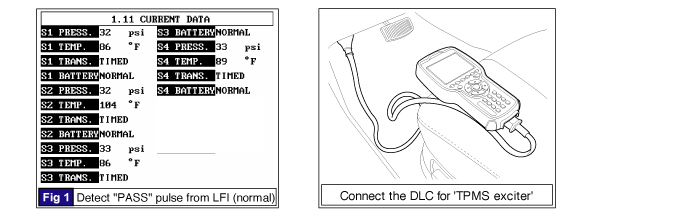
Connect 'TPMS exciter' or scantool to Data
Link Connector(DLC). |
| 2. |
Select "TPMS DIAGNOSIS"
mode. |
| 3. |
Select the "FULL" mode of "TPM DATA VALUES"
function. |
| 4. |
Check current data about S1~S4 on the 'TPMS
exciter' or scantool.
|
| 5. |
Is the current data displayed
normally?
▶ Fault is intermittent. It has been repaired
and TPMS receiver module memory is not cleared yet.
▶ Go to "Verification of vehicle Repair"
procedur.
▶ Replace an unmonitored tire with a WE
sensor-installed tire and register sensor ID with 'TPMS
exciter'.
▶ Go to "Verification of Vehicle Repair"
procedure. |


| Verification of Vehicle Repair |
After a repair, it is
essential to verify that the fault has been corrected.
| 1. |
Connect TPMS exciter or scantool and select
"Diagnostic Trouble Codes(DTCs)"
mode |
| 2. |
Using a TPMS exciter or scantool, Clear
DTC. |
| 3. |
Operate the vehicle within DTC Enable
conditions in General information. |
| 4. |
Are any DTCs present ?
▶ Go to the applicable troubleshooting
procedure.
▶ System performing to specification at this
time. |