| Troubleshooting |
| Symptom |
Possible
cause |
Remedy |
| Hard
steering |
Improper front wheel
alignment Excessive turning resistance of lower arm ball joint Low tire pressure No power assist |
Correct Replace Adjust Repair and replace |
| Poor return of steering
wheel to center |
Improper front wheel
alignment |
Correct |
| Poor or rough
ride |
Improper front wheel
alignment Malfunctioning shock absorber Broken or worn stabilizer Broken or worn coil spring Worn lower arm bushing |
Correct Repair or replace Replace Replace Replace the lower arm assembly |
| Abnormal tire
wear |
Improper front wheel
alignment Improper tire pressure Malfunctioning shock absorber |
Correct Adjust Replace |
| Wandering |
Improper front wheel
alignment Poor turning resistance of lower arm ball joint Loose or worn lower arm bushing |
Correct Repair Retighten or replace |
| Vehicle pulls to one
side |
Improper front wheel
alignment Excessive turning resistance of lower arm ball joint Broken or worn coil spring Bent lower arm |
CorrectReplace Replace Repair |
| Steering wheel
shimmy |
Improper front wheel
alignment Poor turning resistance of lower arm ball joint Broken or worn stabilizer Worn lower arm bushing Malfunctioning shock absorber Broken or worn coil spring |
Correct Replace Replace Replace Replace Replace |
| Bottoming |
Broken or worn coil
spring Malfunctioning shock absorber |
Replace Replace |
Wheel /tire noise,
vibration and harshness concerns are directly related to vehicle speed and
are not generally affected by acceleration, coasting or decelerating.
Also, out-of-balance wheel and tires can vibrate at more than one speed. A
vibration that is affected by the engine rpm, or is eliminated by placing
the transmission in Neutral is not related to the tire and wheel. As a
general rule, tire and wheel vibrations felt in the steering wheel are
related to the front tire and wheel assemblies. Vibrations felt in the
seat or floor are related to the rear tire and wheel assemblies. This can
initially isolate a concern to the front or rear.
Careful attention must
be paid to the tire and wheels. There are several symptoms that can be
caused by damaged or worn tire and wheels. Carry out a careful visual
inspection of the tires and wheel assemblies. Spin the tires slowly and
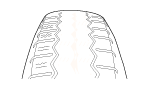
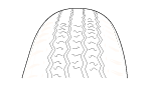
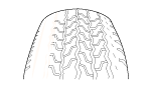
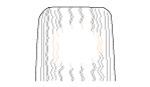
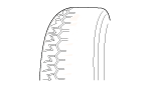
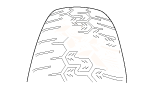
watch for signs of lateral or radial runout. Refer to the tire wear chart
to determine the tire wear conditions and actions
| Wheel And
Tire Diagnosis | ||||||||||||||||||||||||||
| Rapid wear at the center |
Rapid wear at both shoulders |
Wear at one shoulder | ||||||||||||||||||||||||
|
|
|
| ||||||||||||||||||||||||
|
|
| ||||||||||||||||||||||||
| Partial wear |
Feathered edge |
Wear pattern | ||||||||||||||||||||||||
|
|
|
| ||||||||||||||||||||||||
|
|
| ||||||||||||||||||||||||