Sensing seat belt
tension, belt tension sensor sends signals to PODS ECU.
Sensing the intensity
of pressure from pressure sensor and tension from belt tensioner, PODS
ECU decide a passenger as an adult or a child.
DTC B1495 is recorded
when a malfunction is detected in the Belt-Tension Sensor.
Item
|
Detecting
Condition
|
Possible
cause
|
DTC
Strategy
|
| •
|
Belt-Tension Sensor
failure. | |
| •
|
Belt-Tension Sensor
failure. |
|
Enable
Conditions
|
|
Threshold
Value
|
| •
|
Belt-Tension Sensor
failure. | |
Diagnostic
Time
|
Qualification
|
|
De-Qualification
|
|
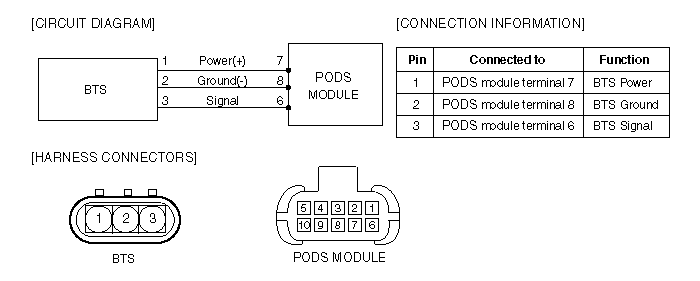
| 1. |
Ignition "OFF", connect
scantool. |
| 2. |
Ignition "ON"& Engine "OFF", select
"Diagnostic Trouble Codes(DTC)"
mode. |
| 3. |
Monitor diagnostic trouble code and present
of trouble code. |
| 4. |
Using a scan tool, clear the
DTC.
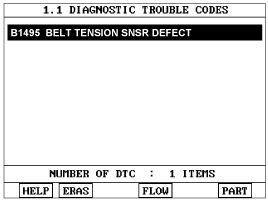
|
- H : Historical fault
- P : Present
fault | |
| 5. |
Is DTC present problem ?
|

|
▶ Go to "W/Harness
Inspection" procedure.
|
|

|
▶ Displaying
nothing(no DTC) or DTC with label "H"(historical) shows that
Fault is intermittent caused by poor contact in the part's
and/or SRSCM connector or was repaired and SRSCM memory was
not cleared.
Thoroughly check
connectors for looseness, poor connection, bending,
corrosion, contamination, deterioration, or
damage.
▶ Repair or replace as
necessary and then go to "Verification of Vehicle Repair"
procedure.
|
|
| Terminal and Connector
Inspection |
| 1. |
Many malfunctions in the electrical system
are caused by poor harness and terminals.
Faults can also be caused by interference
from other electrical systems, and mechanical or chemical
damage. |
| 2. |
Thoroughly check connectors for looseness,
poor connection, bending, corrosion, contamination, deterioration,
or damage. |
| 3. |
Has a problem been found?
|
|
▶ Repair as
necessary and then go to "Verification of Vehicle Repair"
procedure.
|
|
|
▶ Go to "Power
Circuit Inspection" procedure.
|
|
| Power Supply Circuit
Inspection |
| 2. |
Disconnect the battery (-) terminal cable
from the battery and wait at least one
minutes. |
| 3. |
Disconnect Belt tension sensor
connector. |
| 4. |
Ignition "ON" & Engine
"OFF". |
| 5. |
Measure voltage between terminal 1 of the
Belt tension sensor connector and chassis ground.
Specification :
approx. 5V
|
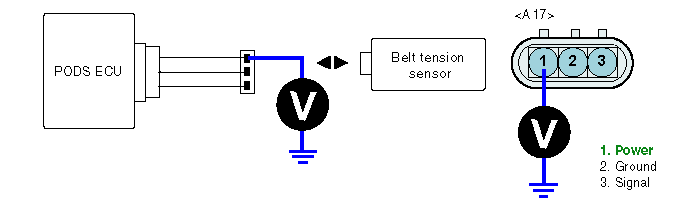
|
| 6. |
Is the measured voltage within
specifications?
|
|
▶ Go to "Ground
Circuit Inspection" procedure.
|
|
|
▶ After reparing
open in power circuit or short circuit of belt tension sensor,
go to "Verification vehicle Repair" procedure
.
▶ Substitute a known-good Belt
tension sensor, and check for proper operation. If the problem
is corrected, replace the Belt tension sensor and then go to
"Verification of Vehicle Repair"
procedure.
|
|
| Ground Circuit
inspection |
| 2. |
Disconnect Belt tension sensor
connector. |
| 3. |
Measure resistance between terminal 2 of
the Belt tension sensor connector and chassis ground.
Specification :
approx. 1Ω below.
|
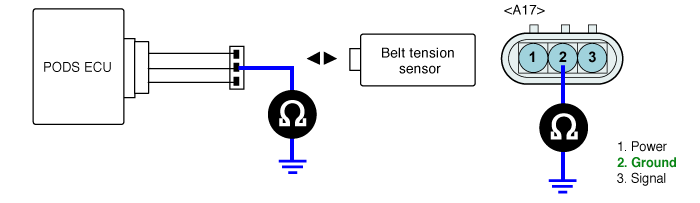
|
| 4. |
Is the measured resistance within
specifications?
|
|
▶ Go to "Signal
Circuit Inspection" procedure.
|
|
|
▶ After reparing
open in ground circuit or short circuit of belt tension
sensor, go to "Verification vehicle Repair" procedure
.
▶ Substitute a known-good Belt
tension sensor, and check for proper operation.
If the problem is corrected,
replace the Belt tension sensor and then go to "Verification
of Vehicle Repair"
procedure.
|
|
| Signal Circuit
Inspection |
| 1. |
Connect Belt tension sensor connector &
PODS ECU. |
| 2. |
Ignition "ON" & Engine
"OFF". |
| 3. |
When mounting seat belt , check belt tension
signals for change for various belt
tension. |
| 4. |
Measure voltage between terminal 3 of the
Belt tension sensor connector and chassis ground.
Specification : approx. 0 ~
5V
|
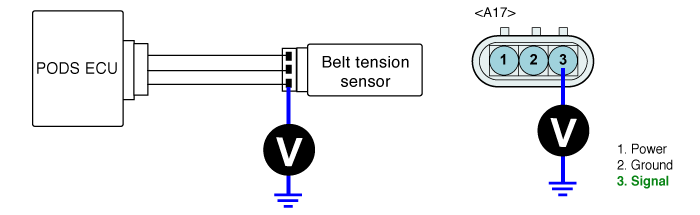
|
| 5. |
Is the measured voltage within
specifications?
|
|
▶ Check Belt
tension sensor for contamination, deterioration, or damage.
Substitute with a known-good Belt tension sensor and check for
proper operation. If the problem is corrected, replace Belt
tension sensor and then go to "Verification of Vehicle Repair"
procedure.
|
|
|
▶ Substitute a
known-good Belt tension sensor, and check for proper
operation.
If the problem is
corrected, replace the Belt tension sensor and then go to
"Verification of Vehicle Repair" procedure.
▶ Substitute a known-good PODS ECU, and check
for proper operation.
If the
problem is corrected, replace the PODS ECU and then go to
"Verification of Vehicle Repair"
procedure.
|
|
| Verification of Vehicle
Repair |
After a repair, it is
essential to verify that the fault has been corrected.
| 1. |
Initialize PODS using scantool when
replacing PODS ECU. |
| 2. |
Connect scan tool and select "Diagnostic
Trouble Codes(DTCs)" mode |
| 3. |
Using a scan tool, clear the DTCs
|
| 4. |
Operate the vehicle within DTC Enable
conditions in General information.
|
| 5. |
Are any DTC present ?
|
|
▶ Go to the
applicable troubleshooting procedure.
|
|
|
▶ System is
performing to specification at this
time.
|
|
