The HECU send
requirement data, such as Torque reduction, the number of fuel cut
cylinders, and TCS control requests, to the Engine ECU & TCU through
CAN bus line.
The Engine ECU
performs fuel cut functions according to requests from the HECU and
retards ignition timing by torque reduction requests.
The TCU maintains
current gear positions during ESC control time, in order not to increase
power which causes a Kickdown shift.
The HECU checks the
CAN communication lines for normal ESC control, and sets this code if
re-initialization is tried for 15 times in sequence without
success.
Item
|
Detecting
Condition
|
Possible
cause
|
DTC Strategy
|
| •
|
Open or short
monitoring | |
| •
|
Open or short circuit in CAN
line | |
Monitoring Period
|
|
Enable Conditions
|
| •
|
A CAN BUS off fault is established if
re-initialization is tried for 15 times in sequence without
success. | |
Fail Safe
|
| •
|
Inhibit the ESC control and allow the
ABS/EBD control.
Meanwhile, stop checking the ESC
switch failure under the ESC
control. | |
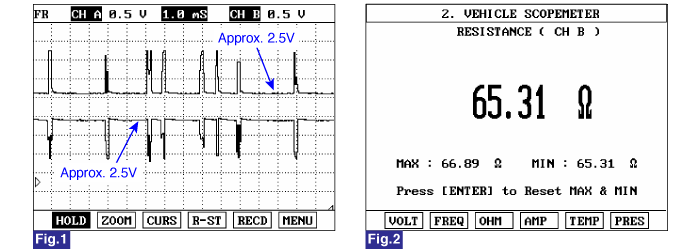
Fig1) Waveform of CAN
communication
Fig2) Resistance
between CAN high and low line with disconnecting HECU
connector.
| Terminal and Connector
Inspection |
| 1. |
Many malfunctions in the electrical system
are caused by poor harness(es) and terminals. Faults can also be
caused by interference from other electrical systems, and mechanical
or chemical damage. |
| 2. |
Thoroughly check connectors for looseness,
poor connection, bending, corrosion, contamination, deterioration,
or damage. |
| 3. |
Has a problem been found?
|

|
▶ Repair as
necessary and then go to "Verification of Vehicle Repair"
procedure.
|
|

|
▶ Go to "Signal
Circuit Inspection"
procedure.
|
|
| Signal Circuit
Inspection |
| 2. |
Disconnet the HECU harness
connector. |
| 3. |
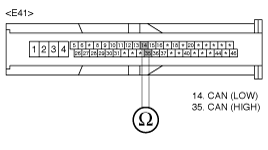
Measure resistance between terminal "14" of
the HECU harness connector and terminal "35" of the HECU harness
connector.
Specification :
Approx. 60Ω
|
|
| 4. |
Is the measured resistance within
specifications?
|
|
▶ Fault is
intermittent caused by open or short in CAN signal harness or
was repaired and HECU memory was not cleared. go to "CAN Bus
Short (to ground) Inspection" procedure.
|
|
|
▶ Check for open or
short in CAN signal harness between terminal "14" of the HECU
harness connector and terminal "35" of the HECU harness
connector. Repair as necessary and then go to "Verification of
vehicle Repair"
procedure.
|
|
| CAN Bus Short (to ground)
Inspection |
| 2. |
Disconnet the HECU harness
connector. |
| 3. |
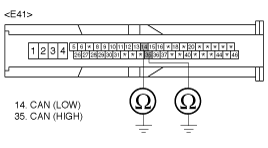
Measure resistance between terminal "14,35"
of the HECU harness connector and chassis ground.
Specification : Approx.
∞ Ω
|
|
| 4. |
Is the measured resistance within
specifications?
|
|
▶ Go to "CAN Bus
Short (between HIGH and LOW) Inspection"
procedure.
|
|
|
▶ Check for short
to ground in CAN HIGH signal harness in case of abnormal
resistance measured between terminal "35" of the HECU harness
connector and chassis ground. Repair as necessary and then go
to "Verification of vehicle Repair" procedure.
▶ Check for short to ground in CAN LOW signal
harness in case of abnormal resistance measured between
terminal "14" of the HECU harness connector and chassis
ground. Repair as necessary and then go to "Verification of
vehicle Repair"
procedure.
|
|
| CAN Bus Short (between HIGH and LOW)
Inspection |
| 2. |
Disconnet all the connetor related to CAN
such as HECU, PCU, EPS, ECS harness
connector. |
| 3. |
Measure resistance between terminal "14,35"
of the HECU harness.
Specification : Approx.
120 Ω
|
|
| 4. |
Is the measured resistance within
specifications?
|
|
▶ Go to
"Verification of vehicle Repair" procedure.
|
|
|
▶ Check for short
in CAN signal harness between terminal "14" of the HECU
harness connector and terminal "35" of the HECU harness
connector. Repair as necessary and then go to "Verification
of vehicle Repair"
procedure.
|
|
| Verification of Vehicle
Repair |
After a repair, it is
essential to verify that the fault has been corrected.
| 1. |
Connect scantool and select "Diagnostic
Trouble Codes(DTCs)" mode |
| 2. |
Using a scantool, Clear
DTC. |
| 3. |
Operate the vehicle within DTC Detecting
Condition in General Information. |
| 4. |
Are any DTCs present ?
|
|
▶ Go to the
applicable troubleshooting procedure.
|
|
|
▶ System performing
to specification at this
time.
|
|