The PCM uses dual
oxygen sensors to monitor the efficiency of the manifold catalytic
converter (warm-up catalytic converter). By monitoring the oxygen storage
capacity of a catalyst, its efficiency can be indirectly calculated. The
upstream (front) HO2S is used to detect the amount of oxygen in the
exhaust gas before it enters the catalytic converter. A low voltage
indicates high oxygen contents (lean air mixture). A high voltage
indicates low oxygen contents (rich air mixture). When the catalyst
efficiency drops, no chemical reaction takes place. This means the
concentration of oxygen will be the same at the rear as it is at the
front.
If the oxygen storage
time for Bank2 is lower than threshold , the PCM determines that a fault
exists and a DTC is stored. MIL(Malfunction Indication Lamp) turns
on.
Item
|
Detecting Condition
|
Possible
cause
|
DTC
Strategy
|
| •
|
Manipulates Airfuel and stores the
times it takes for the pre and post converter oxygen sensors
to switch. | |
|
Enable
condition
|
| •
|
Engine Runtime ≥ 580
sec. |
| •
|
Purge Concentration
Learned |
| •
|
3 g/s ≤ Airflow ≤ 10
g/s |
| •
|
Throttle closed ≤
1.5%. |
| •
|
70°C(158 °F) ≤ Coolant Temp. ≤
120°C(248 °F) |
| •
|
-7°C(19.4 °F) ≤ Ambient Temp. ≤
105°C(221 °F) |
| •
|
Max number of test attempts ≤
12 |
| •
|
250°C( 482 °F) ≤ Catalyst Temp. ≤
950°C(1742 °F) |
| •
|
Fuel learning
completed |
| •
|
Vehicle speed ≤ 3 kph(1.8
mph) |
| •
|
Max idle time( about 60 sec.) not
exceeded |
| •
|
No disabling faults
present |
| •
|
No instrumentation slews
active | |
Threshold
Value
|
| •
|
Oxygen Storage Time < 3.25
sec. | |
Dagnosis
Tme
|
|
MIL On
Condition
|
|
| 1. |
Connect scantool to Data Link
Connector(DLC). |
| 3. |
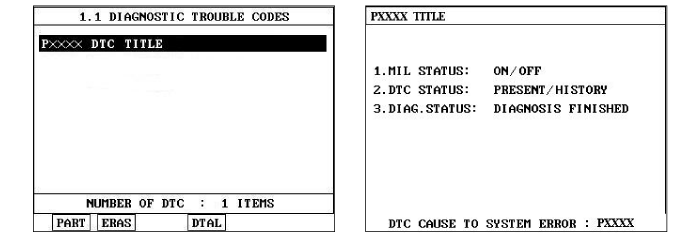
Select "Diagnostic Trouble Codes(DTCs)"
mode, and then Press F4(DTAL) to check DTC’s information from the
DTCs menu |
| 4. |
Read "DTC Status" parameter.
|
| 5. |
Is parameter displayed "Present
fault"?
|

|
▶ Substitute with a
known - good Catalyst Converter and check for proper
operation. If the problem is corrected, Go to "Verification of
Vehicle Repair" procedure.
|
|

|
▶ Go to "Component
Inspection"
procedure.
|
|
| 1. |
Monitor the Catalyst Converter
| (2) |
Start the engine and warm it up until
the radiator fan comes on( more than at least 10
minutes). |
| (3) |
Drive at a steady speed between 45-55
mph(72-88 km/h) for 30
seconds. |
| (4) |
Stop and then maintain idle state for
120 seconds in D-position. |
| (5) |
Repeat step 3 once
again. |
| (6) |
Stop and then keep it in idle state(
D-positon) for 120 seconds. |
| (7) |
Repeat step 3 once
again. |
| (8) |
Stop and then maintain idle state for
120 seconds in D-position. |
| (10) |
Repeat steps 3 through 9 three
times. |
| (11) |
Check if catalyst monitoring readiness
is complete. so, if the readiness is incomplete, repeat steps
2 through 10. |
| (12) |
Does the scan tool show DTC
P0430?
|
|
▶ Substitute
with a known - good Catalyst Converter and check the
signal waveform of HO2S for proper operation. If the
problem is corrected, Go to "Verification of Vehicle
Repair" procedure.
|
|
|
▶ It was
intermittent
failure.
|
| |
| Verification of Vehicle
Repair |
After a repair, it is
essential to verify that the fault has been corrected.
| 1. |
Connect scan tool and select "Diagnostic
Trouble Codes(DTCs)" mode |
| 2. |
Press F4(DTAL) and confirm that "DTC
Readiness Flag" indicates "Complete". If not, drive the vehicle
within conditions noted in the freeze frame data or enable
conditions |
| 3. |
Read "DTC Status"
parameter |
| 4. |
Is parameter displayed "History(Not Present)
fault"?
|
|
▶ System performing
to specification at this time. Clear the DTC
|
|
|
▶ Go to the
applicable troubleshooting
procedure
|
|