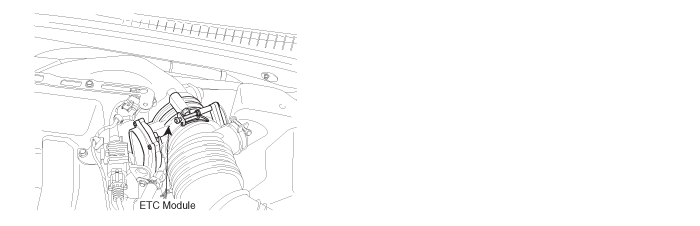
The Electronic
Throttle Control(ETC) system is made of the components throttle body,
Throttle Position Sensor(TPS)1&2 and Accelerator Position Sensor(APS)
1&2. The throttle body contains the actuator, the throttle plate and
the throttle position sensor (potentiometer), which are integrated in one
housing. The actuator consists of a DC motor with a two-stage gear. The
opening angle of the throttle valve is detected by the throttle position
sensor which is mounted on the throttle body. And it provides feedback to
the PCM to control the throttle motor in order to control the throttle
valve opening angle properly in response to the driving
condition.
Checking throttle
valve return state, under detecting condition, if an output signal is
within the threshold value for more than designated time, PCM sets
P1523.
Item
|
Detecting
Condition
|
Possible
Cause
|
DTC
Strategy
|
| •
|
Monitor throttle valve return
state | |
| •
|
Broken Throttle return
spring |
|
Enable
Conditions
|
| •
|
Sensor Supply voltage =
Normal | |
Threshold
value
|
| •
|
The throttle did not return to default
range within 1 to 4 seconds of turning off. That is, (TPS1’s
signal > 0.9V AND TPS1’s signal < 1.85V) or (TPS2’s
signal < 1.85V AND TPS2’s signal > 0.9V) when the power
to the ETC motor is turned
off. | |
Diagnosis
Time
|
|
MIL On
Condition
|
|
Throttle
opening ( ° )
|
Output
voltage(V) [Vref=5.0]
|
Throttle
opening ( ° )
|
Output
voltage(V) [Vref=5.0]
|
TPS1
|
TPS2
|
TPS1
|
TPS2
|
0°
|
0.0V
|
5.0V
|
60°
|
2.7V
|
2.3V
|
10°
|
0.5V
|
4.5V
|
70°
|
3.2V
|
1.8V
|
20°
|
0.9V
|
4.1V
|
80°
|
3.6V
|
1.4V
|
30°
|
1.4V
|
3.6V
|
90°
|
4.1V
|
0.9V
|
40°
|
1.8V
|
3.2V
|
100°
|
4.5V
|
0.5V
|
50°
|
2.3V
|
2.7V
|
110°
|
5.0V
|
0.0V
|
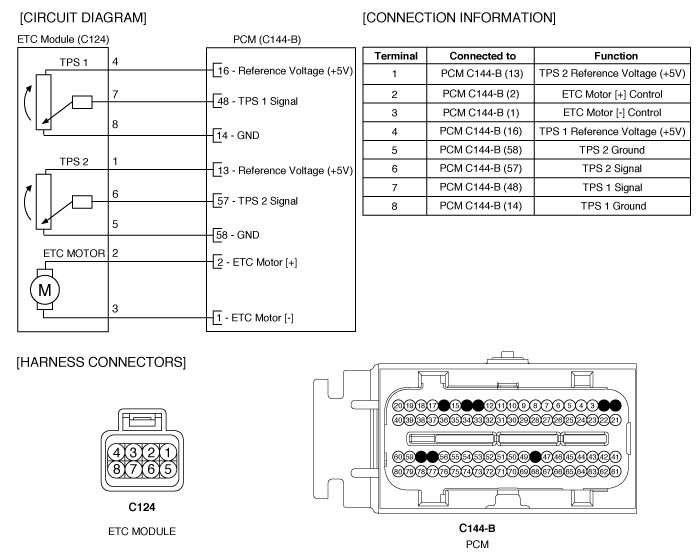
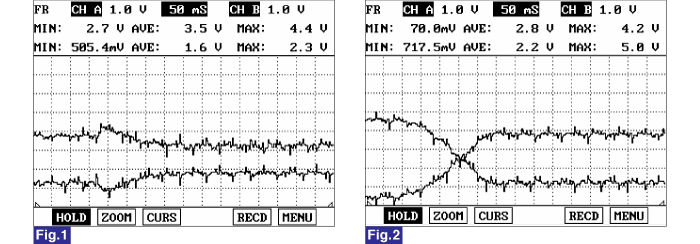
Fig 1) When stepping
on accelleration pedal.
Fig 2) When pulling
out accelleration cable with hand.
| 1. |
Connect scantool to Data Link
Connector(DLC). |
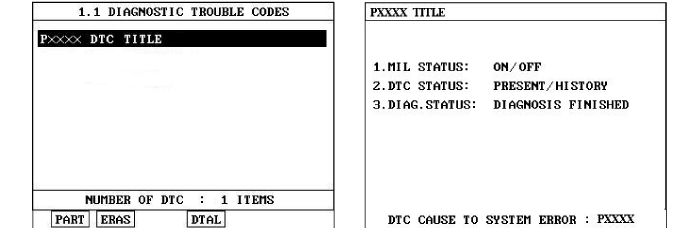
| 3. |
Select "Diagnostic Trouble Codes(DTCs)"
mode, and then Press F4(DTAL) to check DTC’s information from the
DTCs menu |
| 4. |
Read "DTC Status" parameter.
|
| 5. |
Is parameter displayed "Present
fault"?
|

|
▶ Go to "Terminal
and Connector inspection" procedure.
|
|

|
▶ Fault is
intermittent caused by poor contact in the sensor’s and/or
PCM’s connector or was repaired and PCM memory was not
cleared. Thoroughly check connectors for looseness, poor
connection, ending, corrosion, contamination, deterioration,
or damage. Repair or replace as necessary and go to
"Verification of Vehicle Repair"
procedure.
|
|
| 1. |
Visual Inspection
| (2) |
Check throttle valve after removing
air duct.
- Carbon deposit.
- Throttle icy
- Broken return spring.
- Throttle
sticky |
| (3) |
Is the throttle valve return O.K
?
|
|
▶ Substitute
with a known-good PCM and check for proper operation. If
the problem is corrected,replace PCM and then go to
"Verification of Vehicle Repair" procedure.
|
There is a memory reset
function on scantool that can erase optional parts
automaticallydetected and memorized by
PCM.
Before or after testing
PCM on the vehicle, use this function to reuse the
PCM on the
others. | |
|
|
▶ Repair or
replace as necessary and then, do ETS Initialization" as
follows. then, go to "Verification of Vehicle Repair"
procedure.
|
|
※ Procedure of ETS
Initialization
| 1. |
Erase the trouble codes on
PCM |
| 2. |
Turn the ignition key off
and keep this condition until the main relay is
turned off.(It will takes
10sec.) |
| 3. |
Turn ignition key on more
than 1second to record the throttle motor position
on the
EEPROM | | | |
| Verification of Vehicle
Repair |
After a repair, it is
essential to verify that the fault has been corrected.
| 1. |
Connect scan tool and select "Diagnostic
Trouble Codes(DTCs)" mode |
| 2. |
Press F4(DTAL) and confirm that "DTC
Readiness Flag" indicates "Complete". If not, drive the vehicle
within conditions noted in the freeze frame data or enable
conditions |
| 3. |
Read "DTC Status"
parameter |
| 4. |
Is parameter displayed "History(Not Present)
fault"?
|
|
▶ System performing
to specification at this time. Clear the DTC
|
|
|
▶ Go to the
applicable troubleshooting
procedure.
|
|
