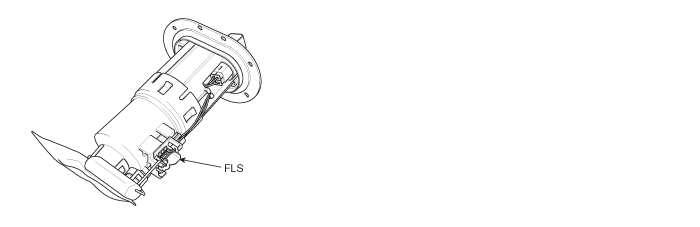
The Fuel Level
Sensor(FLS) measures the fuel level in fuel tank and its information is
used to supply the PCM with information regarding the monitoring condition
of the EVAP canister purge system for leak detection. If the fuel level
sensor is monitored for high or low stuck or difference between voltage of
fuel level sensor and voltage deviation of fuel level sensor is exceeds
limited value while driving, this is interpreted by the PCM as a
fault.
Checking fuel level
change under detecting condition, if the fuel level difference between
current and previous is lower than 10% while odometer difference between
present and previous is higher than 170km, PCM sets P2066. MIL(Malfunction
Indication Lamp) turns on when the malfunction lasts till consecutive 2
driving cycle.
Item
|
Detecting
Condition
|
Possible
Cause
|
DTC
Strategy
|
| •
|
Detects a stuck fuel level
sender | |
| •
|
Faulty Fuel Level sender
A | |
Enable
Conditions
|
| •
|
Fuel Level Fault Not
Present |
|
Threshold
value
|
| •
|
Current fuel level sender’s signal -
Previous fuel level sender’s signal ≤ 10%(After Present
Odometer - Previous Odometer ≥ 170 km(105.6
mile)) | |
Diagnosis
Time
|
|
MIL On
Condition
|
|
FLS
|
Normal
Parameter
|
Float position
|
8/8
|
7/8
|
6/8
|
2/8
|
Warning Lamp ON
|
Sender A-Resistance(Ω)
|
4
|
4
|
4
|
67
|
69.6
|
Sender B-Resistance(Ω)
|
4
|
32
|
53
|
74
|
113.4
|
Fuel volume(ℓ)
|
75
|
63
|
55
|
24.5
|
9.5
|
| 1. |
Connect scantool to Data Link
Connector(DLC). |
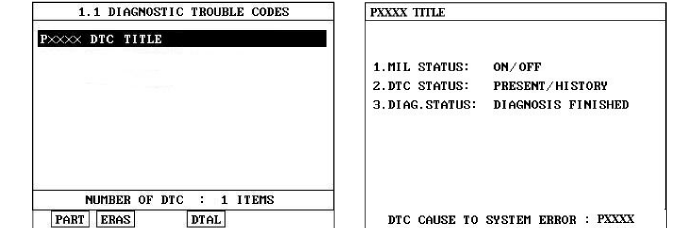
| 3. |
Select "Diagnostic Trouble Codes(DTCs)"
mode, and then Press F4(DTAL) to check DTC’s information from the
DTCs menu |
| 4. |
Read "DTC Status" parameter.
|
| 5. |
Is parameter displayed "Present
fault"?
|

|
▶ Go to "Terminal
and Connector inspection" procedure.
|
|

|
▶ Fault is
intermittent caused by poor contact in the sensor’s and/or
PCM’s connector or was repaired and PCM memory was not
cleared. Thoroughly check connectors for looseness, poor
connection, ending, corrosion, contamination, deterioration,
or damage. Repair or replace as necessary and go to
"Verification of Vehicle Repair"
procedure.
|
|
| Terminal and Connector
Inspection |
| 1. |
Many malfunctions in the electrical system
are caused by poor harness and terminals. Faults can also be caused
by interference from other electrical systems, and mechanical or
chemical damage. |
| 2. |
Thoroughly check connectors for looseness,
poor connection, bending, corrosion, contamination, deterioration,
or damage. |
| 3. |
Has a problem been found?
|
|
▶ Repair as
necessary and go to "Verification of Vehicle Repair"
procedure.
|
|
|
▶ Go to "Component
Inspection"
procedure.
|
|
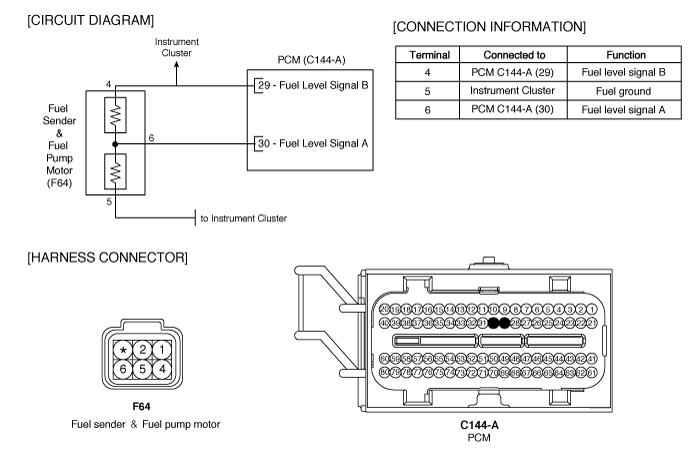
| 2. |
Remove Fuel Sender & Fuel pump motor
from fuel tank. |
| 3. |
Measure reistance between terminal 5 and 6
of Fuel Sender & Fuel pump motor.(Component Side)
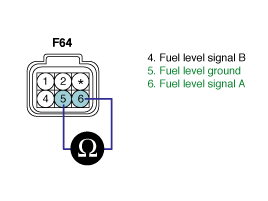
|
| 4. |
Does the resistance of FLS change as lifting
up and down the fuel level float?
|
|
▶ Fault is
intermittent such as Float was stuck by something. Thoroughly
check that any foreign material intrupts float moment. Erase
DTC and drive the vehicle to satisfy the enable codition then,
go to "Verification of Vehicle Repair "
procedure.
|
|
|
▶ Substitute with a
known - good Fuel Level Sender and check for proper
operation.
If the problem is
corrected, replace Fuel Level Sender and go to "Verification
of Vehicle Repair"
procedure.
|
|
| Verification of Vehicle
Repair |
| 1. |
Connect scan tool and select "Diagnostic
Trouble Codes(DTCs)" mode |
| 2. |
Press F4(DTAL) and confirm that "DTC
Readiness Flag" indicates "Complete". If not, drive the vehicle
within conditions noted in the freeze frame data or enable
conditions |
| 3. |
Read "DTC Status"
parameter |
| 4. |
Is parameter displayed "History(Not Present)
fault"?
|
|
▶ System performing
to specification at this time. Clear the DTC
|
|
|
▶ Go to the
applicable troubleshooting
procedure.
|
|