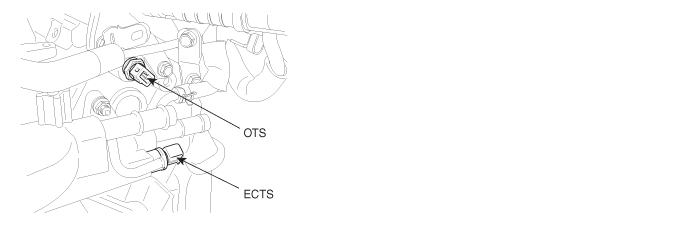
The fluid of the CVVT
is the engine oil and its density changes according to the engine oil
temperature. At this time the Oil Temperature Sensor (OTS) helps
compensation against the temperature differences. The Oil Temperature
Sensor measures the engine oil temperature before the engine oil comes
into the Oil-flow Control Valve (OCV).
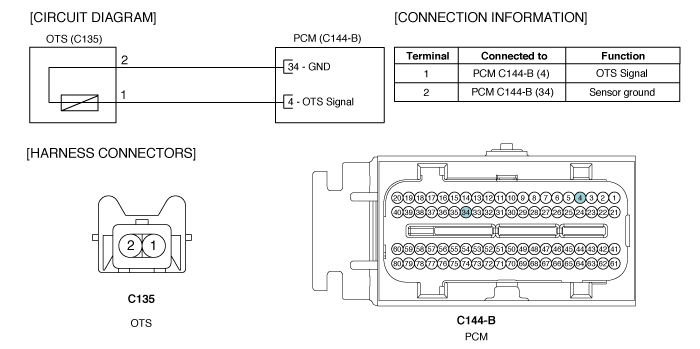
According to the
measured temperature, the Engine Control Module (PCM) compensates the
oil-flow control valve operation time.
Checking the oil
temperture , coolant temperature and intake air temperature every 25 sec.
under detecting condition, if the difference in temperature at start-up
exceeds threshold value, PCM sets P0196. MIL(Malfunction Indication Lamp)
turns on when the malfunction lasts till consecutive 2 driving
cycle.
Item
|
Detecting condition
|
Possible cause
|
DTC
Strategy
|
| •
|
Determines if the oil temperature
value is rational, compared to coolant and intake air
temperature. | |
|
Enable
Condition
|
Case 1
|
| •
|
Engine run time after startup < 30
sec |
| •
|
Soak period required > 300
min | |
Case 2
|
| •
|
Minimum engine run time > 800 sec
| |
Threshold
value
|
Case 1
|
| •
|
The difference in temperature between
oil and coolant temperatures at startup. >
35°C(63°F) | |
Case 2
|
| •
|
The difference in temperature between
oil temperature and intake air temperature at startup >
35°C(63°F) | |
Diagnosis
time
|
| •
|
Continous (More than 800
sec.) | |
MIL ON
Condition
|
|
Temperature(°C/°F)
|
Resistance(kΩ)
|
-20°C/ -4°F
|
16.52kΩ
|
20°C/ 68°F
|
2.45kΩ
|
80°C/ 176°F
|
0.29kΩ
|
| 1. |
Connect scantool to Data Link
Connector(DLC). |
| 3. |
Select "Diagnostic Trouble Codes(DTCs)"
mode, and then Press F4(DTAL) to check DTC’s information from the
DTCs menu |
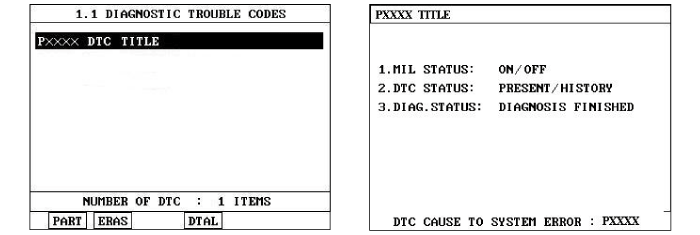
| 4. |
Read "DTC Status" parameter.
|
| 5. |
Is parameter displayed "Present
fault"? |
|

|
▶ Go to "Component
Inspection" procedure.
|
|

|
▶ Fault is intermittent
caused by PCM memory was not cleared after repair. Erase DTC and
drive the vehicle to satisfy the enable codition then, go to "
Component Inspection" procedure.
|
| 1. |
Check resistance of OTS
| (2) |
Monitor Oil Temperature parameter on
the scantool |
| (4) |
Disconnect OTS
connector. |
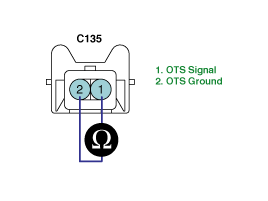
| (5) |
Measure resistance between terminal 1
and 2 of OTS connector after checking out the oil temperature
with scantool
Specification
Temperature(°C/°F)
|
Resistance(kΩ)
|
-20°C/
-4°F
|
16.52kΩ
|
20°C/
68°F
|
2.45kΩ
|
80°C/
176°F
|
0.29kΩ
|
|
| (6) |
Is the measured resistance within
specification ? |
|
|
▶ Go to
"Verification of Vehicle Repair" procedure.
|
|
|
▶ Substitute with a
known - good OTS and check for proper operation. If the
problem is corrected, replace OTS and go to "Verification of
Vehicle Repair"
procedure.
|
|
| Verification of Vehicle
Repair |
After a repair, it is
essential to verify that the fault has been corrected.
| 1. |
Connect scan tool and select "Diagnostic
Trouble Codes(DTCs)" mode |
| 2. |
Press F4(DTAL) and confirm that "DTC
Readiness Flag" indicates "Complete". If not, drive the vehicle
within conditions noted in the freeze frame data or enable
conditions |
| 3. |
Read "DTC Status"
parameter |
| 4. |
Is parameter displayed "History(Not Present)
fault"? |
|
|
▶ System performing to
specification at this time. Clear the DTC
|
|
|
▶ Go to the applicable
troubleshooting procedure.
|