| Component Location |

| General Description |
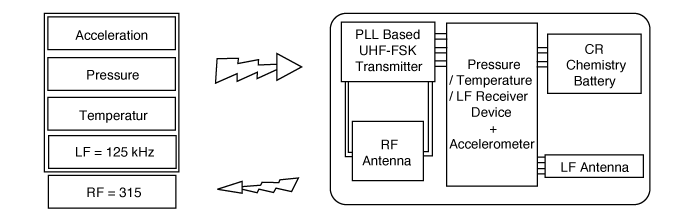
[Wheel Electronic (WE)
sensor unit] - TPMS sensor
Each vehicle wheel is
fitted with a Wheel Electronic (WE) sensor unit attached to the valve on
the inside of the wheel.
The WE unit is powered
with a self-contained battery utilizing a high temperature rated CR
(Manganese Dioxide Lithium) chemistry. The operating voltage range for the
WE module is 2.2Vdc to 3.6Vdc, and the operating temperature range is
-40°F to 257°F(-40°C ~125°C).
The WE measures tire
pressure, temperature, and acceleration periodically. The pressure,
temperature, and acceleration information is converted to digital form
within the MCU inside the WE sensor.
The WE sensor is
equipped with a Radio Frequency (RF) transmitter circuit which is used to
periodically broadcast information from inside the tire.
All WE sensor units
operate on the same RF channel frequency, and each broadcast message
includes pressure and temperature data, a unique ID code, operating state
data, status information, and digital error-detection data.
The pressure measured by
the WE sensor is an absolute pressure value. The pressure measurement
range is 100kPa to 450kPa.
The acceleration data is
used within the WE sensor to determine whether the vehicle is moving or
stationary. The acceleration status is the decision maker within the WE
module that determines if the tire is moving or stationary.
This measurement is used
within the WE module to enable different operating modes depending on the
status of the acceleration value.
Over the fully specified
operating temperature range, if the acceleration measurement is greater
than or equal to 20G, the WE module assumes the tire is
moving.
The basic operation of
the L/L WE sensor is to transmit 3 frames every 3 minutes in both
stationary and rolling modes.
| DTC Description |
This DTC indicates that
the sensor has either failed to learn or has successfully learned and the
receiver did not receive messages from the learned sensor for 9
minutes.
| DTC Detecting Condition |
| Item |
Detecting
Condition |
Possible cause | ||||||
| DTC
strategy |
|
| ||||||
| Enable
conditions |
| |||||||
| Threshold
value |
| |||||||
| Diagnosis
time |
|
| Monitor Scantool Data |
| 1. |
Connect ‘TPMS exciter’ or scantool to Data
Link Connector(DLC). |
| 2. |
Select "TPMS DIAGNOSIS"
mode. |
| 3. |
Select the "FULL" mode of "TPM DATA VALUES"
function. |
| 4. |
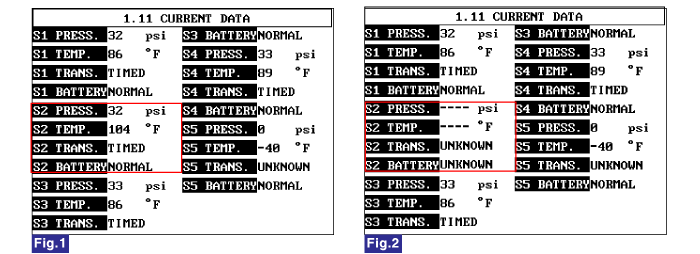
Monitor the parameters of ‘Front Right WE
sensor(S2)’ on the ‘TPMS exciter’ or scantool.
Fig 1) Sensor current data
(normal)
Fig 2) Sensor current data
(failure)
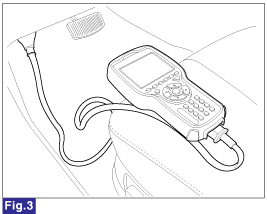
Fig 3) Connect the DLC for 'TPMS
exciter' |
| 5. |
Is parameter normal?
|


| Verification of Vehicle Repair |
After a repair, it is
essential to verify that the fault has been corrected.
| 1. |
Connect TPMS exciter or scantool and select
"Diagnostic Trouble Code(DTC)" mode |
| 2. |
Using a TPMS exciter or scantool, Clear
DTC. |
| 3. |
Operate the vehicle within DTC Enable
conditions in General information. |
| 4. |
Are any DTC present ?
|