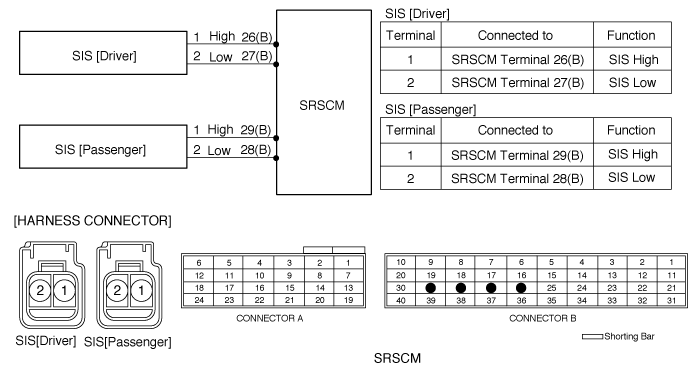
Side Impact Sensor(SIS)
is located in both side of center pillar detects broad collision. When SIS
delivers collision signal to SRSCM, SRSCM checks if safing sensor located
in SRSCM detects collusion. and if both SIS and safing sensor detects
collision simultaneously, SRSCM operates side air bag.
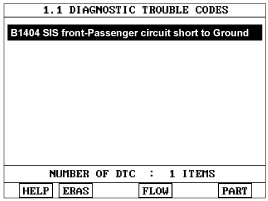
The SRSCM sets DTC B1404
if there is a short to ground in PSIS harness.
Item
|
Detecting
Condition
|
Possible cause
|
DTC
Strategy
|
| •
|
Check current(PWM
type) | |
| •
|
Short to ground in PSIS
harness. |
|
Enable Conditions
|
|
Threshold Value
|
|
Diagnostic Time
|
Qualification
|
|
De-Qualification
|
|
Test Condition
|
Resistance
|
Ignition
OFF
|
Rs
>1kΩ
|
| 1. |
Ignition "OFF", connect
scantool. |
| 2. |
Ignition "ON"& Engine "OFF", select
"Diagnostic Trouble Codes(DTC)"
mode. |
| 3. |
Monitor diagnostic trouble code and present of
trouble code. |
| 4. |
Using a scan tool, clear the DTC.
|
- H : Historical fault
- P : Present
fault | |
| 5. |
Is DTC present problem ?
|

|
▶ Go to
"W/Harness Inspection" procedure.
|
|

|
▶
Displaying nothing(no DTC) or DTC with label "H"(historical)
shows that Fault is intermittent caused by poor contact in the
part's and/or SRSCM connector or was repaired and SRSCM memory
was not cleared.
Thoroughly check
connectors for looseness, poor connection, bending, corrosion,
contamination, deterioration, or damage.
▶ Repair or replace as necessary and then go to
"Verification of Vehicle Repair"
procedure.
|
|
| Terminal and Connector
Inspection |
| 1. |
Many malfunctions in the electrical system are
caused by poor harness and terminals.
Faults can also be caused by interference from
other electrical systems, and mechanical or chemical
damage. |
| 2. |
Thoroughly check connectors for looseness,
poor connection, bending, corrosion, contamination, deterioration,
or damage. |
| 3. |
Has a problem been found?
|
|
▶ Repair as
necessary and then go to "Verification of Vehicle Repair"
procedure.
|
|
|
▶ Go to
"Main harness circuit inspection"
procedure.
|
|
| Main harness Circuit
Inspection |
| 2. |
Disconnect the battery (-) terminal cable from
the battery, and wait at least one minutes.
|
| 3. |
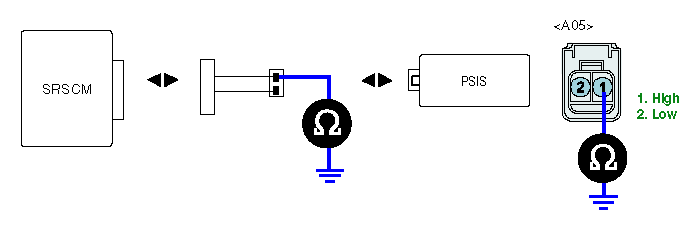
Disconnect PSIS connector and SRSCM main
harness connector. |
| 4. |
Measure resistance between terminal "1" or "2"
of the PSIS harness connector and chassis ground.
|
| 5. |
Is the measured resistance within
specifications?
|
|
▶ Go to
"Component Inspection" procedure.
|
|
|
▶
Substitute the SRSCM main harness and check for proper
operation.
If the problem is
corrected, replace SRSCM main harness and then go to
"Verification of Vehicle Repair"
procedure.
|
|
| 1. |
Ignition "ON" & Engine "OFF" and Using a
scan tool, clear the DTC. |
| 3. |
Disconnect the battery (-) terminal cable from
the battery, and wait at least one
minutes. |
| 4. |
Disconnect PSIS connector
. |
| 5. |
Substitute the PSIS and check for proper
operation. |
| 6. |
Is DTC present problem ?
|
|
▶
Substitute a known-good SRSCM, and check for proper operation.
If the problem is corrected,
replace SRSCM and then go to "Verification of Vehicle Repair"
procedure.
|
|
|
▶
Substitute a known-good PSIS, and check for proper operation.
If the problem is corrected,
replace PSIS and then go to "Verification of Vehicle Repair"
procedure.
|
|
| Verification of Vehicle
Repair |
After a repair, it is
essential to verify that the fault has been corrected.
| 1. |
Connect scan tool and select "Diagnostic
Trouble Codes(DTC)" mode |
| 2. |
Using a scan tool, clear the
DTC. |
| 3. |
Operate the vehicle within DTC Enable
conditions in General information. |
| 4. |
Are any DTC present ?
|
|
▶ Go to the
applicable troubleshooting procedure.
|
|
|
▶ System is
performing to specification at this
time.
|
|
