The Steering angle
sensor(SAS) is joined to the multi function switch and using a CAN
communication.
The SAS is composed of
main gear, serve gear1 and serve gear2 to determine the turning
direction.
If main gear is rotated
according to the rotation of steering wheel serve gear1 and serve gear2,
which is contact with main gear, will be rotated.
The HECU detects the
absolute angle by using magnetic MR effect and the difference gear ratio
of each serve gear and then send to the CAN comunication
line.
The HECU detects the
steering wheel’s operating speed and operating angle by using absolute
angle, and this signal is used as a input signal of anti-roll
control.
The SAS used for ESC
control needs zero point adjustment because the SAS measures a absolute
angle.
Zero point adjustment is
done by using the scantool device. If abnormal zero point adjustment is
detected, a failure is reconized.
Item
|
Detecting
Condition
|
Possible cause
|
DTC
Strategy
|
|
| •
|
A fail of SAS zero point
adjustment |
|
Monitoring
Period
|
| •
|
During SAS zero point
adjustment. | |
Enable
Conditions
|
| •
|
The position of steering wheel is out of
specified range (straight positon, a max. error ±5°) during
SAS zero point
adjustment. | |
Fail
Safe
|
| •
|
Reduced controller function caused by
faulty SAS signal. Allow the ABS/EBD
control. |
| •
|
The ESC warning lamp is
activated. | |
| 1. |
Connect scantool to Data Link
Connector(DLC). |
| 2. |
Ignition "ON" & Engine
"ON". |
| 3. |
Turn the steering wheel to the left or right
until can’t turn the steering wheel any
more. |
| 4. |
Monitor the "steering sensor" parameters on
the Scantool.
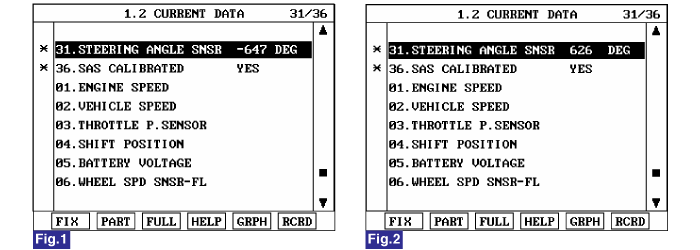
Fig 1) Test Condition : Ignition "ON" &
Engine "ON".
Normal data (Right side)
Fig 2) Test Condition : Ignition "ON" &
Engine "ON".
Normal data (Left
side) |
| 5. |
Is parameter displayed within
specifications?
|

|
▶ Fault is
caused by having been repaired and HECU memory was not
cleared. Clear the DTC and then go to "Verification of Vehicle
Repair" procedure.
|
|

|
▶ Go to
"Component Inspection"
procedure.
|
|
| 1. |
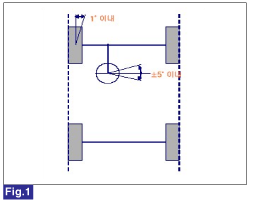
Line up wheels like figure 1.
| (1) |
Perform the wheel
alignment. |
| (2) |
Line up the steering wheel in a
straight. |
| (3) |
Go ahead and Go back the vehicle 2~3
times without holding steering
wheel. | |
| 2. |
Connect scantool to Data Link
Connector(DLC). |
| 3. |
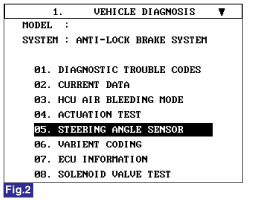
Go in Anti-Rock brake system. (figure
2). |
| 4. |
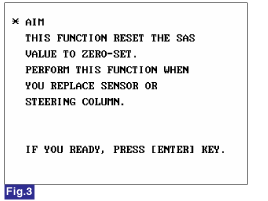
Perform steering angle sensor calibration.
(figure 3). |
| 6. |
Check the condition of SAS zero point
adjustment by opreating the vehicle (turn right and left at least 1
time)
|
| 7. |
Is zero point adjustment
completed?
|
|
▶ Go to
"Verification of Vehicle Repair" procedure.
|
|
|
▶
Substitute with a known-good HECU and check for proper
operation. If problem is corrected, replace HECU and then go
to "Verification of Vehicle Repair" procedure.
|
|
| Verification of Vehicle
Repair |
After a repair, it is
essential to verify that the fault has been corrected.
| 1. |
Connect scantool and select "Diagnostic
Trouble Codes(DTCs)" mode |
| 2. |
Using a scantool, Clear
DTC. |
| 3. |
Operate the vehicle within DTC Detecting
Condition in General Information. |
| 4. |
Are any DTCs present ?
|
|
▶ Go to the
applicable troubleshooting procedure.
|
|
|
▶ System
performing to specification at this
time.
|
|