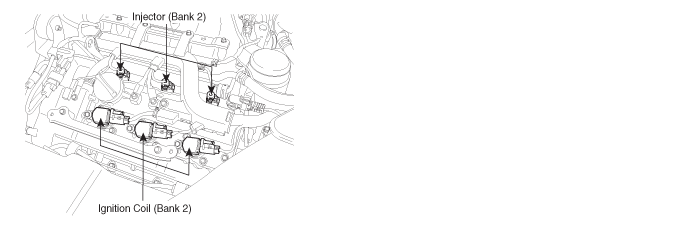
Misfires can be caused
by lack of combustion in a cylinder due to absence of spark, poor fuel
metering, poor compression, or many other causes. Even a small number of
misfires may result in excessive exhaust emissions due to the unburned
mixture. Increased misfire rates cause damage to the catalytic converter.
The PCM monitors the crankshaft speed variation to determine if any
misfiring generated. The PCM identifies the specific cylinder in which the
misfire has occurred and counts individual misfire events by monitoring
changes in the crankshaft rotation for each cylinder. A random misfire
indicates one or more cylinders are misfiring.
The PCM measures
reference event times and calculates the positive and negative
acceleration of the crank wheel to detrmine whether a misfire has
occurred.
When the rate of misfire
exceeds a threshold where the catalyst reaches a temperature where
permanent damage can ocur. PCM sets this DTC. In case that misfire affects
Catalyst damage, MIL(Malfunction Indication Lamp) will be illuminating and
blinking at 1HZ frequency. However, In case of Indivisual and Emission
damaging misfire, MIL will be turned on when the malfunction is
detected.
Especially, if injector
connector is disconnected for more than 46 sec., PCM sets DTC relating to
misfire and conducts the fuel-cut to protect the catalyst.
Item
|
Detecting
Condition
|
Possible Cause
|
DTC Strategy
|
| •
|
Determine if a multiple cylinder misfire
or a cylinder specific misfire is occurring by monitoring
crankshaft acceleration. | |
| •
|
Faulty Spark plug
cables |
| •
|
Belt deflection and Air gap of
CKPS |
| •
|
Improper engine
compression |
|
Enable Condition
|
No disabling
faults present / no disabiling Active Faults
| •
|
P0340 / P0341 / P0118 / P0117 / P0115 /
P0336 / P0335 / P1295 / P0103 / P0102 / 0108 / P0107 / P0106 /
P0501 |
| •
|
Engine speed between 550 and 5800
RPM |
| •
|
System voltage between 9 and 18
volts |
| •
|
The ECT indicates an engine temperature
between -6°C(20°F) and
120°C(248°F) | |
Threshold Value
|
Case1
|
| •
|
Individual cylinder misfire
detection | |
Case2
|
| •
|
Emissions damaging - 18 times in 600
ignitions (In case that the misfire affects more than 1.5
times than FTP
emissins) | |
Case3
|
| •
|
Catalyst damaging - 95 times in 600
ignitions at idle ( It is going to be changeable according to
the load or the temperature which is not in the range where it
does not melt catalyst) | |
Diagnosis Time
|
|
MIL
On Condition
|
|
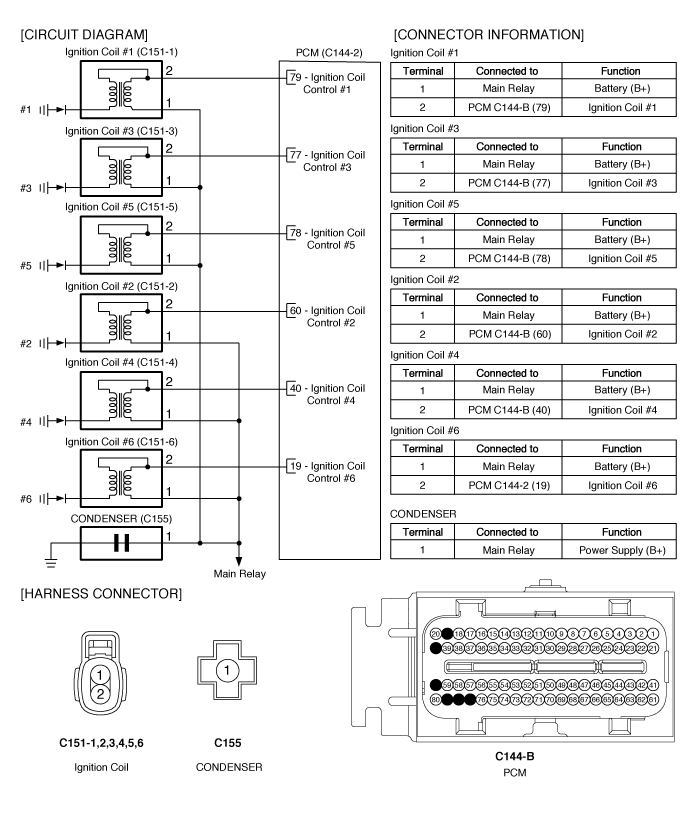
| 1. |
Connect scantool to Data Link
Connector(DLC). |
| 3. |
Select "Diagnostic Trouble Codes(DTCs)" mode,
and then Press F4(DTAL) to check DTC’s information from the DTCs
menu |
| 4. |
Read "DTC Status" parameter.
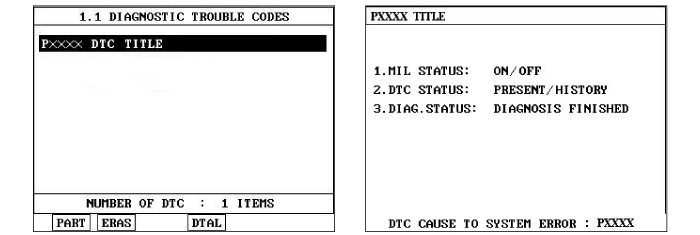
|
| 5. |
Is parameter displayed "Present
fault"?
|

|
▶ Go to
"System Inspection" procedure.
|
|

|
▶ Although
the misfire does not occur when the vehicle is brought to
workshop, misfire can be reproduced when the condition is met.
Drive the vehicle according to the freeze frame data in order
to satisfy the
condition.
|
|
| 1. |
Check Spark Pulg
| (1) |
Remove cylinder’s spark
plugs |
| (2) |
Visually/physically inspect the
following items:
- Damaged insulation, Worn electrodes,
Oil or fuel fouled, Loose terminals and cracks
- Check for plug gap : 1.0 - 1.1 mm
(0.039 - 0.043 in.)
- Check if the spark plug for the
relevant cylinder is lighter in color than the other
plugs. |
| (3) |
Has a problem been found in any of the
above areas?
|
|
▶
Repair or replace as necessary and go to "Verification
of Vehicle Repair" procedure
|
|
|
▶Go
to "Check Air Leakage " as
below
|
| |
| 2. |
Check Air Leakage
| (1) |
Visually/physically inspect the air
leakage in intake/exhaust system as following
items,
- Vacuum hoses for splits, kinks and
improper connections.
- Throttle body gasket
- Gasket between intake manifold and
cylinder head
- Seals between intake manifold and fuel
injectors
- Exhaust system between HO2S and Three
way catalyst for air leakage |
| (2) |
Has a problem been found in any of the
above areas?
|
|
▶
Repair or replace as necessary and go to "Verification
of Vehicle Repair" procedure
|
|
|
▶ Go
to "Check for air leakage in Positive Crankcase
Ventilation
Valve(PCV)
|
| |
| 3. |
Check for air leakage in Positive Crankcase
Ventilation Valve(PCV)
| (1) |
Remove PCV valve from cylinder head
cover by puling ventilation
hose |
| (2) |
With engine idling block PCV valve
opening |
| (3) |
Verify that vacuum is
felt |
| (5) |
Blow through valve from prot "A" and
verify that air comes out of prot
"B" |
| (6) |
Blow through valve from prot "B" and
verifty that no air comes out of port
"A" |
| (7) |
Has a problem been found ?
|
|
▶
Repair or replace as necessary and go to "Verification
of Vehicle Repair" procedure
|
|
|
▶ Go
to "Check Compression pressure" as
below
|
| |
| 4. |
Check Compression pressure
| (1) |
Warm up the engine to normal operating
temperature |
| (2) |
Disconnect the spark plug cables and
remove the spark plugs. |
| (3) |
Crank the engine to remove any foreign
material in the cylinders. |
| (4) |
Put compression pressure gauge into
spark pulg hole |
| (5) |
Crank the engine with widely opend
throttle valve and check compression pressure at each
cylinder
S1323kPa(13.5
kg/cm²,192 psi)
| |
| (6) |
Is compression pressure for each
cylinder displayed within specifications ?
|
|
▶ Go
to "Check Timing " as below
|
|
|
▶ Add
a small amount of oil through the spark plug hole, and
repeat above steps. If the addition of oil causes the
compression to rise, the cause is a worn or damaged
piston ring or cylinder inner surface.
▶ If the compression remains the same, the
cause is a burnt or defective valve seat, or pressure is
leaking from the gasket. Repair as necessary and go to
"Verification of Vehicle Repair"
procedure
|
| |
| 5. |
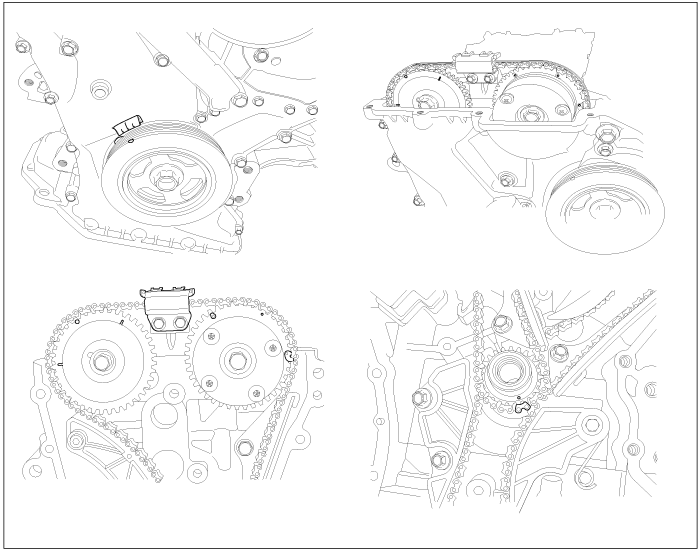
Check Timing
| (2) |
Monitor these signal waveforms from CAM
and Crank shaft position Sensor are correctly
aligned.
Reference : The 17th of CKP signal from
missing tooth is aligned with high of CMP signal
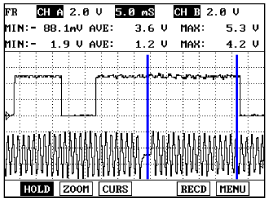
|
| (3) |
Are all timing marks alligned correctly
?
|
|
▶ Go
to "Check Fuel Pressure Test" as below
|
|
|
▶
Repair or readjust as necessary and go to "Verification
of Vehicle Repair"
procedure
|
| |
| 6. |
Check Fuel Pressure Test
|
-Be cautious that fuel is explosive and
an empty fuel tank can still contain explosive gases. when
working on fuel system, make sure to supply adequate
ventilation to the work area. Do not smoke, and keep sparks
and open flames away.
-The fuel system remains under pressure
when the engine is not running. Release fuel system pressure
before disconnecting any fuel line to reduce the chance of
personal injury or fire damage to vehicle
components. |
| (1) |
IG "OFF" and disconnect Fuel Pump Relay
in Junction Box. |
| (2) |
Start-up and wait until it stops
itself. |
| (3) |
IG "OFF" and connect Fuel Pump
Relay. |
| (4) |
Install the fuel pressure gauge to the
delivery pipe with the fuel pressure gauge
adaptor. |
| (5) |
Activate the fuel pump, and with fuel
pressure applied, check that there is no fuel leakage from the
pressure gauge or connection
part. |
| (6) |
Measure the fuel pressure at
idle.
Specifications :
374.6 ~ 384.4 kPa(3.82 ~ 3.92 kg/cm², 54.3 ~ 55.8
psi)
| |
| (7) |
Is the measured fuel pressure within
specifications ?
|
|
▶
Substitute with a known - good PCM and check for proper
operation. If the problem is corrected, replace PCM and
go to "Verification of Vehicle Repair"
procedure.
|
|
|
▶
Repair or replace according to the below table. And
then, go to " Verification of Vehicle
Repair"procedure.
|
Condition
|
Suspected
area
|
Fuel pressure too low
|
Fuel filter,fuel pressure regulator, in-tank
fuel hose or the fuel pump
|
Fuel Pressure is too high
|
Fuel pressure regulator, hose or
pipe
|
| |
| Verification of Vehicle
Repair |
After a repair, it is
essential to verify that the fault has been corrected.
| 1. |
Connect scan tool and select "Diagnostic
Trouble Codes(DTCs)" mode |
| 2. |
Press F4(DTAL) and confirm that "DTC Readiness
Flag" indicates "Complete". If not, drive the vehicle within
conditions noted in the freeze frame data or enable
conditions |
| 3. |
Read "DTC Status"
parameter |
| 4. |
Is parameter displayed "History(Not Present)
fault"?
|
|
▶ System
performing to specification at this time. Clear the
DTC
|
|
|
▶ Go to the
applicable troubleshooting
procedure
|
|
