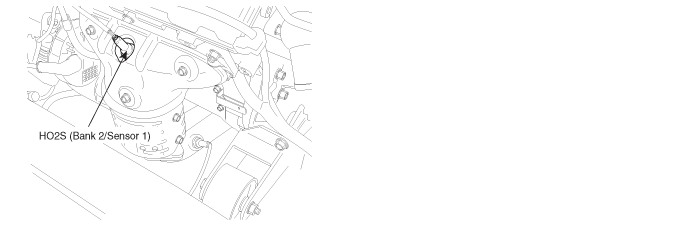
In order to control
emissions of the CO, HC and NOx components of the exhaust gas, heated
oxygen sensor (HO2S), mounted on the front side and rear side of catalytic
converter, detects the oxygen content in the exhaust gas. The front HO2S
signal is used to control air/fuel ratio (closed loop fuel control) and
the rear HO2S signal is used to monitor front HO2S and catalyst for proper
operation. The HO2S requires a minimum temperature to operate properly and
provide a closed loop fuel control system. The HO2S contains the heater
element to reduce its warming-up time and ensure its performance during
all driving conditions. The oxygen sensor generates a voltage that
indicates the difference between the oxygen content of the exhaust stream
and the oxygen content of ambient air. When the exhaust stream is “rich,”
there is more oxygen in the ambient air than in the exhaust stream, so the
voltage will be higher.
Checking output signals
from HO2S under detecting condition, if PCM judges it’s signals too slow,
PCM sets P0153. MIL(Malfunction Indication Lamp) turns on when the
malfunction lasts till consecutive 2 driving cycle.
Item
|
Detecting
Condition
|
Possible cause
|
DTC
Strategy
|
| •
|
Monitor HO2S’s response rate
| |
|
Enable
Conditions
|
| •
|
Engine warm-up
sufficiently |
| •
|
Engine run time >
60sec |
| •
|
Drive at a steady speed between 45-55
mph(72-88 km/h) |
| •
|
Engine Coolant > 70°C( 158
°F) |
|
Threshold
value
|
| •
|
The calculated response rate is too slow
(out of threshold in
PCM) | |
Diagnosis
Time
|
|
MIL On
Condition
|
|
(Reference only)
Test Condition
|
HO2S
Voltage(Sensor1)
|
HO2S
Voltage(Sensor2)
|
HO2S
Signal at idle after warm-up
|
Signal is
commonly switching from rich to lean more than 3 times in 10
sec.
|
Signal is
commonly above 0.6V.
|
HO2S
signal at open circuit(Pumping current OFF)
|
Approx. 0.45V
|
HO2S
signal at open circuit(Pumping current ON)
|
Approx. 3.5V
|
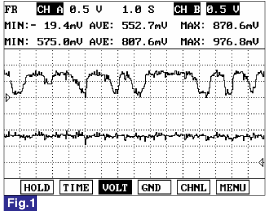
Fig.1) Signal waveforms
of front HO2S(the upper) and rear HO2S(the lower)
After warming-up, if
accelerator pedal is released suddenly around 4000rpm, the HO2S signal
reading will be lower than 200mV resulting from Fuel cut-off for the
moment. Conversely, if suddenly accelerator pedal is depressed, HO2S
signal reading will be around 0.6V ~1.0V. At idle, Normally HO2S signal
will switch from lean to rich with 3 Hz. And as racing, Its frequency
rises.
| 1. |
Connect scantool to Data Link
Connector(DLC). |
| 3. |
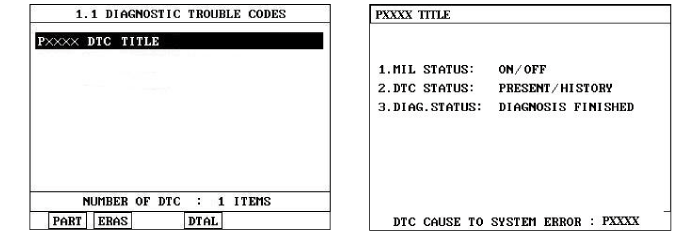
Select "Diagnostic Trouble Codes(DTCs)" mode,
and then Press F4(DTAL) to check DTC’s information from the DTCs
menu |
| 4. |
Read "DTC Status" parameter.
|
| 5. |
Is parameter displayed "Present
fault"? |
|

|
▶ Go to
"Component Inspection" procedure.
|
|

|
▶ Clear DTC and
check if this DTC is set after test-driving under enable conditions.
If DTC isn’t displayed after the test, it was intermittent fault. Go
to "Verification of Vehicle Repair"
procedure.
|
| 2. |
Clear DTC with
scantool. |
| 3. |
Start the engine and warm it up until the
radiator fan comes on( more than at least 10
minutes). |
| 4. |
Drive at a steady speed between 45-55
mph(72-88 km/h) for 120 sec. |
| 5. |
Stop and then maintain idle
state. |
| 6. |
Check if O2 sensor monitoring readiness is
complete. |
| 7. |
Does the scan tool show DTC
P0153? |
|
|
▶ Substitute with
a known - good PCM and check for proper operation. If the problem is
corrected, go to "Verification of Vehicle Repair"
procedure.
|
|
|
▶ Troubleshooting
is finished.
|
| Verification of Vehicle
Repair |
After a repair, it is
essential to verify that the fault has been corrected.
| 1. |
Connect scan tool and select "Diagnostic
Trouble Codes(DTCs)" mode |
| 2. |
Press F4(DTAL) and confirm that "DTC Readiness
Flag" indicates "Complete". If not, drive the vehicle within
conditions noted in the freeze frame data or enable
conditions |
| 3. |
Read "DTC Status"
parameter |
| 4. |
Is parameter displayed "History(Not Present)
fault"? |
|
|
▶ System
performing to specification at this time. Clear the
DTC
|
|
|
▶ Go to the
applicable troubleshooting
procedure.
|