| Removal and Installation |
| 1. |
Remove the radiator upper hose and lower hose.
(Refer to Cooling System - "Radiator
Hose") |
| 2. |
Remove the cooling fan assembly.
(Refer to Cooling System - "Cooling
Fan") |
| 3. |
Disconnect the ATF cooler hoses.
|
| 4. |
Disconnect the over flow hose.
(Refer to Cooling System - "Reservoir
Tank") |
| 5. |
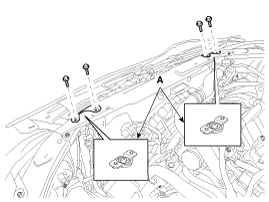
Remove the radiator mounting brackets
(A).
|
| 6. |
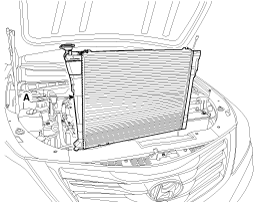
Separate the condenser from the radiator and
then pull radiator (A) up and remove it from engine
room.
|
| 7. |
Installation is in the reverse order of
removal. |
| 8. |
Fill the radiator with coolant and check for
leaks.
|

| Inspection |
Radiator Cap Testing
| 1. |
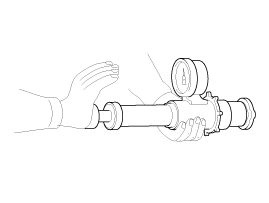
Remove the radiator cap, wet its seal with
engine coolant, and then install it on a pressure
tester.
|
| 2. |
Apply a pressure of 93.16 ~ 122.58kpa (0.95 ~
1.25kg/cm², 13.51 ~ 17.78psi). |
| 3. |
Check for a drop in pressure.
|
| 4. |
If the pressure drops, replace the
cap. |
Radiator Leakage Test
| 1. |
Wait until engine is cool, then carefully
remove the radiator cap and fill the radiator with engine coolant,
then install it on the pressure tester.
|
| 2. |
Apply a pressure tester to the radiator and
apply a pressure of 93.16 ~ 122.58kpa (0.95 ~ 1.25kg/cm², 13.51 ~
17.78psi). |
| 3. |
Inspect for engine coolant leaks and a drop in
pressure. |
| 4. |
Remove the tester and reinstall the radiator
cap.
|