| Description |
The charging system
includes a battery, an alternator with a built-in regulator, and the
charging indicator light and wire.
The Alternator has
built-in diodes, each rectifying AC current to DC current.
DC current appears at
alternator "B" terminal.
The charging voltage
of this alternator is regulated by the ECM.
The main components of
the alternator are the rotor, stator, rectifier, capacitor brushes,
bearings and V-ribbed belt pulley. The brush holder contains a built-in
electronic voltage regulator.
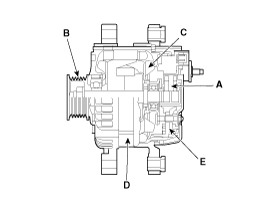
| A. Brush B. Belt pulley C. Rotor |
D.
Stator E. Rectifier |
Alternator
Management System
Alternator management
system controls the charging voltage set point in order to improve fuel
economy, manage alternator load under various operating conditions, keep
the battery charged, and protect the battery from over-charging. Battery
sensor is mounted on battery (-) terminal. It transmits battery voltage,
current, temperature information to ECM. ECM controls generating voltage
by duty cycle based on the signals from battery sensor and vehicle
operating conditions.
The system conducts
discharging control when accelerating a vehicle. Vehicle reduces an
alternator loadand consumes an electric power form a battery. The system
conducts charging control when decelerating a vehicle. Vehicle increases
an alternator load and charges a battery.