Be careful when
driving the vehicle using the smart cruise control system as
follows.
| •
|
The smart cruise control system may
have limits to detect distance to the vehicle ahead due to
road and traffic conditions. |
| •
|
On curves or
inclines/declines |
| -
|
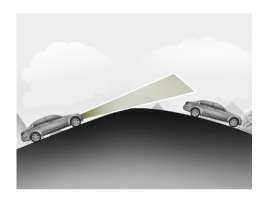
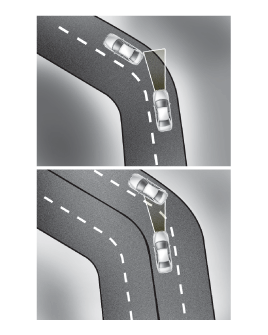
On curves or inclines/declines, the
smart cruise control system may not detect a moving vehicle in
your lane, and then your vehicle may accelerate to the set
speed directly. Also, the vehicle speed may slow down abruptly
when the vehicle ahead is recognized. Select the appropriate
set speed on curves or inclines/declines and control the
vehicle speed by applying the brake pedal if
necessary. |
| -
|
Your vehicle speed can be reduced due
to a vehicle in the adjacent lane. Apply the accelerator pedal
and select the appropriate set speed. Check to be sure that
the road conditions permit.
|
| -
|
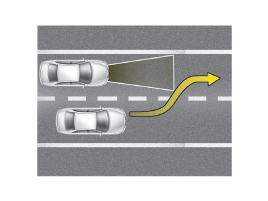
A vehicle which moves into your lane
from an adjacent lane cannot be recognized by the sensor until
it is in the sensor's detection
range. |
| -
|
Be always cautious because a vehicle
which suddenly moves into your lane can be recognized late by
the sensor. |
| -
|
If the vehicle which moves into your
lane is slower than your vehicle, the speed may decrease to
maintain the distance to the vehicle
ahead. |
| -
|
If the vehicle which moves into your
lane is faster than your vehicle, your vehicle will maintain
the selected speed even the vehicle is in the sensor's
detection range.
|
| -
|
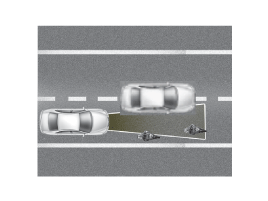
Even though a vehicle is in the same
lane, a vehicle which is out of the sensor’s detection range
cannot be recognized by the sensor.
1) Small vehicle such as motorcycle,
bicycle and cultivator
2) A vehicle offset to one
side
3) A slow-moving vehicle or
sudden-decelerating vehicle
4) A stopped vehicle
5) A vehicle with small rear profile
such as trailer with no loads
|
| -
|
In this following situation, the front
vehicle can’t be recognized correctly so control the vehicle
speed by applying the brake pedal or accelerator pedal if
necessary.
1) When the vehicle is pointing
upwards due to overloading in the trunk
2) While making turns by
steering
3) When driving to one side of the
lane
4) When driving on narrow lanes or on
curves
|
| •
|
If the smart cruise control is left on
(CRUISE indicator light ON), the smart cruise control can be
switched on accidentally. Keep the smart cruise control system
off (CRUISE indicator light OFF) when the smart cruise control
is not in use, to avoid inadvertently setting a
speed. |
| •
|
Observe a regulation speed on road
when setting the cruise speed.
|
| •
|
Use the smart cruise control system
only when traveling on open highways in good weather. Do not
use the smart cruise control when it may not be safe to keep
the car at a constant speed, for instance, driving in heavy or
varying traffic, or on slippery (rainy, icy or snow-covered)
or winding roads or over 6% up-hill or down-hill roads.
|
| •
|
Pay particular attention to the
driving conditions whenever using the smart cruise control
system. |
| •
|
The vehicle cannot be stopped by using
the smart cruise control system. If emergency stop is
necessary, you should apply the brakes.
|
| •
|
Keep the safety distance according to
road conditions and vehicle speed. If the following distance
is too close at a high speed driving, it is dangerous.
|
| •
|
The smart cruise control system can
not recognize a stopped vehicle, pedestrians or an oncoming
vehicle. Always look ahead cautiously to prevent unexpected
and sudden situations from occurring.
|
| •
|
The smart cruise control system is not
a substitute for safe driving practices but a supplementary
function only. It is the responsibility of the driver to
always check the speed and the distance to the vehicle ahead.
|
| •
|
In front of you, vehicles moving with
a frequent lane change may cause a delay in the system's
reaction or may cause the system to react to a vehicle
actually in adjacent lane. Always look ahead cautiously to
prevent unexpected and sudden situations from occurring.
|
| •
|
Your vehicle may accelerate when a
vehicle ahead of you disappears. When you are warned that the
vehicle ahead of you is not detected, drive with
caution.
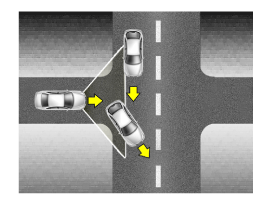
|
| •
|
When vehicles are at a standstill and
the vehicle in front of you changes to the next lane, be
careful when your vehicle starts to move because it may not
recognize the stopped vehicle in front of you.
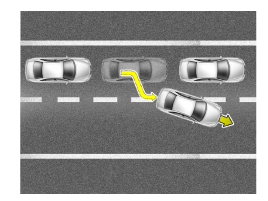
|
| •
|
Always look out for pedestrians when
your vehicle is maintaining a distance with the vehicle ahead.
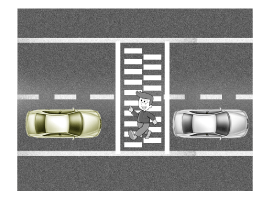
|
| •
|
Always be cautious for vehicles with
higher height or vehicles carrying loads that sticks out to
the back of the vehicle.
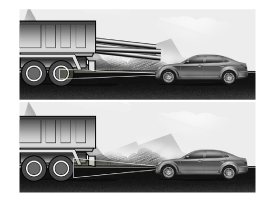
| |
