| Description |
System
Overview
The System offers the
following features:
| - |
Human machine interface through a 1-stage
button, for terminal switching and engine
start. |
| - |
Control of external relays for ACC / IGN1 /
IGN2 terminal switching and STARTER, without use of mechanical
ignition switch. |
| - |
Steering column locking with an ESCL device;
Monitoring of the vehicle status to insure safe activation of the
ESCL. |
| - |
Indication of vehicle status through LED or
explicit messages on display. |
| - |
Immobilizer function by LF transponder
communication between fob and start/stop
button. |
| - |
Redundant architecture for high system
dependability . |
| - |
Interface with Low Speed CAN vehicle
communication network. |
| - |
Interface with LIN vehicle communication
network depending on platform . |
The RKE and SMART KEY
functions are not considered part of this Button Engine Start system and
are specified in separated system.
System
Main Function
| - |
Steering column locking/unlocking with
ESCL. |
| - |
Switching of ACC / IGN1 / IGN2
terminals. |
| - |
Control of the STARTER relay BAT line (high
side) based on communication with EMS
ECU. |
| - |
Management of the Immobilizer
function. |
| - |
Management of BES warning
function. |
Button
Engine Start System
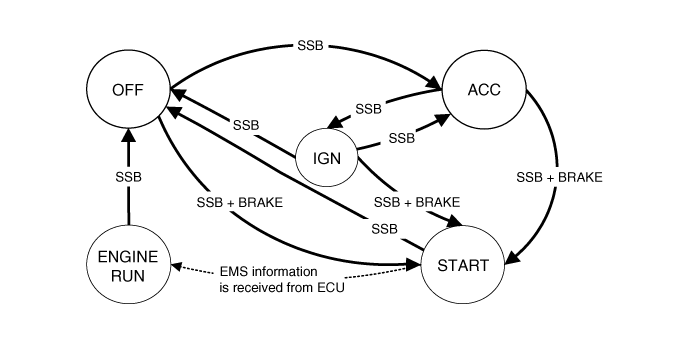
The Button Start
System allows the driver to operate the vehicle by simply pressing a
button (called as SSB) instead of using a standard mechanical key. It also
manages the locking and the unlocking of the steering column (called as
ESCL)without any specific actions by the driver.
If the driver press
the SSB while prerequisites on brakes, fob authentication and transmission
status are satisfied, the BES System will proceed with the
locking/unlocking of the steering column, the control of the terminal, and
the cranking of the engine.
The driver can release
the SSB as soon as this sequence initiated. After positive response from
immobilizer interrogation, the system will activate the starter motor and
communicate with the EMS to check the engine running status for starter
release.
The driver will be
able to stop the engine by a short push on the SSB if the vehicle is
already in standstill. Emergency engine stop will be possible by a long
press of the SSB or 3 consecutive presses in case the vehicle is in ENGINE
RUNNING.
If the conditions for
engine cranking are not satisfied while a push on the SSB is detected and
a valid fob authenticated, the system will unlock the steering column and
switch the terminals to IGN. Another push on the SSB will be necessary to
start the engine.
In case of a vehicle
equipped with SMART KEY system, fob authentication will not require any
action from the driver. For limp home start or in case of vehicle without
SMART KEY, the driver will have to push the start / stop
button.
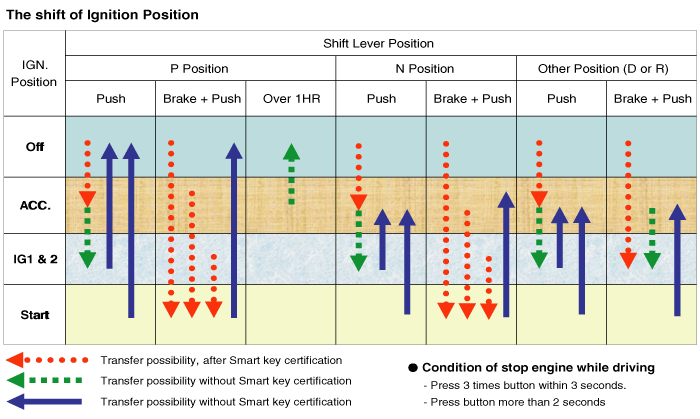
| • |
Control Ignition and engine ON/OFF by
Sending signal to IPM. |
| • |
Display status by LED Lamp ON/OFF. (Amber or
Blue) |
Indicator ON/OFF Condition At Ignition
Key Off Condition
| No. |
Character
lamp |
Conditions |
| 1 |
Indicator Lamp
ON |
Door open, Tail lamp ON,
ACC, IG ON |
| 2 |
Indicator Lamp 30sec ON →
Lamp OFF |
Door close, Tail lamp
OFF, IG OFF |
| 3 |
Indicator Lamp
OFF |
Remote LOCK, Passive
LOCK |
| 4 |
Rheostat at tail lamp ON
(Illumination lamp) | |
Indicator ON/OFF Condition According
To Ignition Key's Position
| No. |
Ignition
conditions |
Start
Button LED status |
| 1 |
IG OFF |
LED OFF |
| 2 |
IG ACC |
Amber color LED
ON |
| 3 |
IG ON (Engine
OFF) |
Blue color LED ON
|
| 4 |
Cranking |
Maintain LED status
before cranking |
| 5 |
Engine
running |
LED
OFF |
Wireless
Communication
Electromagnetic waves
are used to exchange information between the vehicle and the FOB. Two
types of RKE Key can supplement the BES system:
| - |
Non-smart key
RKE |
| - |
SMART KEY
FOB |
Currently the BES
system comprises with SMART KEY FOB always.
The transmitter,
receiver and antennas required for the communication between the fob and
the vehicle will differ depending on functionalities and regional
areas.
The RKE and SMART KEY
functions are in separated documents. Refer to Smart key system for more
detailed information about SMART KEY function.
Smart
Key
The SMK manages all
function related to:
| • |
"Start Stop Button (SSB)
monitoring", |
| • |
"Immobilizer communication" (with Engine
Management System unit for immobilizer
release), |
| • |
"ESCL
control", |
| • |
"Authentication server" (Validity of
Transponder and in case of Smart Key option Passive Fob
authentication ), |
| • |
"System consistency
monitoring", |
| • |
"System
diagnosis", |
| • |
Control of display message / warning
buzzer . |
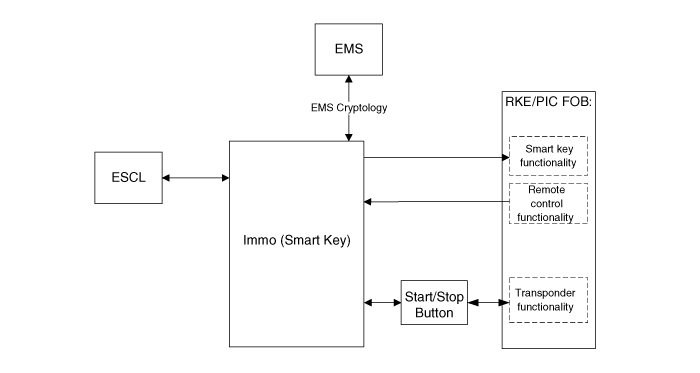
The unit behaves as
Master role in the whole system.
In case of SMART KEY
application, for example "Passive Access", "Passive Locking" and "Passive
Authorization are integrated for ESCL/Terminal switching
Operations".
It collects
information about vehicle status from other modules (vehicle speed, alarm
status, driver door open...), read the inputs (e.g. SSB, Lock Button and
PARK position Switch), controls the outputs (e.g. exterior and interior
antennas), and communicates with others devices via the CAN network as
well as a single line interfaces.
The diagnosis and
learning of the components of the BES System are also handled by the
SMK.
Transponder
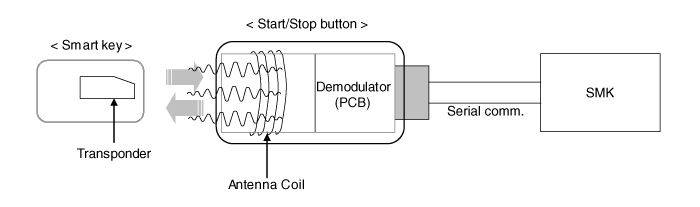
External
Receiver(SRX)
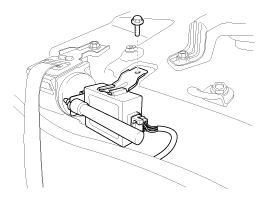
The data transmitted
by the RKE or Smart key Fob is received by an external RF receiver called
as SRX. This receiver will be same as that one for the SMK applications,
with respect to electronics, housing, connector and software.
This receiver is
connected to the SMK via a serial communication line.
Terminal
And Starter Relays
Relays will be used to
switch the terminals ACC / IGN1 / IGN2. Those normally-open relays will be
driven by the SMK unit and located either in the passenger or engine
compartment depending on the vehicle architecture.
Only one relay coil is
connected to the terminal outputs of the SMK unit.
Those relays should
integrate a resistor connected in parallel to the coil in order to reduce
the transients during commutation.
Start/Stop
Button(SSB)
A single stage push
button is used for the driver to operate the vehicle. Pressing this button
allows:
| • |
To activate the power modes ‘Off’,
’Accessory’, ‘Ignition’ and 'Start' by switching the corresponding
terminals |
| • |
To start the
engine |
| • |
To stop the
engine |
The contact will be
insured by a micro-switch and a backlighting is provided to highlight the
marking of the button whenever necessary.
Two (2) LED colors are
located in the center of the button to display of the status of the
system. Another illumination LED is also integrated into the SSB for the
lighting of the "Engine Start/Stop" characters.
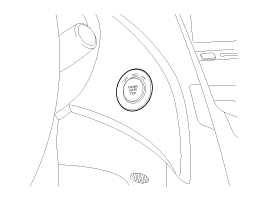
Electronic
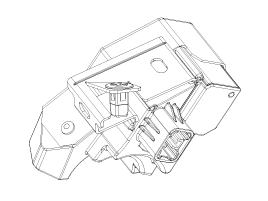
Steering Column Lock (ESCL)
The ESCL is needed to
lock the steering column in order to prevent unauthorized usage of the
vehicle. In order to achieve the required safety integrity level, the ESCL
is controlled and monitored by the SMK. Such redundant architecture
guarantees that the ESCL motor is supplied only during locking/unlocking
operation and that it is disconnected from the battery and ground lines
otherwise to avoid unexpected operation while the vehicle is in
motion.
Data are exchanged
between the ESCL and SMK through an encrypted serial communication
interface.
BES
System State Chart
System
STATES in LEARNT MODE
In learnt mode, the
BES System can be set in 6 different states, depending on the status of
the terminals, ESCL and Engine status:
| System
State |
Terminal
Status |
ESCL
Status |
Engine
status |
| 1. OFF -
Locked |
OFF |
Locked |
Stopped |
| 2. OFF -
Unlocked |
OFF |
Unlocked |
Stopped |
| 3. ACC |
ACC |
Unlocked |
Stopped |
| 4. IGN |
IGN1, IGN2,
ACC |
Unlocked |
Stopped |
| 5. Start |
IGN1, Start |
Unlocked |
Cranking |
| 6. IGN -
Engine |
IGN1, IGN2,
ACC |
Unlocked |
Running (means "self-running") |
Referring to the
terminals, the system states described in the table above are same as
those one found in a system based on a mechanical ignition switch. The one
of distinction with Mechanical-Ignition-Switch based system is that the
BES system allows specific transition from [OFF] to [START] without going
through [ACC] and [IGN] states.
System
STATES IN VIRGIN MODE
The BES System can be
set in 5 different states (OFF LOCKED is not available in virgin mode),
depending on the status of the terminals, ESCL and Engine
status:
| System
State |
Terminal
Status |
ESCL
Status |
Engine
status |
| 1. OFF -
UNLOCKED |
OFF |
Unlocked |
Stopped |
| 2. ACC |
ACC |
Unlocked |
Stopped |
| 3. IGN |
IGN1, IGN2,
ACC |
Unlocked |
Stopped |
| 4. Start |
IGN1, START with special
pattern of activation see Chap 6.2.1 for details |
Unlocked |
Cranking |
| 5. IGN -
Engine |
IGN1, IGN2,
ACC |
Unlocked |
Running (means "self-running") |
Referring to the
terminals, the system states described in the table above are same as
those one found in a system based on a mechanical ignition switch. The one
of distinction with Mechanical-Ignition-Switch based system is that the
BES system allows specific transition from [OFF] to [START] without going
through [ACC] and [IGN] states.