It is necessary to
evacuate the air conditioning system any time the system has been opened.
Evacuation is necessary to rid the system of all air and moisture that may
have been allowed to enter the unit. After installation of a component,
the system should be evacuated for approximately 15 minutes. A component
in service that has been opened for repair should be evacuated for 30
minutes.
| 2. |
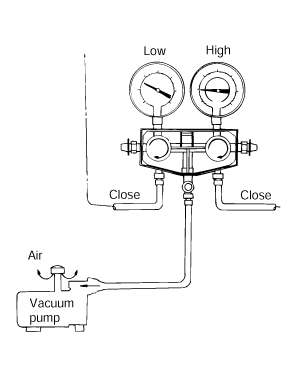
Connect a manifold gauge set to the
compressor gauge fittings. Close both high and low pressure
valves. |
| 3. |
Make sure the refrigerant has been
discharged from the system. |
| 4. |
Connect the center hose of the gauge set to
the vacuum pump inlet. |
| 5. |
Start the vacuum pump and then open the high
and low manifold pressure valves. |
| 6. |
After about ten minutes, check that the low
pressure gauge reads more than 94,39 kPa (0.96 kg/cm, 13.7 psi) of
vacuum. If negative pressure can not be obtained, there is a leak in
the system. In this case, repair the leak as follows:
|
(1) |
Close both manifold valves and stop
the vacuum pump. |
|
(2) |
Charge the system with a can of
refrigerant [about 0.4 kg (0.9 lb)]. Refer to Charging
Refrigerant. |
|
(3) |
Check for refrigerant leakage with a
leak detector. Repair any leakage found. Refer to Checking
Refrigerant Leak. |
|
(4) |
Discharge refrigerant again, and then
evacuate the system. If no leaks are found, continue
evacuating the
system. | |
| 7. |
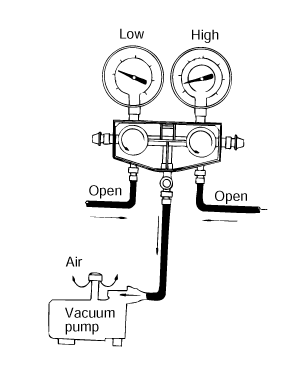
Start the vacuum pump.
|
| 8. |
Open both manifold pressure valves to obtain
94.39 kPa (0.96 kg/cm², 13.7 psi) of
vacuum. |
| 9. |
After the low pressure manifold gauge
indicated close to 94.39 kPa (0.96 kg/cm², 13.7 psi), continue
evacuating for 15 minutes. |
| 10. |
After evacuating for 15 minutes, close both
manifold pressure valves and stop the vacuum pump. Disconnect the
hose from the vacuum pump. The system is now ready for
charging.
|