| PERFORMANCE TEST DIAGNOSIS USING MANIFOLD
GAUGE |
STANDARD
VALUE
If cooling
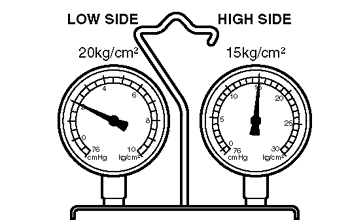
cycle is operating normally, the manifold gauge reading will be approx.
1.5--2.0kg/cm for the low pressure side and approx. 14.5--15kg/cm for the
high pressure side. Inlet temperature should be 30--35°C, with the engine
at 2,000 rpm, maximum cooling selected, and the blower on highest
level.
DIAGNOSIS
|
SYMPTOMS |
PROBABLE CAUSES |
REMEDY |
MANIFOLD GAUGE READINGS |
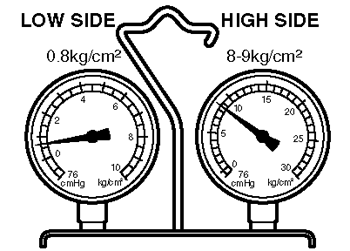
| a. |
Low pressure and high pressure are
low. |
| b. |
Cooler outlet air is a little
cooler. | |
|
|
|
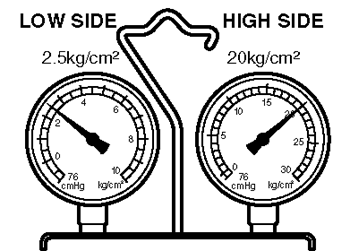
| a. |
Low pressure and high pressure are
high. | |
| a. |
Faulty cooling or condenser
freezing. |
|
| a. |
Maintain the proper level of
refrigerant. Clean the
condenser. |
|
|
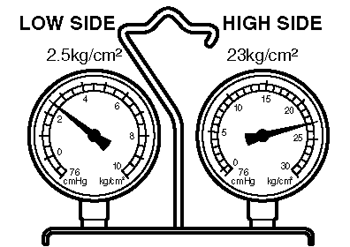
| a. |
Low pressure and high pressure are
high. |
| b. |
Low pressure pipe is not
cold. | |
|
| a. |
Clean or repair the receiver
drier. |
| b. |
Check for oil
contamination. | |
|
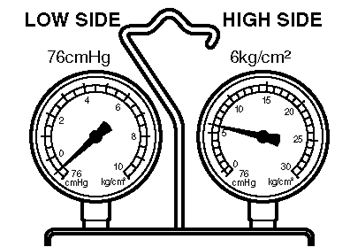
| a. |
Low pressure side indicates negative
pressure and high pressure side indicates low
pressure. |
| b. |
Front or dew on pipes connected with
receiver or expansion
valve. | |
| a. |
Dust or moisture frozen at expansion
valve. |
|
| a. |
Repair the receiver drier and replace
the expansion valve. |
| b. |
Replace the expansion valve if the
receiver-drier is faulty. | |
|
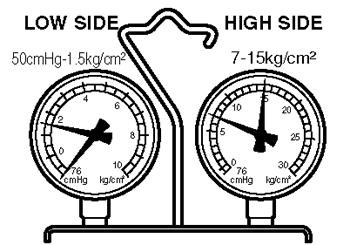
| a. |
Low pressure side pressure sometimes
goes to negative pressure or
normal. | |
| a. |
Intaken moisture is frozen at
expansion valve hole. | |
| a. |
Repair and bleed receiver
drier | |
|
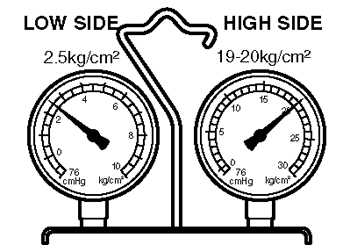
| a. |
Low pressure and high pressure are
high. |
| b. |
Much frost or dew on the low pressure
side piping. | |
| a. |
Expansion valve failure.
Receiver-drier faulty. |
|
| a. |
Repair receiver
drier. |
| b. |
Check oil
contamination. | |
|
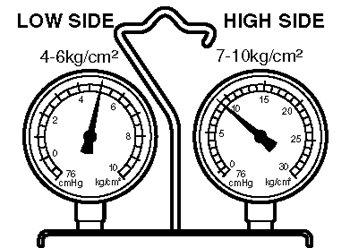
| a. |
Low pressure side pressure is high and
pressure side pressure is
low. | |
| a. |
Leak inside
compressor. | |
|
|