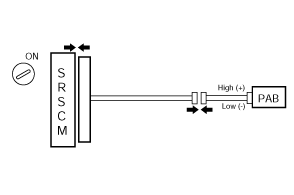
CIRCUIT INSPECTION
|
DTC |
B1351 |
PAB open circuit (R =) |
|
B1352 |
PAB resistance too high (R 5.4
Ω) | |
|
B1353 |
PAB resistance too low (R
0.4) |
CIRCUIT
DESCRIPTION
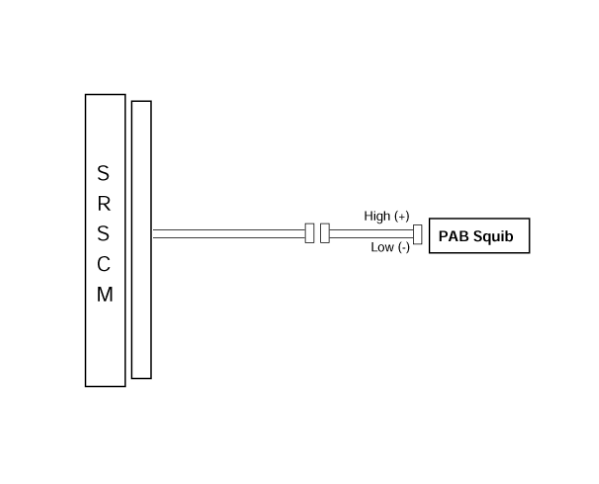
The PAB squib
circuit consists of the SRSCM and PAB. It causes the airbag to deploy when
the airbag deployment conditions are satisfied. The above DTCs are
recorded when the PAB circuit is open or the PAB resistance too high or
low is detected in the PAB squib circuit.
|
DTC Detecting Condition |
Trouble Area | ||||||||
|
| ||||||||
|
|
WIRING
DIAGRAM
INSPECTION
PROCEDURE
| 1. |
Preparation (See step "1" on page
RT-33). |
| 2. |
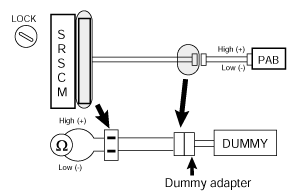
Check the PAB resistance.
[PREPARATION]
Release the airbag activation prevention
mechanism on the SRSCM side of the airbag squib side. Connect the
dummy (0957A-38200) and dummy adapter (0957A-38300) to PAB connector
of the SRSCM connector side.
Before checking the resistance, you have to
insert the shorting bar insert plastic that is attached to the
diagnosis checker into the SRSCM connector.
[CHECK]
Measure the resistance between the PAB high
(+) and the PAB low (-).
1.47 Ω R 2.83 Ω
|
| 3. |
Check the PAB squib.
[PREPARATION]
[CHECK]
[HINT]
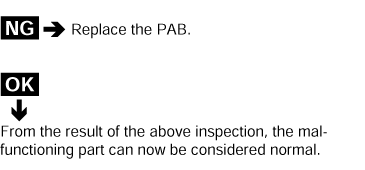
Codes other than these may be output at this
time, but they are not relevant to this procedure.
|