| FRONT WHEEL ALIGNMENT |
When using a
wheel alignment tester to inspect the front wheel alignment, always
position the car on a level surface with the front wheels facing straight
ahead. Prior to inspection, make sure that the front suspension and
steering system are in normal operating conditions and that the wheels and
tires face straight ahead and the tires are inflated to the specified
pressure.
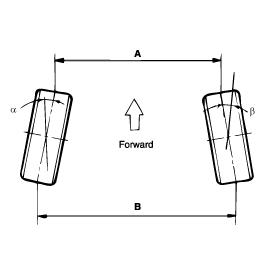
TOE-IN
Toe-in (B-A
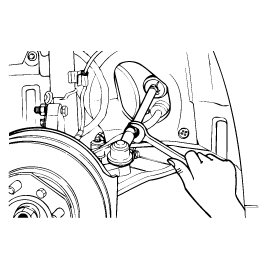
or angle a+b) is adjusted by turning the tie rod turnbuckles. Toe-in on
the left front wheel can be reduced by turning the tie rod toward the
rear of the car. Toe-in change is adjusted by turning the tie rods for
the right and left wheels simultaneously at the same amount as
follows:
|
Toe-in (B-A) mm (in.) [Standard value]
: |
|
0 ± 2 mm (0 ± 0.08
in.) |
| a. |
Toe-in adjustment should be made by turning
the right and left tie rods at the same
amount. |
| b. |
When adjusting toe-in, loosen the outer
bellows clip to prevent twisting the
bellows. |
| c. |
After the adjustment, tighten the tie rod
end lock nuts firmly and reinstall the bellows
clip. |
| d. |
Adjust each toe-in to be the range of
±1mm |
|
Tie rod end lock nuts tightening torque
: |
|
50-55 Nm (500-550 kg.cm, 37-41
lb.ft) |
CAMBER
The steering
knuckle which is installed with the strut assembly is pre-set to the
specified camber at the factory and doesn't need to be adjusted.
|
Camber :
0°±30 |
CASTER
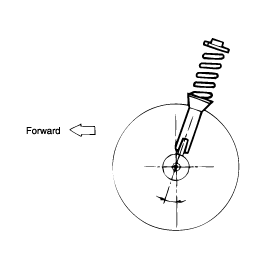
Caster is
pre-set at the factory and doesn't need to be adjusted. If the caster is
not within the standard value, replace the bent or damaged parts.
|
Caster :
2°49±30 |
| a. |
The worn loose or damaged parts of the front
suspension assembly must be replaced prior to measuring front wheel
alignment. |
| b. |
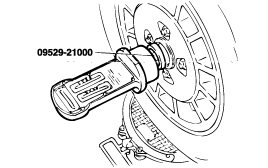
Measure the wheel alignment by using special
tool (09529-21000). |
| c. |
Camber and caster are pre-set to the
specified value at the factory and don't need to be
adjusted. |
| d. |
If the camber and caster are not within
specifications, replace bent or damaged
parts. |
| e. |
The difference of left and right wheels
about the camber and the caster must be within the range of 0° ±
30. |
REAR
WHEEL ALIGNMENT
| TOE-IN |

| a. |
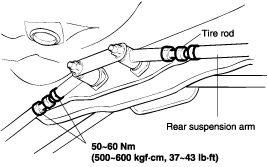
Adjust the toe-in by turning the tie rod
end of the rear suspension arm.
|
| b. |
The cam bolt should be adjusted to a maximum
of 90° left or right from the center
position. |
After adjusting the
tie rod, tighten both nuts to the specified torque.
|
Specified torque : |
|
50-60 Nm (500-600 kg.cm, 37-43
lb.ft) |
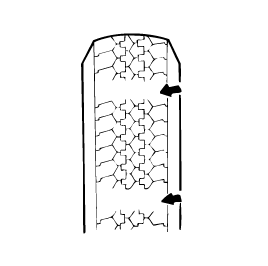
TIRE
WEAR
| 1. |
Measure the tread depth of the
tires.
|
| 2. |
If the remaining tread depth is less than
the limit, replace the tire.
When the tread depth of the tires is less
than 1.6 mm (0.06 in.) the wear indicators will
appear. |