| CHECKING COMPRESSION
PRESSURE |
| 1. |
Before checking engine compression, check
the engine oil level. Also check that the starter motor and battery
are all in normal operating
condition. |
| 2. |
Start the engine and wait until engine
coolant temperature reaches 80-95°C
(176-205°F). |
| 3. |
Turn off engine and disconnect the spark
plug cables. |
| 4. |
Remove the spark
plugs. |
| 5. |
Crank the engine to remove any foreign
material in the cylinders. |
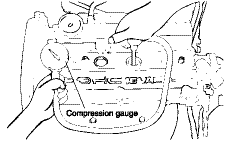
| 6. |
Insert the compression gauge into the spark
plug hole. |
| 7. |
Depress the accelerator pedal to open the
throttle fully. |
| 8. |
Crank the engine and read the
gauge.
|
Standard value : 1500kpa (15Kg/cm²,
218 psi) |
|
Limit : 1400kpa (14Kg/cm², 203
psi) |
|
| 9. |
Repeat steps 6 to 8 over all cylinders,
ensuring that the pressure differential for each of the cylinders is
within the specified limit.
|
Limit : |
Max. 100 kpa (1.0 kg/cm² ,14 psi)
between
cylinders |
|
| 10. |
If a cylinder's compression or pressure
differential is outside the specification, add a small amount of oil
through the spark plug hole, and repeat steps 6 to 9.
|
(1) |
If the addition of oil makes the
compression to rise, it is likely that there may be wear
between the piston ring and cylinder
wall |
|
(2) |
If compression remains the same, valve
seizure, poor valve seating or a compression leak from the
cylinder head gasket are all possible causes.
|
Tightening
torque |
|
Spark plug : 20-30 Nm (200-300
kg.cm, 14-22 lb.ft) |
| | |