| GENERAL INFORMATION |
The starting
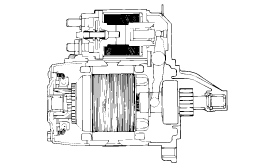
system includes the battery, starter motor, solenoid switch, ignition
switch, inhibitor switch (A/T only), connection wires and the battery
cables.
When the
ignition key is turned to the start position, current flows and energizes
the starter motor's solenoid coil. The solenoid plunger and clutch shift
lever are activated, and the clutch pinion engages the ring gear. The
contacts close and the starter motor cranks.
In order to
prevent damage caused by excessive rotation of the starter armature when
the engine starts, the clutch pinion gear overruns.
TROUBLESHOOTING
|
Trouble condition |
Probable cause |
Remedy |
|
Engine will not crank |
Battery charge low |
Charge or replace battery |
|
Battery cables loose, corroded or
worn |
Repair or replace cables | |
|
Transaxle range switch faulty (Vehicle with
automatic transaxle only) |
Adjust or replace switch | |
|
Fusible link blown |
Replace fusible link | |
|
Starter motor faulty |
Repair starter motor | |
|
Ignition switch faulty |
Replace ignition switch | |
|
Engine cranks slowly |
Battery charge low |
Charge or replace battery |
|
Battery cables loose, corroded or
worn |
Inspect wiring and fix | |
|
Starter motor faulty |
Repair starter motor | |
|
Starter keeps running |
Starter motor faulty |
Repair starter motor |
|
Ignition wiring faulty |
Repair or replace | |
|
Starter spins but engine will not
crank |
Short in wiring |
Repair wiring |
|
Pinion gear teeth broken or starter motor
faulty |
Repair starter motor | |
|
Ring gear teeth broken |
Replace flywheel ring gear or torque
converter |