| CHECKING |
CONDENSER
| 1. |
Check condenser pin for clogging and damage.
If clogged, clean it with water, and blow it with compressed air. If
bent, gently stretch it using a screwdriver or
pliers. |
| 2. |
Check the condenser connection area for
leakage, and repair or replace if
required. |
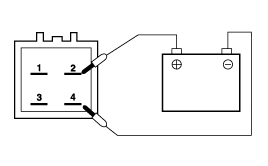
CONDENSER FAN
| 1. |
Check the connector for connection
condition. |
| 2. |
Check the condenser fan motor using battery
voltage. |
THERMAL FUSE
| 1. |
The thermal fuse is located on the compressor
clutch coil. |
| 2. |
Outline
The thermal fuse will detect clutch slip heat
(184°C off) generated by faulty compressor operation, then interrupt
the coil's power supply to stop the clutch operation. Therefore,
clutch bearing and pulley bearing damage will not continue in order,
to protect the belt and engine. Once the thermal fuse operates,
vehicle power supply will be interrupted and the compressor will not
operate. Then, check the clutch coils resistance (3.0-3.2 ohm) to
find the thermal fuse condition, and replace the clutch coil if
required. |
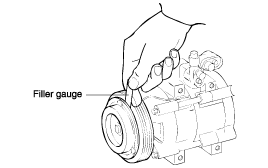
CHECKING CLUTCH AIR GAP
| 1. |
Check clutch air gap between the clutch hub
and the pulley contact surface using a filler gauge.
|
| 2. |
Check gauges around the pullet at 3
points. |
| 3. |
If the clutch air gap is outside the normal
range, correct the air gap into the normal range using a shim of the
proper size.
|
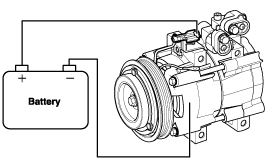
MAGNETIC CLUTCH OPERATION CHECK
Connect the
compressor side terminal to the battery (+) terminal and the ground
battery (-) terminal to the compressor body. Check the magnetic clutch
operating noise to determine the condition.