| INSPECTION PROCESS FOR TROUBLE SYMPTOMS |
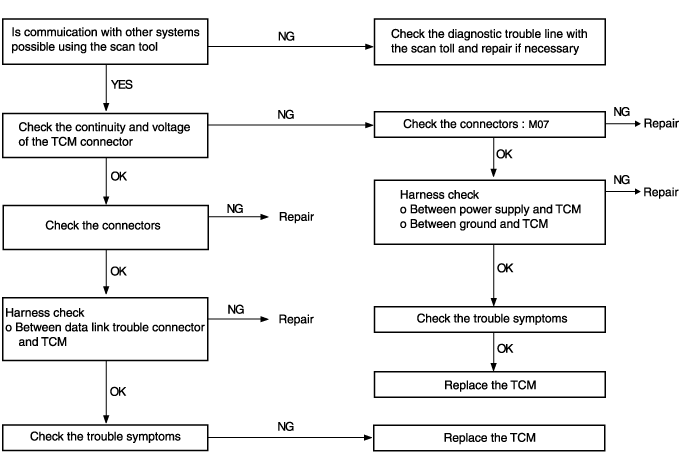
INSPECTION PROCEDURE 1
|
Communication with the scan
tool |
Possible cause |
|
If communication with the scan tool is not
possible, the cause may be a defective diagnostic trouble line or
the TCM is not functioning. |
Malfunction of diagnostic trouble
line
Malfunction of connector
Malfunction of the
TCM |
INSPECTION PROCEDURE 2
|
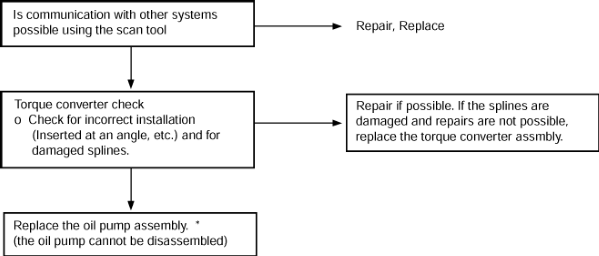
Starting impossible |
Possible cause |
|
Starting is not possible when the selector
lever is in P or N range. In such cases, the cause may be a
defective engine system, torque converter or oil
pump. |
Malfunction of the engine system
Malfunction of the torque
converter
Malfunction of the oil
pump |
INSPECTION PROCEDURE 3
|
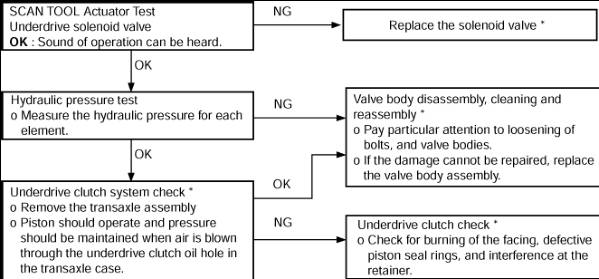
Does not move |
Possible cause |
|
If the vehicle does not move forward when the
selector lever is shifted from N to D, 3, 2 or L range while the
engine is idling, the cause may be abnormal line pressure or a
malfunction of the underdrive clutch or valve body. |
Abnormal line pressure
Malfunction of the underdrive solenoid
valve
Malfunction of the underdrive
clutch
Malfunction of the valve
body |
INSPECTION PROCEDURE 4
|
Does not reverse |
Possible cause |
|
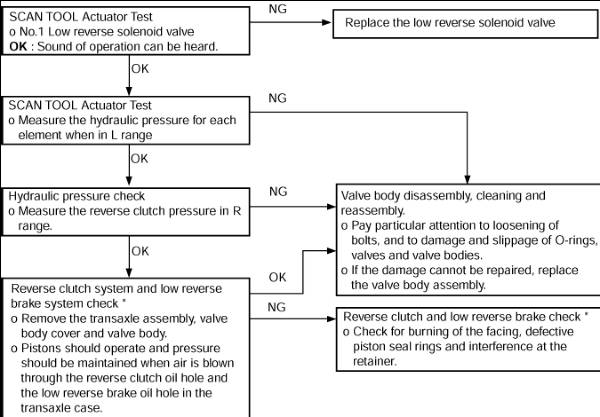
If the vehicle does not reverse when the
selector lever is shifted from N to R range while the engine is
idling, the cause may be abnormal pressure in the reverse clutch or
low and reverse brake or a malfunction of the reverse clutch, low
and reverse brake or valve body. |
Abnormal reverse clutch pressure
Abnormal low and reverse brake
pressure
Malfunction of the low and reverse solenoid
valve
Malfunction of the reverse clutch
Malfunction of the low and reverse
brake
Malfunction of the valve
body |
INSPECTION PROCEDURE 5
|
Does not move (forward or
reverse) |
Possible cause |
|
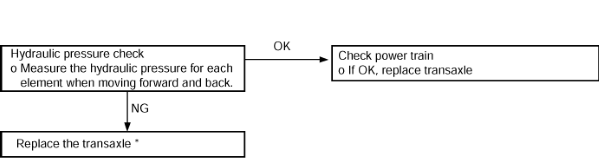
If the vehicle does not move forward or
reverse when the selector lever is shifted to any position while the
engine is idling, the cause may be abnormal line pressure, or a
malfunction of the power train, oil pump or valve
body. |
Abonormal line pressure
Malfunction of the underdrive solenoid
valve
Malfunction of the underdrive
clutch
Malfunction of the valve
body |
INSPECTION PROCEDURE 6
|
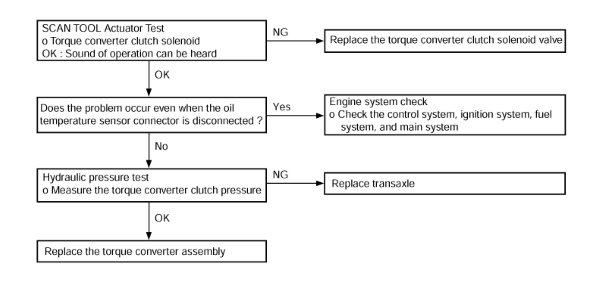
Engine stalling when shifting |
Possible cause |
|
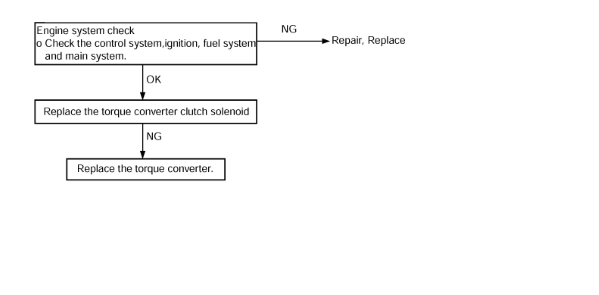
If the engine stalls when the selector lever
is shifted from N to D or R range while the engine is idling, the
cause may be a malfunction of the engine system, torque converter
clutch soledoid, valve body or torque converter (torque converter
clutch malfunction). |
Malfunction of the engine system
Malfunction of the torque converter clutch
solenoid
Malfunction of the valve body
Malfunction of the torque converter
(Malfunction of the torque converter
clutch) |
INSPECTION PROCEDURE 7
|
Shocks when changing from N to D and range
time lag |
Possible cause |
|
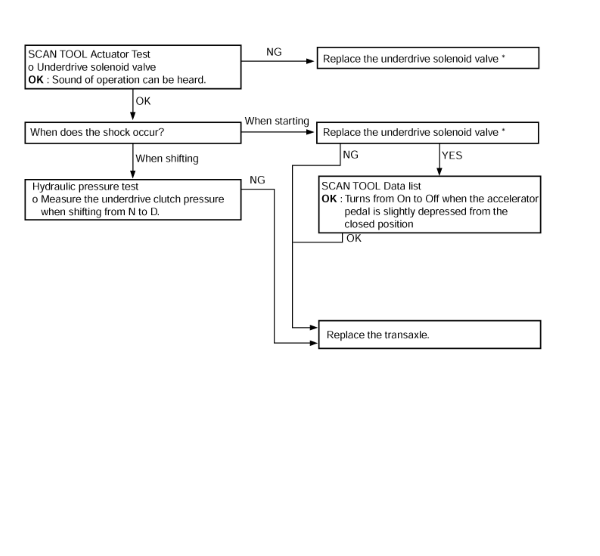
If abnormal shocks or a time lag of 2 second
or more occurs when the selector lever is shifted from N to D range
while the engine is idling, the cause may be abnormal underdrive
clutch pressure or a malfunction of the underdrive clutch, valve
body or closed throttle position switch. |
Abnormal line pressure
Malfunction of the underdrive solenoid
valve
Malfunction of the underdrive
clutch
Malfunction of the valve body
Malfunction of the closed throttle position
switch |
INSPECTION PROCEDURE 8
|
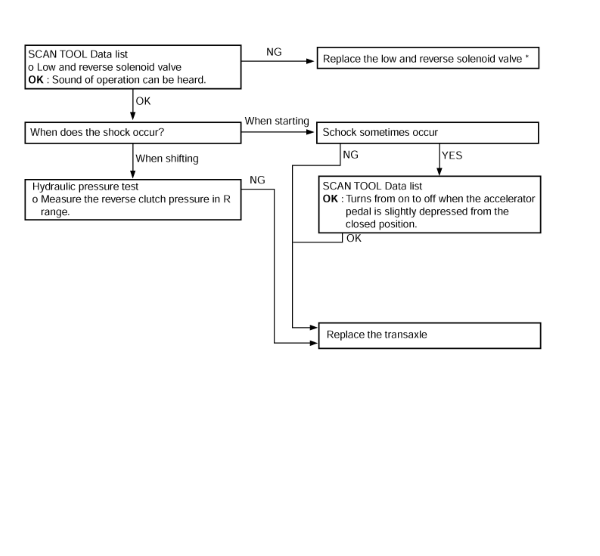
Shock when changing from N to R and large time
lag |
Possible cause |
|
If abnormal shocks or a time lag of 2seconds
or more occurs when the selector lever is shifted from N to R range
while the engine is idling, the cause may be abnormal reverse clutch
pressure or low and reverse brake pressure, or a malfunction or the
reverse clutch, low and reverse brake, valve body. |
Abnormal reverse clutch pressure
Abnormal low and reverse brake
pressure
Malfunction of the low and reverse solenoid
valve
Malfunction of the reverse clutch
Malfunction of the low and reverse
brake
Malfunction of the valve
body |
INSPECTION PROCEDURE 9
|
Shocks when changine from N to D, N to R and
large time lag |
Possible cause |
|
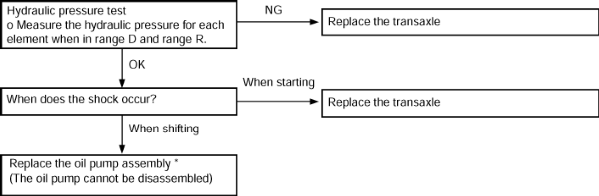
If abnormal shocks or a time lag of 2seconds
or more occurs when the selector lever is shifted from N to D, N to
R range while the engine is idling, the cause may be abnormal line
pressure or a malfunction of the oil pump or valve
body. |
Abnormal line pressure
Malfunction of the oil pump
Malfunction of the valve
body |
INSPECTION PROCEDURE 10
|
Shocks and running up |
Possible cause |
|
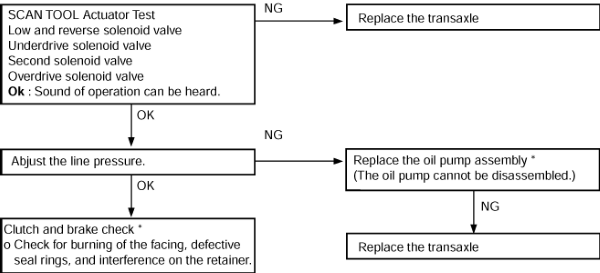
If shocks occur when driving due to upshifting
or downshifting and the transaxle speed becomes higher than the
engine speed, the cause may be abnormal line pressure or a
malfunction of a solenoid valve, oil pump, valve body or of a brake
or clutch. |
Abnormal line pressure
Malfunction of each solenoid
valve
Malfunction of the oil pump
Malfunction of the valve body
Malfunction of each brake or each
clutch |
INSPECTION PROCEDURE 11
|
All points (Displaced shifting
points) |
Possible cause |
|
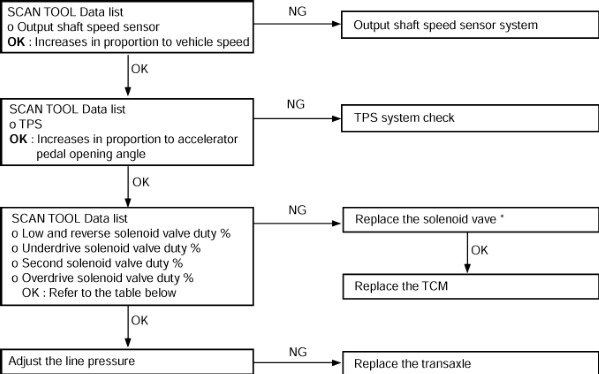
If all shift points are displaced while
driving, the cause may be a malfunction of the output shaft speed
sensor, TPS or a solenoid valve. |
Malfunction of the output shaft speed
sensor
Malfunction of the throttle position
sensor
Malfunction of each solenoid
valve
Abnormal line pressure
Malfunction of the valve body
Malfunction of the
TCM |
INSPECTION PROCEDURE 12
|
Some points (Displaced shifting
points) |
Possible cause |
|
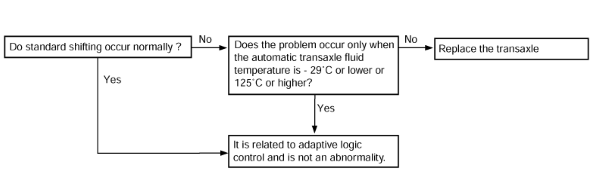
If some of the shift points are displaced
while driving, the cause may be a malfunction of the valve body, or
it is related to control and is not an abnormality. |
Malfunction of the valve
body |
INSPECTION PROCEDURE 13
|
No diagnostic trouble codes (Does not
shift) |
Possible cause |
|
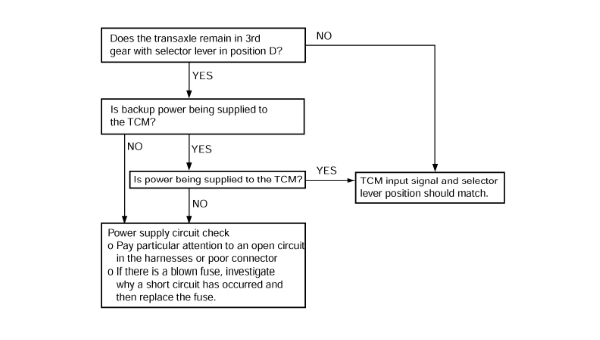
If shifting does not occur while driving and
no diagnostic trouble codes are given, the cause may be a
malfunction of the Park/Neutral position switch, or
TCM. |
Malfunction of the Park/Neutral position
switch
Malfunction of the
TCM |
INSPECTION PROCEDURE 14
|
Poor acceleration |
Possible cause |
|
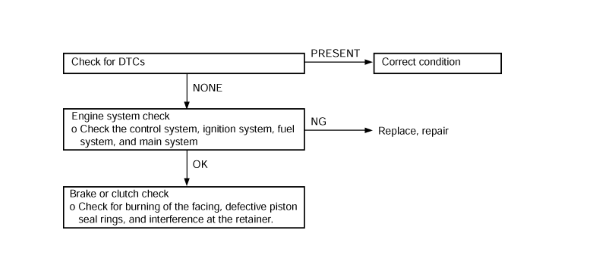
If acceleration is poor even if downshifting
occurs while driving, the cause may be a malfunction of the engine
system or of a brake or clutch. |
Malfunction of the engine system
Malfunction of the brake or
clutch |
INSPECTION PROCEDURE 15
|
Vibration |
Possible cause |
|
If vibration occurs when driving at constant
speed or when accelerating in top range, the cause may be abnormal
torque converter clutch pressure or a malfunction of the engine
system, torque converter clutch solenoid, torque converter or valve
body. |
Abnormal torque converter clutch
pressure
Malfunction of the engine system
Malfunction of the torque converter clutch
solenoid
Malfunction of the torque
converter
Malfunction of the valve
body |